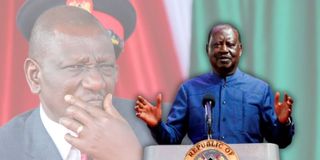
ODM leader Raila Odinga on Monday thrust himself back to the centre of succession politics after he made it clear that nothing would stop the party from fielding a presidential candidate in the 2027 election despite his pact with President William Ruto .
His statement appears to have sent shockwaves across Kenya’s political landscape, upsetting President Ruto’s camp, which had banked on his 2027 re-election support.
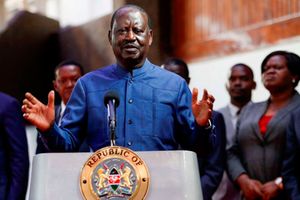
“Who told you that ODM will not have a presidential candidate in 2027? First, think as ODM, we have a clear plan that we have negotiated and agreed on; other decisions will be taken when the time comes,” Mr Odinga declared.
Coming barely weeks after he had assured mourners at former Karachuonyo MP Phoebe Asiyo’s funeral in Homa Bay that his “broad-based government arrangement” with President Ruto would last until 2027, the ODM leader’s statement reawakened the debate about his true intentions—and unsettled the Kenya Kwanza camp.
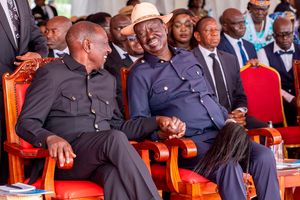
President William Ruto with ODM party leader Raila Odinga at the funeral of Mama Phoebe Asiyo at Wikondiek in Homa Bay County on August 8, 2025.
Photo credit: PCS
At the Homa Bay funeral last month, Mr Odinga had appeared fully committed to walking the journey with President Ruto.
“To the naysayers, give us space and judge us in 2027. This is going to last till 2027; after that, we’ll see where we go,” he told critics of his arrangement with Dr Ruto.
Those remarks emboldened his allies who had joined the broad-based government, but triggered sharp condemnation from within certain quarters in ODM and the opposition, with Wiper leader Kalonzo Musyoka and Democratic Action Party–Kenya boss Eugene Wamalwa arguing that Mr Odinga has formally joined the government.
Mr Musyoka accused him of betraying the opposition’s cause, while Mr Wamalwa told ODM Secretary General Edwin Sifuna—one of Mr Odinga’s most outspoken critics of the Ruto administration—that he was free to “join the one-term team” if he believed Mr Odinga would abandon the president before 2027.
But on Wednesday, September 24, UDA officials dismissed fears that Mr Odinga’s recent pronouncements could destabilise their political arrangement with ODM, insisting that their partnership with him remains mutually beneficial. But deep down, UDA is more than before, working on a plan B just in case Mr Odinga pulls a fast one on them.
UDA National Organising Secretary Vincent Kawaya sought to downplay concerns, saying both sides need each other to remain politically relevant.
“I think there’s nothing wrong. Our relationship with Raila is symbiotic. We need each other and nobody should imagine that Raila doesn’t need us,” Mr Kawaya said.
He argued that Mr Odinga’s decision to rebuild and strengthen ODM was, in fact, in UDA’s interest, warning that a weakened opposition party would only embolden smaller outfits to eat into Raila’s base, weakening the coalition’s prospects in the long run.
“Politically speaking, the easiest way we can lose is if ODM is not strong. Because other small parties could emerge and start taking control of Raila’s base. It’s extremely important for us to have Raila as strong as possible,” the UDA official explained.
According to him, no agreement has yet been reached on power-sharing arrangements beyond 2027, but maintaining Mr Odinga’s political weight is crucial for any future formation.
“Even if he says we have not agreed beyond 2027, that’s true because we have not discussed who takes what. We want Raila to retain his political value. If he becomes a government puppet, we wouldn’t have any strength,” Kawaya said, adding that the opposition should not celebrate Raila’s latest remarks.
UDA Deputy Secretary General Omboko Milemba said their coalition’s 2027 game plan would depend on decisions made at the top level between President Ruto and Mr Odinga.
President William Ruto (left) and ODM party leader Raila Odinga watch the 2024 African Nations Championship match between Kenya and Zambia at Moi International Sports Centre, Kasarani in Nairobi on August 17, 2025.
Photo credit: PCS
“For 2027, Raila and President Ruto will agree at their own level and we shall execute it at that time. We shall execute the instructions they will give us,” he said as he dismissed talk of a fallout, noting that Raila has consistently acted as a statesman in delicate national moments.
“I don’t think Raila has said anything new if you followed the KICC MoU signing ceremony in March. What Raila said is what the president keeps on telling us—bringing the nation together,” Mr Milemba said.
He praised the ODM leader for choosing dialogue and compromise at critical moments in the country’s history, including the 2007 power-sharing deal with President Mwai Kibaki after a disputed election.
“We thank Raila for being a statesman who did not think that Kenya should be taken to the abyss when we looked like we were at a very delicate moment. He became a statesman last year just like his father in 1964,” said Mr Milemba.
Mr Odinga’s latest declaration that ODM would still field a candidate has, however, reopened political uncertainty in the broad-based government.
“Mr Odinga has now introduced known unknowns and unknown unknowns as far as the 2027 elections go,” Mr Mokua observes. “This makes him the centre of 2027 presidential conversations. All candidates will want to hold court with him because ODM has not taken a definitive position.”
For President Ruto, Mr Odinga’s wavering is a double-edged sword.
On the one hand, the ODM leader’s cooperation has helped stabilise the broad-based administration, with key ODM figures benefiting from state appointments and development projects flowing to Mr Odinga’s backyard.
On the other hand, his flip-flopping has made it difficult for UDA to craft a clear re-election script.
“President Ruto is an experienced politician, and it would be naive to imagine that he is not crafting a 2027 strategy with all scenarios on the table,” Mokua says.
“But one of those scenarios—Mr Odinga withdrawing his support and teaming up with former President Uhuru Kenyatta to back another candidate such as Kalonzo Musyoka or Fred Matiang’i—would complicate matters and could even make Ruto a one-term president.”
Nandi senator Samson Cherargei, an ally of President Ruto, has, however, downplayed the jitters, insisting: “People should not read too much into what Baba Raila Odinga said during the ODM MPs’ meeting, because the partnership between UDA and ODM is working very well and will continue even after 2027.”
Still, Prof Gitile Naituli of Multimedia University warns that Mr Odinga’s instincts make it unlikely that he would back Dr Ruto’s re-election bid.
“Raila doesn’t want a Luo leader to rise when he is still alive. ODM will produce a presidential candidate, and most likely, it will be Raila himself,” Prof Naituli argues.
“With Raila, Ruto would have a dignified loss; without him, he would be whitewashed.”
At 80, Mr Odinga faces what could be his final political dilemma. Does he stick with Ruto’s broad-based government and secure his legacy as a statesman who saved the country at the height of political havoc, or does he mount a sixth stab at the presidency?
Others dismiss such calls as mere survival tactics for politicians who depend on Mr Odinga’s coattails to secure their own seats.
Within ODM, fatigue is palpable, with younger leaders pressing for a generational shift and challenging the notion that Mr Odinga must always be on the ballot.
President William Ruto (right) with ODM leader Raila Odinga during the third National Executive Retreat at the KCB Leadership Centre in Kajiado County.
Photo credit: PCS
Yet, as advocate Chris Omore notes, “the question is whether his supporters—accustomed to his name on the ballot—would rally behind another flag bearer.”
Whichever path he chooses, analysts agree, will set the tone for both the opposition and President Ruto’s strategy.
Wiper leader Kalonzo Musyoka and DAP-K chief Eugene Wamalwa have accused him of undermining opposition unity.
The perception that the PDM leader has sided with the president has emboldened Kenya Kwanza, which portrays the opposition as fractured and rudderless.
For ODM itself, the dilemma has been existential.
Mr Mokua describes the party as a “Tower of Babel” ever since Mr Odinga allowed his members to join President Ruto’s government under a broad-based administration.
“His latest statement has reintroduced order by making him the sole authority in the party capable of inflicting pain and supplying pleasure at the same time,” he says.
Mr Odinga’s practice of shifting alliances is not new. In 2001, he rallied his troops behind Daniel arap Moi’s Kanu, only to bolt out months later and crown Mwai Kibaki the opposition’s joint presidential candidate.
His declaration of “Kibaki Tosha” at Nairobi’s Uhuru Park changed the course of history, ending Kanu’s four-decade rule.
In 2007, he came within a whisker of the presidency as ODM’s flag bearer, but the disputed election plunged Kenya into post-election violence.
He settled for a coalition government as prime minister under Kibaki, a role that kept him at the heart of power.
In 2013 and 2017, Mr Odinga led opposition coalitions against Uhuru Kenyatta. After the violent 2017 election, he stunned allies by striking a “handshake” with President Kenyatta in March 2018, effectively pacifying the political climate while leaving his Nasa partners—Kalonzo, Musalia Mudavadi , and Moses Wetang’ula —feeling betrayed.
Now, his cooperation with President Ruto mirrors the same pragmatism: shifting positions when necessary to safeguard his influence, even at the cost of confusing allies.
“Mr Odinga has demonstrated fidelity to selfish personal interests in political decision-making given the multiple handshakes he has had with past presidents,” Mr Mokua notes.
For Dr Ruto, the biggest fear is uncertainty.
Will Mr Odinga run against him in 2027, endorse another candidate, or remain tethered to the broad-based government? Each scenario has far-reaching consequences, according to analysts.
If Mr Odinga runs, his candidacy would give President Ruto a formidable opponent who legitimises the race, though one with diminished energy and a fatigued base.
If he endorses another candidate—especially in alliance with Mr Kenyatta—the risk of a consolidated opposition could tilt the scales against Dr Ruto.
And if he stays with Ruto until 2027, it would further divide the opposition but could erode Ruto’s own hustler narrative, which was built on resisting dynastic politics.
“This scenario is what has a high probability of making President Ruto a one-term president,” Mokua warns.
The ODM leader’s political journey has always been defined by resilience, risk-taking, and reversals.
Prof Gitile Naituli thinks that in whichever way, President Ruto is gearing towards one term.
“He will join the Chakweras (Lazarus), Amadou Ba of Senegal and George Weah of Liberia’s league who were kicked out from power,” he says.
Mr Omore adds that Mr Odinga must first address sharp divisions within ODM and the rebellion against his pro-government stance, whichever path he chooses to go ahead of the 2027 election.