Fears of a disruptive by-election campaigns in the event both Mr Sakaja and his deputy James Muchiri were impeached, display of authority in the city’s politics and scuttling any threats to the broad-based government were at the heart of the efforts by the two leaders to have the impeachment motion dropped.
There were also fears that the city could plunge into leadership chaos that characterised it in 2020 following the resignation of then Deputy Governor Polycarp Igathe and the subsequent impeachment of then Governor Mike Sonko.
Nairobi Governor Mike Sonko (left) and his deputy Polycarp Igathe go through a document during a meeting with Matatu owners at Nairobi Charter Hall on August 29, 2017. Mr Igathe has proposed new taxes on property owners. PHOTO | ANTHONY OMUYA | NATION MEDIA GROUP
A successful ouster of Mr Sakaja and Mr Muchiri would have also benefited former Deputy President Rigathi Gachagua by presenting him with an opportunity to face off with President Ruto and test his political influence in the city ahead of the General Election.
With Nairobi being cosmopolitan and the country’s capital, such a by-election would have given a pointer to the emerging political realignments, which would have hurt the political posturing by the broad-based government.
Further, being a UDA governor, his impeachment would have been a big blow to both Dr Ruto and the ruling party, given the strategic role the county plays as the seat of power.
“Politics is about waves. If Sakaja is impeached, this will create a bad precedent for the upcoming by-elections. Ruto and Raila dare not flop in saving Sakaja because this could end up in opposition parties gaining seats in the upcoming by-elections. So, Nairobi politics are having an oversized impact on national politics,” observed Prof David Monda, a United States-based university lecturer and political analyst.
According to the law, the Speaker of the county assembly takes over as acting governor for a maximum of 60 days in the event both governor and deputy are impeached. Within this period, a by-election must be held to elect new office bearers.
The decision by the Nairobi members of county assembly (MCAs) to propose the removal of both the governor and his deputy also exposed the political mistrust by various camps in the assembly. In most instances, MCAs have only gone after the governor, with the deputy standing as the immediate beneficiary. But by seeking to remove the two, the assembly appeared to cast doubt on Mr Muchiri’s political stance.
Analysts also say that the decision by President Ruto and Mr Odinga to rescue Mr Sakaja was part of their strategy to maintain unity between UDA and ODM and to protect their shared political grounds in the city. Some of the broad-based government backers also claimed that the impeachment motion was part of a broader plan by their opponents to wreck the unity pact between Dr Ruto and Mr Odinga.
“There are some people within both ODM and UDA who have not embraced the broad-based government and have always wanted to create rivalry and friction between the two parties. Some are being used by external forces, who have interests in Nairobi politics,” said Makadara MP George Aladwa.
"Personal aggrandisement"
Kibra MP Peter Orero, an ally of Mr Odinga, said the impeachment motion was being fuelled by personal aggrandisement and desire to settle political scores. He said the MCAs should demand service delivery without resorting to impeachment, which could ruin operations in the capital.
“It would have been a disaster for Nairobi. Nairobi has not enjoyed political tranquillity that is necessary for meaningful development projects. During Sonko’s term, people did not enjoy services because of the chaos that played out during that time,” said Mr Orero.
“Those dissatisfied with the current leadership can wait for the next elections which are in under two years instead of disrupting service delivery through impeachment,” he added.
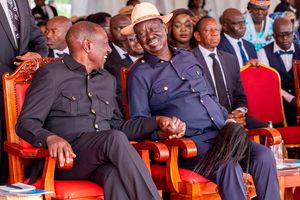
Former Prime Minister Raila Odinga and Nairobi Governor Johnson Sakaja inside Nyayo Stadium in Nairobi during 56th Jamhuri Day celebrations on December 12, 2019.
Photo credit: File/ Nation Media Group
By ensuring Sakaja remains in office, Dr Ruto and Mr Odinga have also sought to ensure political stability in the capital and maintain their influence in the elections.
Embakasi Central MP Benjamin Gathiru, an ally of Mr Gachagua, said it was ironical that Dr Ruto and Mr Odinga would spend a lot of time to protect Mr Sakaja without taking time to listen to the issues being raised by people of Nairobi.
He also observed that the concerted efforts by the two leaders show that they are scared of losing Nairobi politically.
“Even if they protect him now, he will still face the people in 2027. If I were them I would let Sakaja carry his cross for the wrongs he has done to the people of Nairobi,” said the MP.
Prof Monda further noted that both Mr Odinga and President Ruto have invested in the broad-based government and would not have allowed such a motion to rock their unity.
“The former DP is on record for opposing Sakaja in regards to suppressing the ‘Mulima nation’ from doing business in the CBD and suppressing matatus. Any political action, like impeachment, that would benefit Gachagua will be looked at with concern, not only by Ruto, but also by Raila,” he said.
Elected on a UDA ticket with only 52 MCAs in the 125-member assembly, Mr Sakaja has long relied on cooperation with ODM, which has majority members, to implement his programmes and get budget approvals.
But his decision to work with Mr Odinga’s ODM has also attracted criticism, especially from Mr Gachagua. Before his impeachment in October last year, Mr Gachagua took on Mr Sakaja, accusing him of disrupting businesses by relocating traders. He further claimed that Mr Sakaja was elected on the strength of his promise to the traders.
“We promised that our administration will never disrupt lives or undermine economic activities. Please consider holding a meeting with the leadership of the market to agree on any changes your government wishes to make without affecting their livelihoods. These traders have given you their trust and vote...it is only fair that you listen to them,” Mr Gachagua said then.
“There are some people who are not comfortable with us having to balance politics. There are some people who believe in the politics of exclusion. What they talk about is that you can only give things to these people, we can only support this part of the country,” Mr Sakaja said in a past interview with the Nation.
“I don’t believe in that kind of politics. I believe politics must be inclusive. My projects are in areas even where I didn’t get votes. So part of the problem is that I am working with people who did not vote for UDA,” he added.[email protected]