While some see them as necessary instruments for reform, critics accuse him of wasting public resources on bodies that duplicate the work of existing institutions or produce reports that gather dust without implementation.
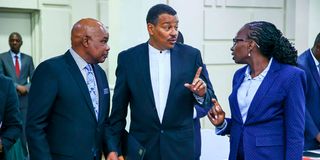
The debate intensified this week after the High Court temporarily suspended the commencement of the latest task force, chaired by law scholar Prof Makau Mutua. The 18-member panel, gazetted on August 25, is mandated to design a framework to verify, categorise and compensate victims of protests dating back to 2017. Law Society of Kenya president Faith Odhiambo is vice-chairperson. The team was expected to complete its work within 120 days.
Justice Kizito Magare ordered the suspension following a petition filed by lawyer Levi Munyeri, who challenged the constitutionality of the task force. The matter will be mentioned again on October 6, 2025.
Criticism of the President’s reliance on task forces has been mounting. Former Deputy President Rigathi Gachagua dismissed the compensation team as political posturing.
“He is trying to hoodwink the international community by ordering Prof Makau Mutua to set up a team to compensate victims of extra-judicial killings,” said Mr Gachagua. “Compensation is important, but it should come after acknowledging the killings and apologising to the nation and affected families.”
Despite the backlash, President Ruto insists there is compelling national interest in creating frameworks for accountability, redress and reparations for victims of demonstrations.
Prof Makau Mutua.
Photo credit: File | Nation Media Group
His communications director, Munyori Buku, defended the task forces, arguing that they deliver results. “The education reforms report led to changes in subjects and the publication of new books, while recommendations from the Maraga task force are being implemented,” Mr Buku told Nation .
Yet the cost of such task forces is a persistent concern. They require millions of shillings for allowances, research, logistics and consultancy fees. According to a 2014 circular from the Salaries and Remuneration Commission (SRC), public sector task force chairpersons were entitled to Sh5,000 per day, members Sh4,000, and support staff between Sh1,000 and Sh2,000.
Private sector appointees earned much higher rates, with chairpersons receiving Sh15,000, vice-chairpersons Sh12,000 and members Sh10,000 per day.
The spending can be substantial. A 10-member negotiations team created by President Ruto and ODM leader Raila Odinga in August 2023 requested Sh106 million for its operations. A breakdown of costs showed Sh5.9 million set aside for allowances and conference facilities, Sh10 million for document translation, Sh15 million for publishing 1,000 copies of its report, and Sh9.7 million for contingencies.
Members from outside the public service were entitled to Sh25,000 per sitting, while co-chairs Kalonzo Musyok a and Kimani Ichung’wah were each allocated Sh50,000 per sitting.
National Dialogue Committee co-chairpersons Kalonzo Musyoka and Kimani Ichung'wah flanked by committee members present their final report at the Hilton Garden Inn on November 25, 2023.
Photo credit: Francis Nderitu | Nation Media Group
President Ruto’s preference for task forces emerged barely two weeks after he assumed office. His first team, on gender-based violence and femicide, was formed in September 2022 under the leadership of former Deputy Chief Justice Nancy Barasa. That 34-member group was to serve for 90 days.
Later the same month, he created another task force on basic education, chaired by Prof Raphael Munavu, to evaluate the competence-based curriculum and tertiary education reforms. The 42-member panel submitted its report in August 2023, though implementation of its recommendations remains slow.
In December 2022, the President established a task force on police and prison service reforms, led by former Chief Justice David Maraga. The team delivered its report in October 2023, recommending better terms and conditions of service. However, the High Court later ruled its formation unconstitutional, declaring its decisions invalid.
President William Ruto (right) receives the security agencies welfare reforms task force report from former Chief Justice David Maraga at State House Nairobi on November 16, 2023.
Photo credit: Wilfred Nyangaresi | Nation Media Group
Several other task forces have faced similar legal setbacks. The eight-member commission of inquiry into the Shakahola massacre , chaired by Court of Appeal Judge Jessie Lessit, was declared illegal before it began work. The human resources for health task force, chaired by Khama Rogo and Judith Guserwa, was also struck down by the courts, which found its mandate clashed with the Health Act.
Even where the teams have operated, delays in implementing recommendations remain common. For example, a task force on the regulation of religious organisations, chaired by former MP Mutava Musyimi, submitted its report to the President in July 2024. Yet in January this year, Mr Musyimi told Nation that no action had been taken. Interior Cabinet Secretary Kipchumba Murkomen later said the Cabinet was reviewing the recommendations before forwarding them to Parliament.
The President’s appetite for committees has extended into diverse sectors. He created a task force to design a national lottery in February 2023, another to audit public debt in July 2024, and yet another in December 2024 to address the exit of businesses citing regulatory hurdles. Last month, he unveiled an 11-member multi-agency task force to tackle corruption, though its work too has been temporarily halted by the courts.
The cost of maintaining this network of task forces is rising against a backdrop of economic strain. Their proliferation has left critics questioning whether the President is overstepping his powers under Article 129 of the Constitution. Legal analysts argue that many of the teams duplicate roles of statutory institutions. Others warn that repeated invalidation by the courts undermines the legitimacy of the presidency’s approach.
For President Ruto, however, the task forces remain central to his governance style. He describes them as tools for consultation and reform, designed to bring expertise from diverse sectors into government decision-making. His allies argue that task forces offer solutions where traditional bureaucracies have stagnated.
But for many Kenyans, the question persists: are these panels engines of reform, or costly distractions that consume resources without producing tangible change?
As the High Court considers the latest challenge, the debate over President Ruto’s reliance on task forces is set to intensify, shaping both his legacy and the direction of governance in the years ahead.