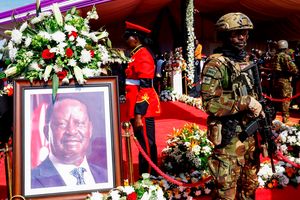
The sudden death of opposition leader Raila Odinga has shone a spotlight on how such a national security issue should be handled to ease tensions.
While addressing mourners during Raila’s burial in Siaya on Sunday, President Ruto revealed how he got news of the former premier’s death, an account that exposed the lack of diplomatic communication between Nairobi and New Delhi.
President William Ruto pays tribute to Raila Odinga
President Ruto said the news was broken to him on his mobile phone by Odinga's elder brother, Oburu Oginga and confirmed by Raila’s daughter, Winnie.
"Mr Oburu was not committal...it was about 6.45am...he said Odinga was critically ill. Later, he said Odinga had departed, only for Winnie to call me and break the news that the bad had occurred," President Ruto said.
He added that he felt the weight of the tragedy, had to consult with family and other stakeholders before breaking the news to the nation.
President Ruto also revealed that Odinga had suffered ill health for some time, "and I committed the government to footing all medical bills in a health facility of his choice anywhere in the world...because I needed no guesswork around his health".
ODM leader Raila Odinga wiping his eye as he addressed journalists at Jaramogi Oginga Odinga Foundation in Nairobi on May 16, 2023
Photo credit: Evans Habil | Nation Media Group
And even when details of the death of such a towering figure were communicated, many felt that it lacked the ingredients of meticulousness and completeness.
Dr Leonard Kimani of Doctors Without Borders said, "In such matters of unreconciled opinions on death, the final arbiter is open, transparent and competent postmortem report".
Dr Kimani said, "I am not conversant with a situation where I saw the postmortem report made as part of the disclosures regarding Odinga's death".
However, he clarified that "all medical information is owned by the patient or next of kin, hence why you still have time for the family to decide whether or not to make it public".
Dr Kimani said, "What is odd is that the doctors were quick to make the deceased's ailments public but not the postmortem.”
The Devamatha Hospital in Kerala, southern India, where former Prime Minister Raila Odinga died.
Photo credit: Nation Media Group
Dr Sister Alphons, who had attended to Odinga, mentioned that he had diabetes, kidney problems, and had suffered from Deep Vein Thrombosis (DVT) in the leg.
The death ended up coming as a shocker that was crudely broken by bloggers, denying the historical moment the decency it deserved.
The matter was not helped by accounts of Indian medics who handled Odinga, official information being that he had been admitted as an eyesight complications' patient but who died of cardiac arrest.
Dr Alphons said that despite their best efforts to revive him from the cardiac arrest, they couldn't save him.
Rumours and 'hidden' truths
Earlier, prior to news of his death, when it became clearer that all was not well with Odinga's health, his political spinners came up with a theory that the Opposition was spreading rumours about the issue. They specifically picked on former deputy President Rigathi Gachagua , Kalonzo Musyoka and Eugene Wamalwa as the 'kings of rumour mongers'.
In an October 5 press release, Odinga's spokesman Dennis Onyango urged the opposition to quiet the rumours.
"The political formation of impeached former Deputy President Rigathi Gachagua and his struggling team of Kalonzo Musyoka and Eugene Wamalwa, among others, are on a familiar campaign of misinformation on the health of former Prime Minister," Mr Onyango wrote.
Former Prime Minister Raila Odinga speaks to the media in Nairobi, January 21, 2011.
Photo credit: Reuters
He said that the trio, in partnership with others, "were happily picking feeds from bloggers, including AI-generated images, and broadcasting them as some kind of investigative Breaking News".
Mr Onyango accused the United opposition of bullying Odinga to provide a back for them to ride on in their struggle against President William Ruto.
He proceeded to update about Odinga thus: "Mr Odinga has a strong tradition of being open and generous with the country on matters of his health".
He revealed that "the former premier had travelled out of the country on October 3, 2025, on a normal one of the many trips he has made this year, and definitely not the last".
He added that Odinga had definitely not travelled to Europe, as picked from bloggers and broadcast by some media houses... He is not indisposed, as prayed for by his frustrated opponents".
This forced Mr Gachagua to hit back, asking, "...they are saying Kalonzo is behind the problems bedeviling Odinga...Is Kalonzo a bacteria or a virus?".
Later in a TV interview, Mr Gachagua said, "The intention of the mischievous press release was meant to drive a wedge between Mt Kenya and Luo Nyanza voters".
He added: "they needed be so petty as to try and manufacture such a cheap propaganda ..if they wanted to pass the message that Odinga is well they only needed to arrange for him a public activity and invite the media to show the world that all was well".
Later, however, Odinga's elder brother, Dr Oburu, confirmed that the former PM had fallen ill and was receiving treatment in India.
Mr Oburu had a few hours before Odinga's death reiterated that "my brother is well, I spoke to him and he is in high spirits...looking forward to reuniting with him".
He later said, "it was in good faith; he was well, only that he suddenly suffered a heart attack that killed him".
"I have lost my best friend", Oburu Oginga pays tribute to his brother Raila in Bondo
There followed a flurry of politicians recounting how they had spoken to Odinga before his death, all insisting he was in high spirits.
"Odinga has not been economical with information about his health. He told the country that he was undergoing a procedure when he was hospitalized as the sitting Prime Minister in June 2010. He told the country that he was diagnosed with Covid and hospitalized as Opposition leader in 2021. Odinga family even told us that their daughter risked getting blind but was being treated abroad," says Makueni Senator Dan Maanzo.
Mr Maanzo adds "it compromised nothing to be speedy and truthful about Odinga's health, for that was his tradition of living a transparent life, including on his own health".
"What would have been a straightforward communication about Odinga's health status, his flight to seek medication, regular updates...ended up being a disorganized affair that has left simmering mistrust on how he exactly died," says former Provincial Commissioner Mr Joseph Kaguthi.
Mr Kaguthi adds "Odinga was in the run-up to his death a national security issue, a man of great public interest, and entertaining grey areas in informing interested parties about his well-being was exactly not spot on".
He says, "Odinga's last days of life define how not to treat the health status of high-stakes' politician.”
However, National Assembly Minority Leader Junet Mohammed, while admitting laxity in proper handling of the issue, said: "we are sorry, I personally I m sorry, I did not expect it to end like this...we did not foresee a situation that was to end like this".
Mr Mohammed said "while death is a complex and hidden issue that we all wait to strike, we did not expect it to visit us so soon...we anticipated Mr Odinga coming back to partner with us in national welfare".