If you have ever bought meat from Burma and Ndunyu markets in Nairobi, then chances are that you have eaten donkey meat—a government report has established.
Behind the bustling stalls where thousands of Nairobi residents flock daily for affordable meat lies a shadowy criminal enterprise that a new report now says stretches from remote villages, across county borders and into international trafficking networks. It is mainly fuelled by the lucrative demand for donkey skins in Asia.
The report, titled Theft and Illegal Trade in Donkey Skins and Related Products in Kenya , paints the picture of a sophisticated underground industry that no longer revolves around simply stealing livestock. Instead, criminal syndicates have perfected a brutal supply chain where every part of the animal is monetised—from its skin, prized for the production of ejiao , a gelatin used in traditional Chinese medicine and luxury health products, to its meat, secretly supplied to unsuspecting consumers.
The July 2026 report by the National Crime Research Centre (NCRC) established "a demand-driven model where some meat suppliers source orders from restaurants, institutions and urban markets."
"Once an order is received, criminal groups are recruited to steal, slaughter and transport the meat in sacks via boda bodas to unsuspecting customers in areas like Burma or Ndunyu meat markets in Nairobi," the report stated.
Part of the contraband meat from stolen donkeys seized by police in Murang'a on November 14, 2023. The meat was being transported to Nairobi.
Photo credit: Mwangi Muiruri | Nation Media Group
Speaking during the launch of the report, where she was the chief guest representing Interior Principal Secretary Dr Raymond Omollo, Principal Administrative Secretary for National Administration Beverly Opwora expressed concern over the sharp decline in the country's donkey population, saying it was a devastating loss for thousands of families who depend on the animals for transport, farming and their daily livelihoods.
Principal Administrative Secretary for National Administration Beverly Opwora during the launch of the Report on the Theft and Illegal Trade in Donkey Skins and Related Products in Kenya at Fairmont The Norfolk in Nairobi on July 30, 2026.
Photo credit: Bonface Bogita | Nation Media Group
"This is not only a public health concern but also a food safety issue, a socio-economic issue, an organised crime issue, as well as an animal rights issue," she said.
Ms Opwora said the booming international demand for donkey products is the biggest driver of the illegal trade, with sophisticated criminal networks exploiting weak enforcement mechanisms to smuggle hides and meat across the country and beyond.
"It is executed under the cover of darkness at very clandestine slaughter sites, and the products are moved through illegal transport routes with the help of unscrupulous individuals. We cannot allow this criminal enterprise to thrive at the expense of our people," she said.
Researchers found that what was once isolated livestock theft has transformed into a highly organised criminal business operating with military precision.
Instead of driving away stolen donkeys for resale, criminals now slaughter them almost immediately in hidden bush locations, strip off the valuable hides and rush the meat into urban markets before dawn.
What makes the trade particularly difficult to detect is the elaborate planning behind every operation.
The report found that syndicates usually strike between midnight and 4am when villages are asleep. They often schedule raids during heavy rains to drown out noise from the theft and wash away blood trails that could expose slaughter sites.
Long before the theft takes place, reconnaissance teams disguised as charcoal vendors, water sellers or ordinary traders spend days scouting villages, identifying homes with many donkeys and monitoring police patrols.
Once targets are identified, specialised teams move in.
Some lure donkeys away from their pens using salt or fodder, while others poison guard dogs to silence the first line of security.
The report says criminals have adopted compartmentalised logistics, where different individuals handle separate stages of the operation, ensuring no single suspect can easily be linked to the entire theft-to-market chain.
Small, fast vehicles, particularly Toyota Probox cars, are stationed at strategic junctions to ferry hides and meat through panya routes before daylight.
The report also uncovered the existence of extensive informer networks within communities. These insiders reportedly identify vulnerable homesteads, monitor security movements and even deliberately mislead villagers searching for stolen animals by sending them in the wrong direction.
More worrying are allegations that some illegal slaughter operations enjoy protection from rogue security officers, allowing criminal cartels to process animals without interruption.
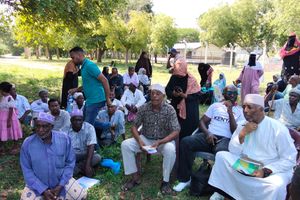
Dr Raphael Kinoti, the Regional Director of Brooke East Africa.
Photo credit: Bonface Bogita | Nation Media Group
said the huge disparity between what local criminals earn and the final value of donkey products abroad explains why the illegal trade continues to flourish.
"The young men carrying out the business are paid a paltry Sh7,000 per job, and a small amount is also paid at the ports for export clearance. When the hides reach the Chinese market, they fetch as much as Sh150,000 per kilo. This already tells you how lucrative the business is," he said.
The report says the skin has become the most valuable part of the animal because it is processed into ejiao.
The report shows the enormous profits have shifted criminals' focus away from the live animal, whose value as a means of transport and farm labour is insignificant compared to the international price of its hide.
The report shows Kenya's donkey population has already declined dramatically from 1.8 million animals in 2009 to just 1.1 million in 2019, a trend that continues to threaten rural livelihoods.
The report documented widespread theft and illegal slaughter in Mwingi East, Mwingi Central, Machakos, Kiambu and Kajiado, with veterinary officers in some regions reporting more than 200 donkey theft cases.
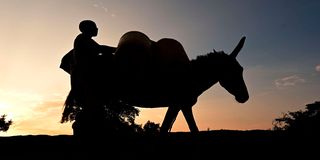
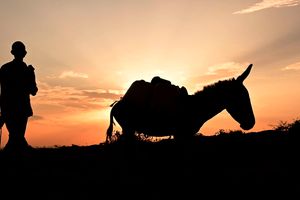
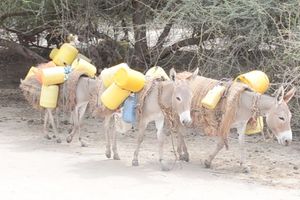
For thousands of rural households, particularly in arid and semi-arid counties, donkeys are the engines of daily life. They transport water, carry farm produce, plough fields and provide the only affordable means of moving goods over long distances.
When one is stolen, families lose not just an animal but their primary source of labour and income, and it is women and children who bear the heaviest burden.
The report found that tasks previously performed by donkeys, such as fetching water, now consume half a day of exhausting manual labour, leaving women with little time for farming or income-generating activities.
The report established that school-going children have dropped out or frequently missed classes because they had to help their families fetch water and perform other physically demanding chores after donkeys disappeared.
National Assembly Health Committee Chairperson and Seme MP Dr James Nyikal warned that, besides the economic damage, the illicit trade poses significant environmental and health risks because slaughtering is conducted in unhygienic bush locations with no veterinary supervision.
"Anthrax, which is a common disease in livestock, can be transmitted even through dry animal skins, yet the people involved in this business continue to sell these skins illegally," he said.
His concerns were echoed by Mary Mwimali, Assistant Director at the Directorate of Veterinary Services, who said every part of the stolen donkey is commercialised, exposing consumers to dangerous diseases.
"This brings the aspect of public health risk. Eating uninspected meat slaughtered in bushes can lead to diseases such as anthrax, salmonella and tapeworms," she said.
The report cautioned that because illegal slaughter takes place outside licensed abattoirs, unsuspecting consumers are exposed to meat that has never undergone veterinary inspection, while carcasses dumped in bushes contaminate rivers and grazing fields.
Illegal trading in donkey meat and skin has persisted in parts of the country despite a crackdown.
Photo credit: File | Nation Media Group
The report further warned that the donkey population may be approaching what researchers describe as an "extinction stage."
Unlike the speed at which animals are stolen and slaughtered, donkeys reproduce slowly, often requiring three to four years to replace lost populations.
The Meat Control Act mainly focuses on cattle, sheep and goats and contains few specific provisions addressing clandestine donkey slaughter. Legal loopholes surrounding the possession and transportation of donkey hides allow traffickers to escape with minimal penalties that are insignificant compared to the profits generated by the trade.
Police also face operational challenges. Unlike smaller exhibits, recovered donkeys require feeding, shelter and care during investigations—resources many police stations lack.
Ms Opwora urged the Ministry of Agriculture and Livestock Development to work closely with veterinary and livestock agencies to implement the report's recommendations. She also called on the Office of the Director of Public Prosecutions and the Judiciary to strengthen the prosecution of livestock theft and illegal slaughter cases and impose sentences that, in her words, "speak to the seriousness of the offences."