It started like a cliché scene out of a romantic movie. Two young students meet in a university library, flirting as they read, before agreeing to go out on a date.
Only that in such movies, the two would likely end up married with children, navigating life’s many challenges together, ending with a lesson about how love between two people can move mountains.
But 14 years later, Sarah Akello Aruwa is dead.
Duncan Livingstone Kimathi, the man she went out on a date with on June 30, 2012, is the prime suspect.
Prosecutors believe that they have direct, circumstantial and documentary evidence – a hat trick that would almost always secure conviction in any jurisdiction – to serenade the judge into entering a “guilty” verdict.
Kimathi’s lawyer still holds that the evidence is disjointed and contradictory, a position that if proven at trial could set his client free.
Both legal stands will now be tested in trial, as the High Court on April 21 found that Kimathi has a case to answer, but reminded all parties that the accused is still presumed innocent at this stage.
After agreeing to the date, Sarah informed her friend, Ivy Gathu, that a boy she met in the library was taking her out that night.
Students outside the USIU library.
Photo credit: File
A car Kimathi had hired, and which had a tracker, was driven in the area in which Sarah’s body was found. The car owner also had copies of Kimathi’s driving licence.
On the night of the date, someone called Hellen Atieno Aruwa, Sarah’s mother, claiming to be a kidnapper who had taken the USIU student.
The caller demanded a Sh100, 000 ransom. The following morning, another call from a different man, who used derogatory language to make a second ransom demand.
Sarah’s mother was in the presence of a relative identified as Jim Onyango. Jim took the phone and tried to get the kidnappers to accept Sh70,000.
By this time the matter had been reported to Kasarani police station, and an abduction investigation had already started.
“This was the beginning of a nightmare for the family that ended with the discovery of the deceased’s body at Ngewa, Githunguri,” the High Court ruling reads in part.
On July 2, police officers broke into Sarah’s room with the help of the hostel caretaker. In there, they found the notebook.
When the officers sent some money to one of the phone numbers scribbled, the confirmation message indicated spat out Kimathi’s name.
An officer at Safaricom’s security liaison office confirmed in the course of investigations that the number was indeed registered to Kimathi.
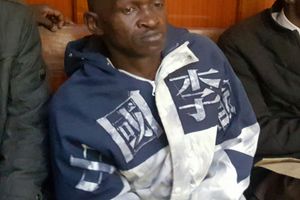
Winnie Wairimu Kariuki and Dancun Livingstone Kimanthi at Milimani Law Courts in February 2014 when they were charged that between June 30, 2012 and July 1, 2012 at Kiamiako Area, Githunguri, Kiambu County they murdered Sarah Akello Aruwa.
Photo credit: File
When detectives questioned the owner of the Toyota NZE which Kimathi had hired, he revealed the tracking information.
This information showed that the vehicle was driven to Ngewa, where Sarah’s body was eventually found, and then to the Githunguri area within Kiambu County.
On July 8, Sarah’s body was found in a coffee plantation in Ngewa, Kiambu County.
Police constable John Amalemba, the eighth witness to give evidence, told the court that together with Administration Police Officer Samuel Njuguna, he visited the scene where a crowd of “about 100 villagers was standing on the roadside.
Amalemba told the court that the body was found inside a thicket about two to three metres off the road.
A saloon car stopped near the scene, and a man Amalemba said was Kimathi, got out and allegedly identified himself to some members of the crowd as a police officer.
When someone in the crowd told him other police officers were around, the man allegedly got back into the car, which then sped off.
After Sarah’s body was found, government pathologist Johansen Oduor conducted a postmortem examination.
The examination showed that there were some cuts at the back of Sarah’s head, bruises around her neck with her tongue protruding from her mouth.
The cause of death was cyanosis, or poor oxygenation before death. She had been strangled to death.
Investigations would lead police to Kimathi and another USIU-A student, Winnie Wanjiru Kariuki. The two were suspected to be part of a kidnapping ring targeting fellow students.
Sarah Aruwa, a final year student at USIU, was kidnapped by her college mate, and her body was found in a thicket five days later.
Photo credit: Pool
In its ruling, the High Court stated that it also considered the evidence of police officers who visited the scene of murder and also took part in the identification parade in which Kimathi was identified.
During the defence hearing, Kimathi’s lawyers will attempt to argue that there was a discrepancy in names that linked his client to the murder.
In one of the instances, the defence argues that Sarah’s date was with a Daniel Mureithi and not Dancan Livingstone Kimathi.
The defence also holds that there is no DNA evidence linking Kimathi to the murder and that there is no proof beyond reasonable doubt – the legal threshold in criminal matters – and which can lead to a conviction.