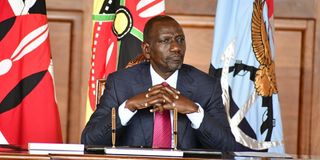
President William Ruto has backed the transfer of an additional Sh65.9 billion to county governments, potentially giving counties a major financial boost as the national government moves to match devolved functions with the resources required to deliver them.
President Ruto said the Intergovernmental Relations Technical Committee (IGRTC), working with the Commission on Revenue Allocation (CRA), had completed verification of the previously identified interim allocation and developed recommendations on the funds.
The recommendations will be submitted to the National Treasury for consideration in the 2027/28 financial year, with a view to facilitating the transfer of the requisite resources to county governments.
The announcement came as the President said the government had made progress in resolving long-running disputes over the division of responsibilities between the national and county governments, including functions relating to energy, sports, fisheries and soil and water conservation sectors.
He said the delineation, unbundling and gazettement of the devolved functions had now been completed including functions previously considered contested.
“Clarity of functions must be matched by resources allocation, whenever a function is transferred, the resources necessary to perform it must follow. Devolution cannot succeed when functions move but resources remain behind; when responsibilities are assigned without capacity; or when expectations are created without the means to meet them,” President Ruto said.
Council of Governors chairman Ahmed Abdullahi hailed reforms in the collaboration between both levels of government but said counties were still struggling with inadequate resources to implement functions that had already been transferred to them.
“I must say that we are still having challenges with the transfer of functions yet there are no funds to match this transfer, making it difficult for counties to deliver effectively,” Mr Abdullahi said.
His remarks underscored the resource gap that the proposed Sh65.9 billion transfer is intended to address, with counties continuing to shoulder responsibilities without corresponding financial allocations.
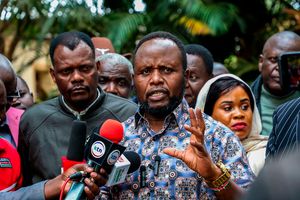
Council of Governors Chairperson Ahmed Abdullahi.
Photo credit: Boniface Mwangi | Nation Media Group
The President said the verified Sh65.9 billion allocation represented an important step towards addressing the resource gaps that have accompanied the transfer of functions to counties.
He did not, however, announce an immediate disbursement of the funds, saying the recommendations would first go to Treasury for consideration in the 2027/28 financial year.
The development comes as counties are already set to receive Sh503.5 billion in the 2026/27 financial year, comprising Sh428 billion in equitable share and Sh75.5 billion in conditional allocations.
He, however, warned that increasing county allocations alone would not be enough to strengthen devolution, saying the focus must shift to what counties deliver with the money.
“Strengthening devolution is not simply about transferring more money. It is about converting every shilling into a service, every allocation into an opportunity and every public investment into a measurable improvement in the lives of citizens,” he said.
He said Kenyans experience devolution through practical services including medicine in hospitals, water in their homes, accessible roads, productive farms, cleaner towns and responsive public services.
The push for additional resources is part of a wider effort by the government to streamline relations between the two levels of government and reduce disputes over the implementation of devolved functions.
During the 13th national and county governments coordinating summit at State House, President Ruto said the government had also identified the full operationalisation of Intergovernmental Sector Forums as an immediate priority, with the forums expected to serve as the first line of consultation, coordination and problem-solving between the national and county governments.
“Sectoral technical issues should be addressed before they develop into disputes. Consultation must come before confrontation, coordination before litigation and resolution before disruption,” he said.
Deputy President Kithure Kindiki said the changes marked a significant shift from the early years of devolution which he described as a period characterised by competition, conflict and confrontation between institutions.
“Fifteen years later, we have a much better working relationship and a much better system,” Professor Kindiki said.
He credited the improved relations to what he described as efforts to perfect the way national and county governments work together, particularly through the Intergovernmental Budget and Economic Council (IBEC) and the Council of Governors.
Prof Kindiki, who chairs IBEC, said the next phase should involve strengthening sector forums so that technical and operational issues are resolved before reaching the Summit.
“The Summit is not the place to do technical, professional and operational work,” he said, arguing that it should instead serve as the “apex” forum where high-level policy decisions are made.
He said the health sector forum had emerged as the most successful, followed by agriculture, trade and investment, where he cited progress around County Aggregation and Industrial Parks.
President Ruto linked the strengthening of intergovernmental relations to the need to resolve pending bills, warning that unpaid government debts were putting businesses and jobs at risk.
“As the next election cycle approaches, pending bills remain a major concern across both levels of Government,” President Ruto said, adding that they “undermine businesses, destroy jobs, and weaken confidence in Government.”
“For many enterprises, especially small and medium-sized businesses, an unpaid Government bill is not merely an accounting entry. It is working capital withheld, salaries delayed and livelihoods placed at risk,” he said.
He called on the Controller of Budget and Auditor-General to assist counties in verifying pending bills and establishing credible payment programmes.
The President also directed the National Treasury to provide resources for the evaluation of the performance of both levels of government, after the exercise stalled because of budgetary constraints.
He said the evaluation framework had already been developed by IGRTC but that sectoral evaluation had not begun because of lack of funds.
“What is not measured cannot be improved; what is not evaluated cannot be strengthened; and what is not accounted for cannot inspire public confidence,” he said.
The Summit identified five immediate priorities, including operationalising sector forums, strengthening alternative dispute resolution, settling pending bills, evaluating the performance of the two levels of government and accelerating the legal transfer and registration of gazetted assets to counties.