It is another chapter in the unravelling of a political career that once placed him at the helm of Kiambu County.
The decision leaves Waititu facing three costly consequences, including continued imprisonment, the loss of assets worth millions of shillings and a 10-year ban from holding public office.
The judgment delivered a further blow. The court reinstated money laundering charges against Waititu, his wife, Susan Wangari Ndungu, former Kiambu County Chief Officer for Roads, Transport, Public Works and Utilities, Luka Mwangi Wahinya, and Testimony Enterprises Limited director Charles Chege Mbuthia.
Justice Ougo set aside the acquittals and directed that they return to the Milimani Anti-Corruption Court for mitigation and sentencing on October 19, 2026.
Waititu spent much of the past year fighting to be released on bond, pending the determination of his appeal, which he submitted was arguable.
The case dates back to allegations that the Kiambu County government irregularly awarded Testimony Enterprises Limited a Sh588 million contract to upgrade gravel roads to bitumen standards in Thika, Limuru, Gatundu North, Juja and Ruiru during the 2017/2018 financial year.
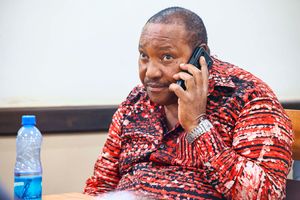
Former Kiambu governor Ferdinand Waititu.
Photo credit: File | Nation Media Group
Investigations by the Ethics and Anti-Corruption Commission (EACC) began in 2019, focusing on the alleged irregular procurement and the movement of money linked to the contract.
He was subsequently convicted alongside his co-accused of offences including conflict of interest, dealing with suspicious property, abuse of office and fraudulent procurement practices.
In February 2025, the trial court sentenced Waititu to 12 years in prison, with an alternative fine of Sh53 million.
He challenged both the conviction and the sentence, arguing that the prosecution had failed to establish its case and that the default imprisonment terms attached to the fines were unlawful.
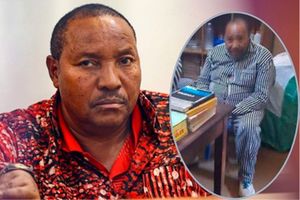
Former Kiambu Governor Ferdinand Waititu (also inset) at Nairobi Remand and Allocation Maximum Security Prison.
Photo credit: Nation Media Group and Pool
Justice Ougo dismissed the appeals, finding no sufficient legal basis to interfere with the sentences.
“The fines imposed by the court under the Anti-Corruption and Economic Crimes Act, being mandatory fines, were properly imposed,” the judge ruled.
The court noted that the law provides for mandatory fines, including additional penalties calculated according to the financial benefit obtained from an offence or the loss caused by the criminal conduct.
The judge also upheld the order barring the convicted persons from holding public office for 10 years, extending the consequences of the case beyond prison walls.
Former Kiambu County Governor Ferdinand Waititu before Chief Magistrate Lucas Onyina at Milimani Law Court on October 1, 2024.
Photo credit: Wilfred Nyangaresi|Nation Media Group
For a man who rose through elective politics to become Kiambu governor, the restriction represents a significant blow to any plans for a political comeback during the disqualification period.
In December 2025, the Anti-Corruption Court ordered the forfeiture of assets valued at approximately Sh131.2 million in a separate case concerning unexplained wealth.
The properties included two parcels of land in Thindigua, Kiambu County, valued at about Sh64 million, a Caterpillar excavator worth Sh11 million, two motor vehicles and property associated with his wife and a company linked to him.
Susan was ordered to forfeit a parcel of land in Kitengela, Kajiado County, valued at approximately Sh3 million, while Saika Two Estate Developers Limited was ordered to surrender property valued at about Sh52 million.
The forfeiture followed proceedings in which the EACC sought to establish whether Waititu and associated parties could explain how they acquired properties and accumulated wealth during the period under investigation.
However, the court did not order the forfeiture of all the assets targeted by the commission as it allowed Waititu to retain other properties after finding that the explanations given for their acquisition were satisfactory or that the EACC had failed to establish its case.
The court was particularly critical of the commission’s handling of funds in bank accounts, saying it had cited cumulative deposits without adequately analysing individual transactions.
“In regard to funds in bank accounts, as explained in the judgment, the commission’s case was not sound or well-founded nor justified. What the plaintiff (EACC) did was to cite the total cumulative funds. No analysis of the deposits or withdrawals was made to establish a trend,” the court said.
The EACC is also pursuing a separate civil case seeking to recover Sh170 million from Waititu and Testimony Enterprises Limited as alleged proceeds of corruption. That case remains pending.
Waititu’s political decline began before his criminal conviction. In December 2019, the Kiambu County Assembly impeached him over corruption allegations and other misconduct.
The Senate upheld his removal in January 2020, and his subsequent challenge was dismissed by the High Court.
His conviction in February 2025 marked another turning point. He later secured temporary freedom in February 2026 after a review of the conditions attached to his detention, following difficulties obtaining a bank guarantee equivalent to the fine imposed on him.
His lawyers had proposed alternative security, including a Sh20 million cash payment or property offered by his sister, Esther Njoki Waititu. They also cited his deteriorating health, including diabetes, hypertension, failing eyesight and kidney complications.
The latest judgment, however, has shifted attention back to the substance of the corruption case and the reinstated money laundering charges.
The EACC welcomed the ruling, describing the reversal of the acquittals as an important step in tracing the alleged proceeds of corruption.