When President William Ruto addressed the United Nations General Assembly in New York in September, he outlined the problems with Kenya’s Haiti mission and how the international community had failed it.
Kenyan troops, he said, were underfunded, under-equipped and operated at below 40 per cent of their authorised 2,500 personnel strength, a situation he described as unacceptable and incomparable to any other UN-sanctioned peace mission.
In interviews, President Ruto later said that while the United States “stepped up”, the Kenyan troops ended up with second-hand vehicles that often broke down, “putting our personnel in great danger.”
Even then, he noted, the Kenyan troops had, in 15 months, restored the presidential palace as the seat of government, overseen the return of police headquarters and the training academy to the Haitian police, and helped reopen schools and other critical infrastructure.
“This begs the question: if so much could be achieved with limited resources and stretched personnel within months, what more could have been accomplished if the United Nations fraternity had truly acted together in solidarity with the people of Haiti?” Dr Ruto posed to the UN assembly.
Confirmation by the Inspector General of Police last week that Kenyan police were now handing over to the incoming unit and are “expected back around March” has opened a window for fresh scrutiny of the mission.
Kenyan officers landed in Haiti in June last year for the UN-authorised, US-funded Multinational Security Support (MSS) mission to reclaim a nation sinking under gang violence. The deployment was hailed as historic: an African country leading a peace mission outside its continent.
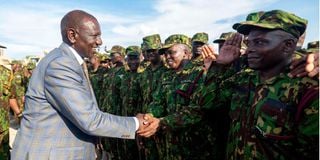
In an interview with Al Jazeera early this month, President Ruto revealed he held talks with Laurent Saint-Cyr, the head of Haiti’s Presidential Transitional Council, on the sidelines of the Doha meeting, where the two reviewed the shifting security situation and the role Kenya is expected to play under the new UN framework.
Dr Ruto added that he also spoke to the Kenyan commander leading the contingent in Port-au-Prince, describing him as “very upbeat” despite the fluid situation on the ground.
French President Emmanuel Macron shares light moment with President Ruto at the UN headquarters in New York on September 22, during the 80th United Nations General Assembly.
Photo credit: Pool
The remarks come as pressure builds in Nairobi for clearer communication on how long the officers will remain in Haiti and whether the transition to the Gang Suppression Force (GSF) signals a withdrawal, extension or reassignment under a new mandate. GSF will replace the Kenyan-led MSS.
Currently, the Kenyan officers are operating under the GSF, but they no longer play a leading role in the peacekeeping mission since October 2025.
The plan for how the Kenyan officers will be paid as they serve under the GSF is yet to be clarified, even as evidence of previous payment delays has been recorded.
International law expert Wilson Rading told the Nation that while Kenya “did its best”, the country was let down by others who failed to honour their pledges. “The full mission was supposed to have 2,500 officers. Kenya offered 737, but many nations never deployed as promised, leaving our officers exposed,” he said.
He added that despite limited resources, Kenyan officers managed to recapture key zones but struggled due to equipment shortages.
The mission never reached full strength — only 989 officers in total: 737 from Kenya, 150 from Guatemala, 78 from El Salvador, 23 from Jamaica, three from the Bahamas and one from Canada.
The bold mission to restore order in gang-plagued Haiti came at a sombre price for Kenya, with five of its brave officers making the ultimate sacrifice in the line of duty.
The first casualties were Police Constable Samuel Tompoi Kaetuai and Benedict Kabiru , who fell victim to the brutal realities of the conflict, sustaining injuries and perishing in ambushes and confrontations with heavily armed criminal syndicates that dominate Port-au-Prince and the Artibonite region.
Their deaths, in February and March, sent shockwaves across the nation, highlighting the perilous environment Kenyan forces faced thousands of miles from home and bringing immense grief to families who held onto hope amid initial confusion and conflicting reports. The grim tally was later compounded by a separate and equally tragic incident in late August/early September, when three more officers lost their lives in a devastating road accident during a recovery operation involving armoured vehicles.
These fallen heroes, including Corporal Kennedy Mutuku Nzuve , represent the human cost of Kenya's commitment to global security and a humanitarian mission that President Ruto has described as a service to humanity.
As the bodies of the officers were repatriated with military honours, the nation mourned its sons, grappling with the heavy burden the MSS mission had placed on its police service.
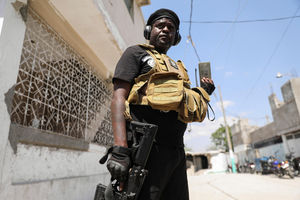
Inside Haiti, Kenyan officers endured sweltering heat, poor sanitation, erratic supply lines and constant fear of ambush.
“We never really knew who was in control from one street to the next,” said one officer who has since returned home. “We were always on edge.”
Morale dipped as weeks turned into months with little visible progress. Communication with authorities back home was limited, and delays in allowances made things worse. “Most of the time, payments were delayed and it became hard to plan,” said the spouse of one officer.
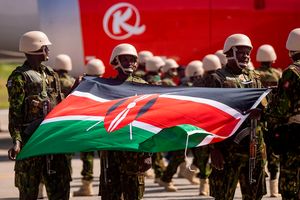
Members of the Kenyan National Police Service hold a Kenyan flag after disembarking in Port-au-Prince, Haiti June 25, 2024.
Photo credit: Reuters
Back home, the mission triggered fierce debate. Opposition leaders accused the government of “exporting security” while Kenya battled domestic crises, from banditry in the North Rift to rising urban crime.
Human rights groups questioned the legality of the deployment, citing the earlier court ruling. Government officials defended the mission as a symbol of African solidarity and global leadership.
“We are part of the global community,” said Foreign Affairs Cabinet Secretary Musalia Mudavadi in July. “If Kenya doesn’t lead, who will?”
Still, questions linger about cost and accountability. The National Treasury has yet to release a detailed breakdown of the mission’s expenses.
Kenya’s exit from Haiti offers a moment of reckoning. For decades, the country has built its reputation as a regional peacekeeping powerhouse: from Somalia and South Sudan to the Democratic Republic of Congo. Those missions were within Africa, backed by established structures and predictable funding.
Haiti, by contrast, was a bold leap into unfamiliar territory. The limited results underscore a harsh truth: Kenya’s peacekeeping strength lies in experience, not expansion.
“It’s not that Kenya shouldn’t lead,” said Mr Rading. “But leadership requires clarity. Was Haiti about global image or genuine impact? That’s the question Nairobi must answer.”
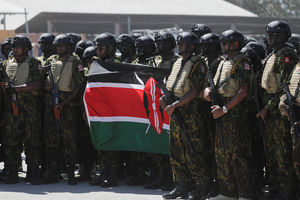
Members of the first contingent of Kenyan police stand in formation after arriving in the Caribbean country as part of a peacekeeping mission, in Port-au-Prince, Haiti June 26, 2024.
Photo credit: File | Reuters
Questions over the deployment began just after the announcement, when the High Court, following a case by the Dr Ekuru Aukot-led Thirdway Alliance Kenya, ruled that Nairobi could not deploy police officers outside Kenyan borders, but created a window that the State later sealed through the presentation of a signed bilateral deal with Haiti.
Security expert George Musamali said the mission was “prone to fail from day one,” comparing it to previous failed peace efforts in Haiti. “There was no clear entry plan,” Mr Musamali said. “A year later, they’re back home having achieved very little.”
Mr Musamali also warned that Haitian gangs were better armed and motivated. “In Haiti, gangs are seen as freedom fighters. That changes the dynamic,” he said.
Analysts say Kenya must refine its foreign policy priorities: focusing on regional stability, economic diplomacy and institutional partnerships rather than symbolic global ventures.
Barbara Jarra, a regional integration scholar at the Catholic University of Eastern Africa, said logistics and welfare should be central in future missions.
“Delays in allowances and unfulfilled troop pledges hurt morale. Everything looked promising at first, but as time went on, it became hard to justify,” she said.
Experts also point to communication lapses, weak coordination between UN agencies and troop-contributing countries, and lack of clear exit strategies.
Members of the first contingent of Kenyan police when they arrived in Port-au-Prince, Haiti June 26, 2024.
Photo credit: Reuters
For President Ruto, the Haiti deployment was a high-stakes gamble, one that showcased ambition but exposed the limits of Kenya’s reach. His broader vision of assertive African diplomacy remains intact, but Haiti has become a cautionary tale: speeches can inspire, but missions demand structure, funding and clear objectives.
As the operation winds down, a handful of Haitian police units trained by Kenyan officers continue to patrol Port-au-Prince, a faint echo of what once promised a new dawn for Haiti and Kenya’s foreign policy.
It began with applause at the UN and ends with quiet reflection. For Kenya, the lesson is sobering: global leadership cannot rest on symbolism alone. Haiti proved peacekeeping, like politics, requires not just courage, but capacity, patience and clarity of purpose.