The cooperation agreement between President William Ruto’s administration and the Nairobi City County is now at the centre of a legal battle after two public interest litigants moved to court to block its implementation.
The petitioners, Bernard Peter and Christine Gathoni, want the Sh80 billion deal suspended, arguing it unlawfully shifts control of devolved functions, bypasses public participation and exposes public funds to unapproved expenditure.
They further contend that the Nairobi County Assembly was excluded from the process and that Governor Johnson Sakaja committed county resources unilaterally.
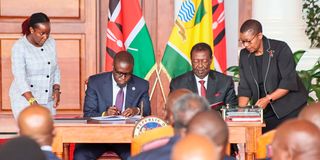
In papers filed at the High Court in Milimani, Nairobi, the petitioners say the pact signed on February 17, 2026 at State House Nairobi goes beyond intergovernmental cooperation and effectively restructures how key county services are governed and financed.
“The Agreement creates oversight and implementation frameworks that substantially reconfigure operational control over devolved functions. Article 187 of the Constitution requires formal transfer arrangements with constitutional safeguards, which were not invoked,” says the petitioners.
Sakaja inks Nairobi-National Government deal at State House
The contested agreement covers joint projects between the National Government and Nairobi City County in areas including roads, waste management, markets, housing, urban planning, and water and sanitation.
President Ruto had praised the deal as an initiative to “strengthen Nairobi’s standing as a globally respected African metropolis that reflects our national ambitions.”
“We have unveiled an Sh80 billion cooperation agreement between the National Government and the Nairobi City County Government to make the capital more livable, secure, and efficient for its 4.4 million residents,” the President stated.
Under the agreement, the two entities pledged Sh3.7 billion to complete 10,000 unfinished streetlights and install 40,000 new ones across the city. Additionally, the National Government, through Kenya Power, committed Sh1.5 billion for transformers and last-mile connections in informal settlements.
“In every ward, we will improve roads under a Sh5 billion programme, supplemented by Sh3.7 billion from the county government. A further Sh1 billion will enhance drainage systems,” Ruto added.
'Who oversees billions spent?'
However, the petitioners contend that although the cooperation agreement states it does not constitute a transfer of functions, its structure places devolved functions under joint governance dominated by national executive officials.
At the heart of the legal dispute is governance architecture and the management, allocation, and oversight of the billions of shillings in public funds allocated to the county government by the exchequer.
The petition states that the deal establishes a steering committee chaired by the Prime Cabinet Secretary and an implementation committee made up of national and county officials, alongside joint financing modalities and coordinated implementation. According to the petitioners, this framework amounts to a disguised transfer of functions, circumventing constitutional safeguards under Article 187. This is because it places constitutionally devolved services under joint control dominated by the national executive.
While the deal provides that projects will be subject to public participation, the petition argues participation must precede major governance and structural decisions, not follow them.
The case also raises questions about county and parliamentary oversight. The petitioners say the agreement commits Nairobi City County to financial, administrative, and structural obligations, yet it was not tabled before, debated by, or approved by the City County Assembly, contrary to Article 185.
“The Agreement was not tabled before, debated by, or approved by the Nairobi County Assembly. The Governor cannot unilaterally bind the County Government to structural and fiscal commitments without legislative oversight,” they say.
They further argue the Senate, whose Article 96 mandate is to protect county interests, was sidelined despite the pact affecting devolved functions and financial arrangements.
On public finance, the petition point to clauses providing for joint financing and budgetary commitments, warning that the arrangement introduces financial obligations “without legislative oversight”. According to them, this risks exposing public funds to unconstitutional expenditure, contrary to Articles 201 and 202 on transparency and accountability.
Respondents include the Attorney-General, Prime Cabinet Secretary, Governor Sakaja, Nairobi County Government, County Assembly and Senate.
Interested parties comprise the Law Society of Kenya, Council of Governors, Auditor-General, Controller of Budget, Commission on Revenue Allocation, and Katiba Institute-led civil society groups.
The petitioners have requested the Chief Justice to constitute a three-judge bench to hear the matter.
Pending hearings, they seek interim orders barring the formation of committees, project implementation, or fund disbursement under the agreement.
The High Court has certified the application as urgent, directing expedited service on respondents, tight submission timelines, and a virtual hearing on March 16, 2026.