When Nairobi Metropolitan Services (NMS) was established in March 2020 to take over key functions in Nairobi County, it seemed like a one-off move.
However, six years later, President William Ruto’s administration is introducing a different version of NMS, with the two entities due to sign a cooperation agreement later today.
In 2020, Lieutenant General Mohamed Badi was recruited from the military by the regime of former President Uhuru Kenyatta to take on the role of head of NMS.
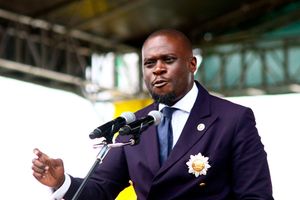
Lieutenant General Mohamed Badi who served as the Director-General of Nairobi Metropolitan Services (NMS).
Photo credit: File | Nation Media Group
These functions included health and transport, public works and utilities, ancillary services, and county planning and development services.
Talks of another takeover by the national government have resurfaced after Governor Johnson Sakaja announced a collaboration with President Ruto’s administration to execute some county government functions.
This time, the two levels of government intend to collaborate on transport and road infrastructure, solid waste management, water source development and supply, sewerage expansion and public lighting.
However, Governor Sakaja has claimed that certain powerful individuals within the national government are keen to take control of key City Hall functions, a move which he says he will not allow.
The county boss explained that, unlike the former Nairobi Metropolitan Services arrangement, the current model is a support mechanism, not a transfer of functions.
Sakaja inks Nairobi-National Government deal at State House
He said that the framework agreed with President Ruto’s administration is for additional support, not a transfer of functions, yet some individuals are pushing the latter narrative for their own benefit.
“We have not ceded any functions. A transfer of functions is not what we are discussing. It is not something we are going to do. If there was a transfer of functions, there would be a document as provided for in Article 187 of the Constitution. Have you seen any such document? There is none,” said Governor Sakaja.
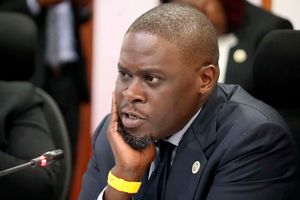
Nairobi Governor Johnson Sakaja.
Photo credit: Dennis Onsongo | Nation Media Group
“There are speculations and there are people pushing that agenda and the stories. Think about political interests in Nairobi. After the Presidency, there is no bigger seat you can vie for apart from governorship of Nairobi,” he added.
However, Principal Secretary for the State Department for Housing and Urban Development Charles Hinga threw the cat among the pigeons when he said it is just a matter of time before the government takes over Nairobi.
Speaking during the International Relations Society of Kenya City Diplomacy workshop held at the Best Western Premier Hotel in Nairobi on Thursday last week, the PS said that the ownership and control of Nairobi County are partially in the government's hands.
“Nairobi is not a county but a capital city, so collaboration with the national government is inevitable despite what people say,” Mr Hinga said.
There has been a political standoff between the national government and City Hall over ownership and control of Nairobi County.
The dispute centres on authority, governance, and accountability, and has sparked a fresh debate over who truly holds the power to manage the city’s affairs.
The Principal Secretary, State Department for Housing and Urban Development, Charles Hinga, speaks during the Smart Cities Forum in Nairobi on October 30, 2025.
Photo credit: Wilfred Nyangaresi | Nation Media Group
According to Mr Hinga, Nairobi under the current administration is not working arguing that the capital city cannot continue to be run as is currently being done.
He added that as a capital city which hosts United Nations offices, which are going to expand in the coming years, it cannot be run as it is being run.
“You are the host of UN-Habitat, the one who deals with slums and everyday slums are coming up and you also have a dirty river which runs across the city,” said the PS.
“This Nairobi is dysfunctional. Is it not time that, as the head of diplomacy, we said that Nairobi should not be run as a county, but as a capital city?” he posed.
For the two years, NMS gobbled up more than Sh27 billion from the Exchequer but ended up leaving the county government with pending bills of around Sh15.5 billion.
Despite tapping the Kenya Revenue Authority (KRA) to manage City Hall revenue collection, the taxman managed a paltry Sh8.6 billion in the financial year ended June 30, 2020, one of the lowest recorded at the time, falling far short of the Sh17.2 billion target.
A slight improvement was recorded in the next two financial years between 2021 and 2022 with KRA collecting Sh9.96 billion in the financial year ended June 30, 2021 against a target of Sh16.4 billion.
The own source revenue dipped to Sh9.2 billion in the following fiscal year against even a lofty target of Sh19.6 billion.
KRA was appointed the principal county revenue collector on March 16, 2020 as part of the agreement in the deed of transfer of functions of the county to the national government.
However, Governor Sakaja has maintained the current arrangement is a closer collaboration between the two entities because of Nairobi’s unique status, which demands a funding structure that reflects its national and international obligations.
Consequently, the intention of the collaboration is to improve service delivery to the city's millions of residents and does not amount to a surrender of county authority.
He cited Section 6 of the Urban Areas and Cities Act, 2019, which recognises Nairobi as Kenya’s Capital City and calls for formal cooperation between the county and national governments on funding and service delivery.
President William Ruto with Nairobi Governor Johnson Sakaja in Nairobi on August 25, 2022.
Photo credit: File | Nation Media Group
According to Mr Sakaja, the law provides a clear framework for joint planning and resource sharing, pointing out that major capitals such as New York or Paris receive substantial national support while remaining under locally elected leadership, a precedent Nairobi is increasingly mirroring.
“I have not transferred any functions but entered into a collaboration with the national government. The collaboration allows both levels of government to jointly address financing gaps without complex legislative approvals, enabling faster delivery of services such as roads, transport systems and large infrastructure projects,” said Governor Sakaja.
Section 6 of the Urban Areas and Cities Act 2019 states that Nairobi is the capital city of Kenya and it shall be governed and managed in the same manner as a county government.
Sub-section 5 of the Act states that the two levels of government shall enter into an agreement regarding the performance of functions and delivery of services by the capital city and the agreement may provide for funding of operations and activities of the capital city, and joint projects to be undertaken by both governments in the capital city, among others.
Under the collaboration, the national government is said to have committed to pump in an estimated Sh2.1 billion in the implementation of select infrastructure projects to be undertaken through agencies such as the Kenya Urban Roads Authority.
The county will, however, continue constructing, rehabilitating, and maintaining urban roads alongside national interventions.
On water and sewer infrastructure, national agencies — particularly the Athi Water Works Development Agency (AWWDA) — are expected to spearhead large-scale, long-term supply projects such as the construction of a new dam in Maragua, advancement of the Northern Collector II Tunnel, and expansion of trunk sewer lines.
The meeting further resolved that unfinished roads, sewerage, and lighting projects initiated under the defunct NMS will be completed under the supervision of the AWWDA as the contracting authority.
The initiatives are designed to secure water sustainability and sanitation resilience for a rapidly expanding metropolis whose needs extend beyond county-level financing capacity.
On public lighting, nationally-funded road projects will incorporate street lighting as a contractual requirement, with the national government settling public lighting electricity bills.
In the environment and waste management sector, Nairobi County has already contracted a firm to deliver consolidated services spanning collection, transportation, recycling, and value addition.
Long term plans include the establishment of material recovery centres within residential areas to support aggregation and sorting, as well as longer-term ambitions to convert waste into power and fertiliser.