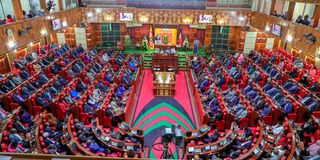
The government hopes of recovering at least Sh115 billion suspected to have been lost through various questionable dealings hangs in the balance after the National Assembly went quiet on investigations that would have helped trace the billions.
The Sh62.9 billion suspected to have been lost in revenue through the misdeclaration of imported edible palm oil at the port of Mombasa, tops the list of the high octane investigations into possible loss of public funds that the committees of the National Assembly have sat on.
The Sh21 billion fictitious claims probe at the Social Health Authority (SHA), previously National Health Insurance Fund (NHIF), the National Social Security Fund (NSSF) involvement in questionable treasury bonds worth Sh12 billion also form part of the investigations MPs have abandoned.
There is also the Sh15 billion probe in doubtful VAT exemptions granted to 14 local manufacturing companies, the multibillion shilling Kenya’s bank notes printing deal and the dubious E-citizen consultancy agreement that have faded out quietly.
This is notwithstanding the questionable dealings at the Kenya Bureau of Standards (KeBS) involving multibillion shilling Pre-Export Verification Conformity (PVOC) tender for the year 2025-28, awarded to Japanese firm- Quality Inspection Services Inc. Japan (QISJ).
KeBS is also at the centre of the Sh420 million lost in revenue through forgery and falsification of documents.
Members of the Finance and National Planning Committee of the National Assembly that is investigating the edible oil scandal, NSSF irregular bond trade, questionable VAT exemptions to 14 local manufacturing companies and the bank notes printing scam have complained of frustrations from the National Treasury.
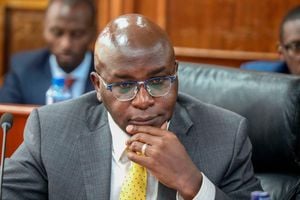
Molo MP Kuria Kimani who identified National Treasury Cabinet Secretary John Mbadi as the biggest impediment to the committee’s discharge of its mandate, wondered why the CS “is always available for Senate committees yet he has no time for this committee that oversees his ministry.”
National Assembly Finance and National Planning Committee chairperson Kuria Kimani.
Photo credit: File | Nation Media Group
“We are disappointed with the National Treasury because it is making the committee unable to discharge its mandate. We have so many matters pending before the committee yet we cannot move,” said Mr Kimani as his committee members also weighed in.
“This committee has lost meaning,” says Mr John Ariko, the Turkana South MP as his Kitui Rural colleague David Mwalika noted; “it is disheartening to start an investigation on a matter then it disappears because some people cannot honour the committee’s summons.”
The MPs’ frustrations point to the possible loss of the billions that the government dearly needs to finance its operations.
More than a year since the Kuria Kimani-led committee launched investigations into the questionable misdeclaration of edible palm oil, not even the National Treasury has honoured invitations.
On September 24, 2024, Kenya Revenue Authority (KRA) Commissioner-General Mr Humphrey Wattanga appeared before the committee but was thrown out for failing to present documents to the committee in good time.
Kenya Revenue Authority Commissioner General Humphrey Wattanga Mulongo.
Photo credit: File | Nation Media Group
Ever since, requests for his appearance have been frustrated by either his refusal to honour invitations or requests for more time that seemingly, never comes.
The Parliamentary Budget Office (PBO) documents presented to the Finance and National Planning Committee, show that the misdeclaration of the palm oil is done in two ways to evade paying the required import duty at the port of Mombasa.
This includes blending 60 percent crude palm oil with 40 percent refined palm olein and declaring the entire shipment at the port of Mombasa as crude palm oil “allowing them to avoid paying import duties altogether.”
Other than KRA, the Finance Committee had listed State agencies- Kenya bureau of Standards (KeBS), Government Chemist, AFFA, and Kenya Ports Authority (KPA) and Intertek, a private laboratory for questioning.
Also lined up for interrogation were consignees- Vipingo, Mazeras, ACEE, Mvita oils, LDC Kenya, LDC PTA Asia and the National Treasury.
By misdeclaring refined palm oil as crude palm in Kenya, importers not only save on the export tax but also evade the 35 percent import duty.
Blending refined and crude palm oil reduces local processing costs, further benefiting the importers.
Further blending 40 percent refined palm oil with 60 percent crude palm oil in the same ship tanks, violates the World Customs Organization guidelines, which provide that any adulterated cargo cannot be classified as crude palm oil, meaning that duties should apply to the entire shipment.
The illegal blending benefits the exporters who save USD28 per ton when shipping the cargo from Indonesia and Malaysia.
The Sh21 billion fictitious Incurred But Not Reported (IBNR) claims at the defunct NHIF arose from a petition that was filed in the National Assembly on October 30, 2023.
The petition would later be committed to the Public Petitions Committee by Speaker Wetang’ula on December 6, 2023.
Speaker of the National Assembly Moses Wetang’ula at the Chambers on April 26, 2023.
Photo credit: Dennis Onsongo | Nation Media Group
Under the Standing Order 227 of the National Assembly, the matter ought to have been concluded within 90 days through a report to the House.
However, two years down the line, the committee is nowhere near conclusion having heard only from the petitioner- Mr Bernard Muchere, a former Internal Auditor at the National Treasury and currently a Fraud Risk Assessment Consultant.
Mr Muchere appeared before the committee on September 10, 2024, almost a year since he filed the petition.
“I did my part as a citizen of this country to petition parliament on a matter of public concern. The MPs’ work on the matter is well cut out. I will be happy to see it concluded,” said Mr Muchere.
However, with the petition having been overtaken by the timelines provided in the Standing Orders, city lawyer David Ochami says that any report that the committee may generate from the probe can easily be challenged in court.
Delayed investigations in parliament
“It is a waste of taxpayers’ resources for the committee to continue hearing the matter. The committee has already overshot the timelines provided in the House rules meaning that the report it will generate can be challenged, rendering the whole thing a wasted time, effort and resources,” said Mr Ochami.
Mr Muchere had wanted the Committee to summon the Ministry of Health, National Treasury, the board of the defunct NHIF, now SHA to respond to the matter.
The irregular payment, Mr Muchere says, “caused a major crisis in the contributors’ medical coverage resulting in most patients being denied treatment with vital consequences.”
“This is a matter that ought to have been addressed in time to safeguard public funds from theft. But with the delayed investigations in parliament, who knows how many such scams have happened?” posed Mr Muchere.
IBNR is a type of reserve account used in the insurance industry as the provision for claims or events that have transpired but have not yet been reported to an insurance company.
IBNR is therefore used by insurance companies, “particularly along the eastern Gulf Coast of the United States where Hurricanes and other natural disasters are common.”
Mr Muchere claims that upon undertaking a fraud examination on NHIF financial statements, he established that during the preparation of financial statements for the 2021/22 financial year, the NHIF management “fraudulently created IBNR claims aggregating to over Sh21 billion.”
The creation, he says, was done and backdated to the 2019/2020 and the previous financial years.
“The facts enumerated in the petition provide proof that IBNR claims were deliberately created to siphon out NHIF funds,” Mr Muchere said as he urged parliament to establish whether the Health Cabinet Secretary approved the ineligible claims.
The petitioner reveals that the unbudgeted claims were then charged to the NHIF members’ contributory schemes like Health Insurance Subsidy Programmes for Orphans and Vulnerable Children, and the poor, Older Persons and Persons with Severe Disability (HISP- OVCs and OPPSD).
The dubious payments include Sh9.7 billion being proceeds from the National Health Scheme, Sh4.01 billion from National Police Service (NPS) and Kenya Prisons Service (KPS), Sh2.9 billion from civil servants’ scheme, Sh2.3 billion meant for Linda Mama program and Sh780.7 million from parastatal scheme.
The others include Sh683.92 million from EduAfya scheme, Sh525.3 million from county scheme, Sh190.2 million being proceeds from retirees’ scheme, Sh31.3 million from HISP- OVCs and Sh6.5 million from HISP- OPPSD.
In 2014, the government, through NHIF, rolled out HISP to cushion OVCs and OPPSDs through a cash transfer programme under the State Department for Social Protection.
What should have been of interest to the Public Petitions Committee is that in the audited NHIF financial statements for the 2020/21, 2019/20 and the preceding financial years, IBNR reserves were non-existent and only “propped up in the financial year ending June 30, 2022.”
The petitioner claims that he established that the audited financial statements for the financial year ended June 2021 was deceitfully restated.
The National Social Security Fund (NSSF) involvement in questionable treasury bonds may have seen the country lose over Sh12 billion after it emerged that they were procured at a premium price but sold cheaply.
The irregular transaction, which has been flagged by Auditor-General Nancy Gathungu on the audited accounts of NSSF for the financial year 2023/24, saw the Finance Committee question whether the transaction was prudent use of public resources.
Auditor-General Nancy Gathungu.
Photo credit: File | Nation Media Group
However, its attempts to investigate the matter never moved as NSSF is yet to appear before it since the Central Bank of Kenya (CBK) raised alarm in its August 19, 2024 letter to Mr Wyckliffe Shamiah, the CEO of Capital Markets Authority (CMA), the industry regulator.
The audit report shows that the schedule of Treasury bond purchases, sales and redemption and bank statements shows that the bonds purchased at a nominal value of Sh5.2 billion were sold for Sh4.32 billion contrary to the 2020 Fund Investment Policy Statement, 2020.
Section 2.1 of the Fund Investment Policy Statement, 2020 states that the board has a responsibility to invest the NSSF assets in a responsible and prudent manner.
The irregular bond transaction was traced to the NSSF CSD accounts and those of Mr Humphrey Wachira Gichuru and Pergamon Investment Bank Ltd.
NSSF’s CSD accounts involved in the trade are 114813-0004 and 142816-0004 with Mr Wachira’s CSD accounts 234783-0004 and 265560-0004 and Pergamon bank’s CSD accounts 245351-0004, 207255-0004 and 245221-0004.
The probe into the Sh15 billion questionable VAT exemptions granted to 14 local manufacturing companies was triggered by leader of majority Kimani Ichung’wah in April this year.
National Assembly Majority Leader Kimani Ichung’wah.
Photo credit: File| Nation Media Group
The Finance and National Planning Committee launched the investigations to establish whether the companies merited the exemptions.
This came as it emerged that the companies, with a claimed cumulative capital investment of Sh93.53 billion may be forced to pay back the exemptions granted “outside the law.”
Alego Usonga MP Samuel Atandi, Budget and Appropriations Committee (BAC) chairman, quoting the Parliamentary Budget Office (PBO), a technical body that advices parliament and its committees on fiscal matters, warned that tax exemptions have seen the country lose over Sh300 billion in the current financial year.
“It will be bad if we continue to do the same knowing very well that we are unable to raise revenues. We are projecting to raise Sh2.8 trillion in ordinary revenue in the 2025/26 financial year. We will never achieve this with these exemptions,” said Mr Atandi.
In September 2024, the Finance Committee launched investigations over how the multibillion shilling bank notes printing deal was awarded to a German firm.
The committee went ahead to demand that Central Bank of Kenya (CBK) Governor Dr Kamau Thugge furnishes it with certified documentation regarding how it hired a German company- Ms Giesecke+Devriet Currency Technologies GmbH (G=D)- in a multibillion shilling deal to print Kenya’s new currency notes.
Central Bank of Kenya (CBK) Governor Kamau Thugge.
Photo credit: Dennis Onsongo | Nation Media Group
Other than appearing before the committee once and seeking an extension, a year down the line, Dr Thugge is yet to appear before the committee despite numerous invitations.
The probe by the Trade, Industry and Cooperatives Committee into the irregular importation of accident vehicles sold to unsuspecting Kenyans flopped after Kenya Bureau of Standards (KeBS) Managing Director Esther Ngari declined to honour committee invitations.
The committee wanted Ms Ngari to explain how the multibillion shilling Pre-Export Verification Conformity (PVOC) tender for the year 2025-28, awarded to Japanese firm- Quality Inspection Services Inc. Japan (QISJ), was procured.
The loopholes in the E-citizen consultancy agreement scandal is another botched investigation by the Administration and Internal Affairs Committee.
The agreement for the government's E-payment system handles hundreds of millions of shillings on a daily basis being payment from Kenyans for services offered by the government but it is signed by a junior officer representing the government and the suppliers on the other side.
Conspicuously missing on the contract presented to parliament, is the signature of the Attorney-General, the government’s chief legal advisor.