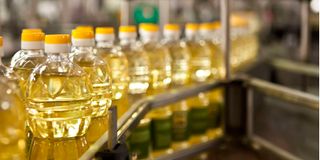
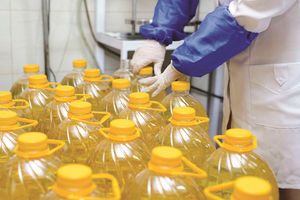
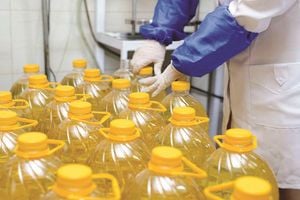
Taxpayers will part with Sh1.7 billion to pay firms involved in the controversial import of edible oils and rice, after Parliament sneaked the provision into the National Treasury’s mini budget before breaking for a 10-day recess last Thursday.
MPs approved the fresh allocation proposed by the National Assembly’s Liaison Committee, which allowed for release of Sh1.7 billion to the Kenya National Trading Corporation (KNTC), whose former CEO Pamela Mutua is among bureaucrats facing charges over the 2022 edible oils and rice import scheme.
The Sh1.7 billion allocation was not part of the mini budget that the National Treasury submitted to the MPs.
“Increase Sh1.7 billion (recurrent) to KNTC for financial obligation from edible and rice importation,” reads the report from the Liaison Committee which was eventually approved by the legislators.
The committee did not, in its report, justify the payments.
Gladys Boss Shollei, the chairperson of the Liaison Committee, did not pick our calls or respond to text messages asking for the basis of the payments amid investigations into the import scheme.
The allocation to the State-owned Kenya National Trading Corporation (KNTC) is contained in the second supplementary budget for the Financial Year ending June.
Parliament’s decision to pay the firms comes as it emerges in court proceedings that some well-connected suppliers lobbied State House to facilitate faster settlement of their dues, running into billions of shillings.
The import scheme — aimed at stabilizing consumer prices — saw well-connected dealers import critical commodities including rice, edible oils, beans and fertilizer duty-free.
The scheme, which started in January 2023, was valued at Sh17 billion.
As it emerged that taxpayers stood to lose billions as KNTC could not find takers of the edible oil, which was alleged to be of poor quality, President William Ruto ordered investigations into the finances of government officials that were implicated in the scandal.
The award of the tenders to the politically-exposed dealers was done through an opaque single-sourced tendering process raising suspicions of favoritism and corruption.
Questions were also raised about how funds were managed by KNTC, with the former KNTC Managing Director Pamela Nduku Mutua and Supply Chain Manager Amos Juma Sikuku being charged in court for mismanagement.
There were reports of overpayments to suppliers, discrepancies in exchange rate calculations, and potential losses of billions of Kenyan shillings.
KNTC managing director Lucy Anangwe testified in court last month that Purma Holdings, associated with Communications Authority of Kenya Board chairperson Mary Wambui Mungai, was paid Sh3.9 billion for rice valued at Sh3.1 billion.
At the time of the import scheme, Ms Mungai was the sole owner and director of Purma Holdings, with 1,300 shares.
The company was incorporated on February 13, 1996.
Purma Holdings was one of four companies associated with Ms Mungai which were awarded supply contracts by the KNTC in 2022 – just months before the Office of the Director of Public Prosecutions dropped a Sh2.2 billion tax evasion case against the firm and its owner.
Aside from the rice, Purma Holdings was also contracted for the supply of edible oil worth Sh2.5 billion, and beans worth Sh3.4 billion.
Charma Holdings, registered to Ms Mungai’s close aide Ruth Waithira Kinyanjui, got a contract for the supply of edible oil worth Sh1.95 billion.
The company was incorporated on July 31, 2007 and Ms Kinyanjui held 3,600 shares at the time it dealt with the KNTC.
Evertec General Trading Company Ltd got a contract for the supply of edible oil worth Sh984 million.
At the time of getting the contract, the firm was registered to George Maina Wanjohi, another close aide of the Communications Authority Board chairperson.
Evertec General Trading Company Ltd was incorporated on April 10, 2008.
It was also mentioned in the Sh2.2 billion tax evasion case against Ms Mungai, and which the ODPP dropped in January, 2023.
Enterprise Supplies Ltd, where Ms Mungai was listed as the sole shareholder at the time of being awarded a contract by KNTC, supplied edible oil worth Sh984 million.
The company was incorporated on January 13, 2010.
The money has been given to the State-owned Kenya National Trade Corporation (KNTC), which had been allowed to import these products duty-free in a plan to bring down the sky-high consumer prices.
When the Kenya Kwanza administration rose to power towards the end of 2022, it found sky-high inflation due to a crippling drought that would see consumer prices touch a five-year high of 9.6 percent in October of the same year.
Dr Ruto’s government quickly crafted a plan to bring down the high prices of household goods including cooking oil and maize flour by allowing KNTC to import foodstuff valued at Sh17 billion duty-free.
But there were complaints from local manufacturers that allowing duty-free import of cooking oil would hurt them.
In the 1970s and ‘80s, when importation and distribution of rice, maize, soap, shampoo, batteries, sweets, insecticides, hardware, cement, wire and tools were restricted to citizen traders and wholesalers, it was the KNTC that bought these items and distributed them to agents selected by the government.
Dr Ruto, however, pressed on with the plan to import rice, beans and edible oils to bring prices down, and fertiliser to help subsidise the food production process.
KNTC contracted four UAE-based companies – Lamar Commodity Trading DMCC, Multi Commerce FZC, Lone Trading FZE and Invest Africa FZCO – to import fertiliser, edible oil and rice.
Invest Africa did the KNTC deals through a local subsidiary, Shehena Commodity Ltd. It imported, and then sold to the KNTC, edible oil worth Sh1.2 billion.
The firm is the only shareholder of Emerging Capital Holdings, which is the beneficial owner of Smith & Gold Productions Ltd.
Smith & Gold Productions is the company Mr Kuria used to successfully bid for a tender to construct Kararu Stadium in Kiambu County. The project remains incomplete, despite Smith & Gold receiving Sh102 million from taxpayers.
A Parliamentary report in 2020 showed that Smith & Gold had not done work worth the money it received.
Lamar Commodity Trading has a local subsidiary by the same name, registered on July 20, 2018.
Three Kenyans – Abdi Mohamed Abdi, Kenneth Dedan Kimathi, and Antony Kimeu Muindi– are listed as shareholders of Lamar Commodity Trading (Kenya) Ltd.
Lamar imported 30,000 tonnes of NPK fertiliser and sold it to the KNTC.
Multi Commerce FZC sold edible oil worth $59.17 million (Sh8.3 billion) to the KNTC, alongside 10,000 tonnes of rice. The firm is registered in Dubai but has no local subsidiary.
Lone Trading FZE sold edible oil worth $50.7 million (Sh7.1 billion), and 52,500 tonnes of rice.