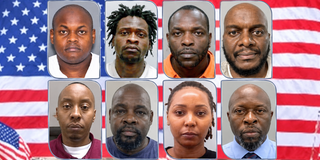
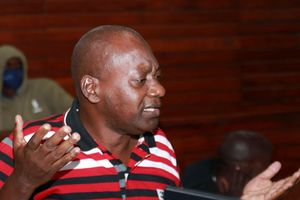
John Muyeka’s criminal operation spanned 10 American states, where he and his accomplices used fraudulent cheques, stolen identities, and counterfeit driving licences to obtain more than $2 million (about Sh259 million) in merchandise from retailers.
For more than three years, between December 2013 and February 2017, the Kenyan was involved in a scheme targeting home improvement stores, acquiring expensive items such as air conditioners and hardwood flooring using fictitious identities backed by fake identification documents.
John Muyeka.
Photo credit: Pool
The operation exploited weaknesses in retailers’ payment and credit systems. The conspirators presented cheques bearing false names but authentic bank account and routing numbers. In other transactions, they posed as authorised signatories on store credit accounts opened using fraudulent cheques.
Muyeka, 44, who lived in Sayreville, New Jersey, played a central role in the identity-forgery operation. He used aliases, including John Murunga and Daniel Okwiri, and manufactured counterfeit driving licences to support the false identities used in the transactions.
The merchandise was obtained from retailers in New Jersey, New York, Pennsylvania, Delaware, North Carolina, Georgia, Virginia, Connecticut, Massachusetts and South Carolina.
The scheme eventually brought Muyeka before a federal court in Newark, New Jersey, where he pleaded guilty in 2019 to one count of misprision of a felony, an offence that carried a maximum potential penalty of three years in prison and a $250,000 fine (Sh32.4million), according to the US Department of Justice.
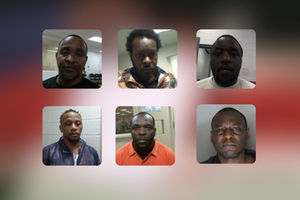
Muyeka is among 52 Kenyans appearing on records of the US Department of Homeland Security’s (DHS) “Worst of the Worst” initiative, a database maintained by US Immigration and Customs Enforcement (ICE) to publicise immigration arrests involving people with criminal histories.
The Kenyan entries feature a range of offences, including homicide, rape, sexual crimes, robbery, assault, drug trafficking, fraud, cheque forgery and money laundering.
Among those listed is Osbert Owuor, whose record includes homicide involving a firearm and a weapons offence. His entry is associated with Hawthorne, California.
Jackson Gichema is listed in connection with rape and other sexual offences, with Hagerstown, Maryland, recorded as the location associated with his arrest.
Jackson Kabut Gichema, the Kenyan national who was convicted of rape in Baltimore County, Maryland.
Photo credit: Pool
Bilali Wanjau Mohamed appears in connection with drug trafficking and cocaine distribution, with Conroe, Texas, listed as his arrest location. Collins Keanche is associated with Saint Cloud, Minnesota, in a case involving cheque forgery and money laundering.
The list also includes Adan Abdikadir, whose record lists burglary and assault, with Wartburg, Tennessee, recorded as his arrest location. Winrose Ndichu is associated with money laundering, and the records list Bruceton Mills, West Virginia, as the location.
Winrose Ndichu.
Photo credit: Pool
Another Kenyan, Newton Githiri, appears in connection with a sexual offence. The official ICE website identifies him as Newton Njuguna Githri and says he was arrested in New Orleans on August 25, 2025. ICE states that he had been convicted of sexually abusing a child and burglary in Jefferson County, Alabama.
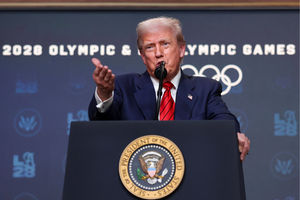
The cases place the Kenyans among thousands of people whose criminal histories are being publicised as the Trump administration intensifies immigration enforcement during the US president’s second term.
The “Worst of the Worst” website was launched on December 8, 2025, as part of the administration’s campaign to highlight people arrested by ICE. DHS says the database allows the public to search profiles of people arrested across the United States, with entries covering offences including homicide, sexual assault, drug trafficking, kidnapping, assault and burglary. By September 30, 2026, the department said the website contained more than 40,000 profiles.
The initiative forms part of President Donald Trump’s broader immigration crackdown, which has prioritised arrests, detention and deportation of non-US citizens. ICE has expanded enforcement operations, while the administration has tightened visa screening and increased scrutiny of applicants’ backgrounds and social media activity.
For people featured on the website, the consequences can extend beyond their criminal cases. ICE uses immigration enforcement powers to detain non-citizens and pursue their removal from the country where the applicable legal requirements are met. Depending on the circumstances, an individual may face immigration proceedings after serving a criminal sentence or may be taken into immigration custody while removal arrangements are pursued.
Newton Githiri.
Photo credit: Pool
The ICE website describes those featured as people who have been convicted of or accused of serious crimes and who are either in immigration custody or have already been removed from the United States. The profiles provide details of the individuals, their recorded criminal histories and the locations associated with their arrests.
Earlier this week, State Department spokesperson Tommy Pigott said more than 300,000 visas had been revoked during Trump’s second term, describing the pace as unprecedented.
From left: Ian Mwangi Irungu, Newton Njuguna Githiri, Said Salat Yarow and Mohamed Chekchekani.
Photo credit: Pool
“With over 300,000 revocations, the Trump administration has revoked more visas at a faster pace than any administration in history. We are taking, and will continue to take, action to keep our borders, and our nation, secure,” Pigott said.
He added: “Every visa decision is a national security decision, and that standard doesn’t stop once a visa is issued. If someone breaks the law or threatens our national security, that’s grounds for visa revocation.”
Pigott also said the government was examining social media links as part of efforts to ensure visa applicants were fully vetted. The administration has maintained that these measures are intended to protect national security and enforce immigration laws.
Visa revocation and deportation are distinct actions. Revoking a visa affects a person’s authorisation to travel to or seek entry into the United States, while deportation involves the removal of a non-citizen under immigration law. The figure of more than 300,000 visa revocations, however, is separate from the number of people featured on the “Worst of the Worst” website.
The crackdown has placed criminal histories at the centre of the administration’s approach to immigration enforcement, with ICE using arrests and removals to demonstrate its efforts to implement the president’s policies.