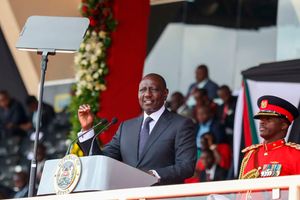
President William Ruto delivers his speech during Madaraka Day Celebrations at Masinde Muliro Stadium in Kanduyi, Bungoma County.

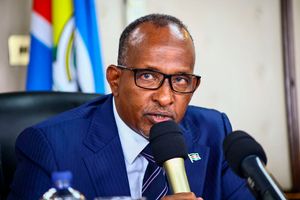
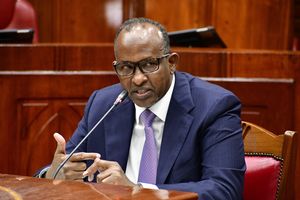
The High Court has temporarily suspended a committee appointed by Health CS Aden Duale to verify pending claims at the National Health Insurance Fund (NHIF).
Four petitioners led by Dr Magare Gikenyi challenged the NHIF pending medical claims verification committee, arguing that the move was a usurpation of the roles of the Auditor General.
The NHIF has since been replaced by the Social Health Insurance Fund (SHIF), although a case challenging the replacement is pending in court.
While naming the 19-member committee on March 28, chaired by Mr James Msairo Ojee, Mr Duale said the team would scrutinise and audit NHIF claims from July 2022 to September 2024.
The petitioners said the move appeared to raise questions about the constitutional mandate of the Auditor-General.
Justice Reuben Nyakundi said public interest lies in ensuring that both the important work of improving healthcare administration and the equally important adherence to constitutional principles receive proper consideration.
“A temporary pause through conservatory orders achieves this balance. On the face of it, there are competing interests and rights as between the public and the health sector-wide institutions which had signed Service Level Agreements with the defunct National Hospital Insurance Fund,” said the judge.
The case will be heard on June 2.
Judge Nyakundi said the privacy concerns raised by the petitioners regarding the handling of sensitive medical records “present temporal considerations that cannot be overlooked”.
He said the matters touch on rights that, once compromised, cannot be fully restored.
Dr Gikenyi and his co-petitioners challenged the committee, arguing that it was named without any proper legal or constitutional foundation.
The medic said the establishment of the team was a mere roadside declaration that lacked specific authorising legislation.
He maintained that the sovereign power to audit and verify public funds was explicitly delegated to the Auditor-General, not to ad hoc appointees of a cabinet secretary.
The petitioners further said there was no public participation, either in setting the terms of reference of the committee or appointment of its members, as required by law.
It was their argument that the CS does not have constitutional authority to recruit staff for the office of the Auditor-General, let alone hand-pick persons to serve in or act as staff of the Auditor-General.
“The appointment of the 19 persons to carry out a function exclusively reserved to the office of the Auditor-General and its staff, is a violation of Article 252(1)(c) of the Constitution,” he said in an affidavit.
Dr Gikenyi added that duplicating roles is a waste of scarce public resources since the task force would essentially be performing the roles of existing public offices.
He further stated that the gazette notice made no provisions for any remuneration or benefits of the persons appointed out of public funds.
The omission, he said, provides reasonable grounds to believe the persons serving on the committee are there to fulfil the private interests of unknown persons and not serve the people of Kenya in accordance with the constitution and the law.
Attorney General Dorcas Oduor defended the committee, saying it had no coercive or decision-making authority, but an internal advisory body constituted to assist the Ministry in addressing performance, compliance, and operational challenges in the health sector.
Its role does not encroach upon the mandate of the Auditor-General, Ms Oduor submitted.
Further, the A-G said the petitioners did not identify any legal provision that the CS Duale contravened in the process of picking the committee and that the allegations were general, speculative, and unsupported by evidence.
According to the A-G, the committee was established as a matter of urgency to address critical governance, financial, and performance issues in the health sector.
“The committee addresses urgent and sensitive issues affecting the management and oversight of health institutions and public resources. Halting the process midstream would obstruct critical institutional reforms and risk loss of public funds or deterioration of service delivery,” the A-G submitted.