Share information to fight misinformation, State told
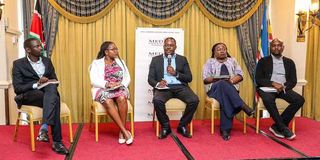
From left: Office of Registrar of Political Parties Corporate Communications Deputy Director Mutethia Mbeeria, Commission on Administrative Justice Access to information Officer Joyce Kihara, Political Journalists Association of Kenya Chairperson Rawlings Jerry, Aga Khan University Graduate School of Media and Communications Dean Prof. Nancy Booker and Kenya Editors Guild Council member Kenfrey Kiberenge in a panel discussion.
Kenyan media practitioners have called for government agencies to close gaps in access to official information, warning that delays and lack of authoritative records could fuel misinformation and disinformation ahead of the 2027 General Election.
The call was made on Monday during a ceremony to mark the International Day for Universal Access to Information hosted by the Media Council of Kenya (MCK) and the Commission on Administrative Justice (CAJ).
The event, held under the theme “Upholding Information Integrity in the Digital Age: The Role of Access to Information in Addressing Information Disorder,” brought together journalists, media owners, government representatives, civil society organisations, academics and development partners.


Participants discussed the role of access to information in combating disinformation and strengthening information integrity, particularly during election periods.
Kenya Editors Guild President Zubeida Kananu said timely access to credible official information was essential in preventing information vacuums.
“When credible information is missing, delayed or difficult to access, we create an information vacuum. And in today’s digital world, an information vacuum does not remain empty for long. Someone fills it. And during an election, that becomes even more serious. You cannot fight misinformation by withholding information,” she said.
Katiba Institute Executive Director Nora Mbagathi said access to public records was critical for citizens to participate in governance and hold public officials accountable.
“Access to information is a right, not a favour. When we ask for information, we are exercising a right firmly enshrined in our Constitution. We need that access to take part in public participation, to hold those in power accountable and to keep government transparent,” she said.
From left: Office of Registrar of Political Parties Corporate Communications Deputy Director Mutethia Mbeeria, Commission on Administrative Justice Access to information Officer Joyce Kihara, Political Journalists Association of Kenya Chairperson Rawlings Jerry, Aga Khan University Graduate School of Media and Communications Dean Prof. Nancy Booker and Kenya Editors Guild Council member Kenfrey Kiberenge in a panel discussion.
Kenya Union of Journalists Secretary-General Eric Oduor urged media organisations to invest in rigorous verification as audiences increasingly confront unverified information.
He challenged media houses to invest in journalism that audiences can trust and rely on amid the growing volume of information circulating online.
On his part, MCK board chairperson Maina Muiruri said artificial intelligence, emerging technologies and user-generated content had forced the council to revise the Code of Conduct for Media Practice.
“The tools reshaping our information space carry new ethical responsibilities,” Mr Muiruri said.
CAJ Chairperson Charles Dulo said access to primary records would become increasingly important as the country approaches the 2027 elections.
“Citizens need credible information to understand the electoral process, assess public issues and participate meaningfully,” Mr Dulo said, adding that journalists need access to primary records and authoritative sources to investigate claims and provide evidence-based reporting.
Also Read: Deepfakes, hashtags and hate: The 2025 online disinformation threatening Kenya’s 2027 polls
Participants called for stronger cooperation among government agencies, the media and other stakeholders to improve access to official information and strengthen public trust.
Follow our WhatsApp channel for breaking news updates and more stories like this.