The Independent Electoral and Boundaries Commission (IEBC) is facing a three-front battle that has placed hurdles in its race against time to adequately prepare for the 2027 General Election.
From a Sh33 billion funding shortfall and a bruising legal contest over the National Tallying Centre to a fresh push in Parliament to curtail some of its powers, the electoral agency finds itself in a tight spot in its quest to deliver credible and verifiable elections.
With the clock fast ticking towards the August 10, 2027, poll date, the financial strain is already visible in the commission’s preparations.
Documents tabled before the Justice and Legal Affairs Committee indicate that IEBC requested Sh74.8 billion across a three-year electoral cycle but has only been allocated Sh41.3 billion, resulting in a Sh33.5 billion funding deficit.
The budget shortfall, according to the document, will mainly affect payment of wages to election officials, which requires Sh7.63 billion in funding.
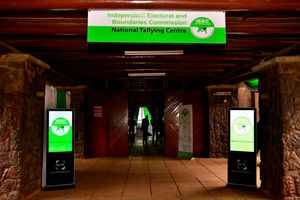
Bomas of Kenya, which was the Independent Electoral and Boundaries Commission's national tallying centre in the 2022 General Election.
Photo credit: File | Nation Media Group
The commission has also accumulated pending bills to the tune of Sh5.75 billion, largely in legal fees arising from the previous elections.
The electoral agency, according to documents before the House, requires at least Sh10.7 billion to acquire new Kenya Integrated Election Management System (KIEMS) kits as well as replace obsolete ones.
The KIEMS kits were procured in 2017 for the 2017 General Election and, with the general rule that technology becomes obsolete after 10 years, it means that, to ensure the credibility of the 2027 General Election, the commission has no choice but to procure new election gadgets.
This means that only the 14,000 KIEMS kits purchased in 2022 will be retained for use. KIEMS kits have a biometric voter registration system that is used to electronically capture voters’ facial images, fingerprints and civil data, which are used to verify voters’ identities and curb impersonation.
Commenting on the budget for the elections in his recent interview with the Nation, IEBC chairman Erastus Ethekon said the commission would continue engaging Parliament on the resources required.
“An election covering the entire Republic and millions of voters is necessarily a substantial national undertaking. We must distinguish between expenditure that is necessary to safeguard electoral integrity and expenditure that can reasonably be reduced. The Commission is not asking for a blank cheque, we are asking for the resources necessary to conduct the election that the Constitution demands,” Mr Ethekon said.
The electoral agency told the National Assembly during its fourth retreat in Naivasha that activities such as voter education and civic awareness, particularly for special interest groups, as well as legal and regulatory reforms, risk being affected by the funding gaps.
Other activities that will also be affected include strategic communication and countering misinformation, stakeholder engagement and dispute prevention, election security preparedness, staff training, welfare and logistics, procurement of election materials and settlement of legal bills.
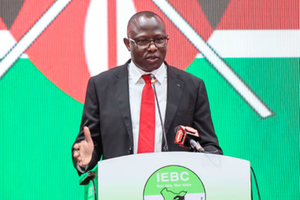
The Independent Electoral and Boundaries Commission Chairperson Erastus Ethekon briefs the media in Nairobi on April 30, 2026.
Photo credit: Francis Nderitu | Nation Media Group
“The current funding gap limits the commission’s ability to implement these interlinked activities effectively. Collectively, these constraints elevate operational, reputational, and security risks and undermine the constitutional principles under Articles 10 and 81 of the Constitution,” Mr Ethekon told MPs.
On Friday, Wiper Patriotic Front leader Kalonzo Musyoka warned the commission that the high cost of conducting the 2027 elections risks subverting the will of the people.
“IEBC itself puts the cost of the 2027 General Elections at Sh63.95 billion. We cannot spend such an enormous sum preparing for an election while serious constitutional questions remain unresolved,” Mr Musyoka said.
“My message to IEBC is simple: Do not subvert the wishes of the majority of Kenyans. We must protect the election before Kenyans vote — not litigate its credibility after the results are declared,” he added.
Adequate funding of the electoral agency is among the agenda that MPs will give priority to as the National Assembly resumes its sittings on Tuesday next week after a one-month recess.
Due to the tight schedule ahead of the 2027 polls, the lawmakers are also expected to start consideration of the 2027/2028 Budget and attendant legislation before they break next year in June, ahead of the 2027 General Election.
The timely consideration of the 2027/28 Budget is set to provide adequate resources to the Independent Electoral and Boundaries Commission (IEBC) to conduct the August General Election.
The provision of funds to IEBC by the House will allow the electoral agency to procure all election-related materials on time.
The Chairperson of the Independent Electoral and Boundaries Commission (IEBC) Erastus Edung Ethekon (left) with his deputy Fahima Araphat Abdallah and other delegates during the launch of the IEBC Strategic Plan 2024–2029 and Election Operations Plan 2025–2027 at the Kenyatta International Convention Centre (KICC) in Nairobi on June 24, 2026.
Photo credit: Wilfred Nyangaresi | Nation Media Group
To this end, the lawmakers are expected to fast-track the submission of the Budget Policy Statement (BPS) by the National Treasury and conclude its consideration by the first week of December before the House breaks again for the December recess period.
In addition, the National Assembly is also expected to consider and pass the Division of Revenue Bill by the first week of December 2026.
In order to accomplish consideration of the two key Bills, MPs will resume their sittings in the last week of January next year, which is a month earlier than in their usual previous calendar.
The earlier resumption of the lawmakers will allow the House to consider and pass the Budget Estimates, and the Appropriation and Finance Bills before the end of March 2027.
“The Liaison Committee, which brings together all the Chairpersons of Committees of the National Assembly, held a retreat which underscored the need for timely consideration and conclusion of all pending priority business as the country gears up for the general election,” reads a dispatch from the National Assembly.
The funding dispute comes as the commission faces an equally consequential battle over the National Tallying Centre.
On Tuesday, the commission got a reprieve after the High Court upheld the legality of the national tallying and verification of the presidential election results.
The court ruled that IEBC is constitutionally mandated to tally and verify presidential results at the national level in order to determine whether a candidate has met the threshold for election as President.
The commission’s role was challenged through a petition filed by Busia Senator Okiya Omtatah and opposition leaders led by Kalonzo Musyoka, Rigathi Gachagua and Fred Matiang’i.
DCP party leader Rigathi Gachagua, Jubilee deputy party leader Fred Matiang’i, Wiper Party leader Kalonzo Musyoka and DAP-Kenya’s Eugene Wamalwa during a press briefing at the SKM Centre, Nairobi, on the opposition’s alternative budget proposals and key economic priorities.
Photo credit: File | Nation Media Group
The opposition leaders moved to court challenging the legality of the National Tallying Centre and further verification of presidential results.
According to the petitioners, the presidential results declared and certified by constituency returning officers are final and, therefore, IEBC should not re-tally, re-verify or subject them to any alteration.
However, despite the High Court relief for the electoral agency, the commission is not yet out of the woods as the battle now heads to the Court of Appeal, where the petitioners have vowed to appeal the ruling.
Even before the dust has settled on that ruling, the commission is facing the same battle in Parliament, as Suba South MP Caroli Omondi and the People’s Coalition on Electoral Reforms are preparing to take the fight to abolish the tallying centre to the House.
Mr Omondi, a first-term lawmaker, has hinted at sponsoring an Elections Amendment Bill seeking to abolish the National Tallying Centre and limit the IEBC chairperson to aggregating and announcing presidential results received from constituency returning officers.
The coalition says it will push the amendments through Parliament and return to court if the proposals are rejected.
A senior parliamentary official told the Saturday Nation that they are yet to receive any such proposal, but once it comes, it will be subjected to the normal legal procedure before it is published as a Bill.
“For now I’m just getting the proposal from you, we don’t have anything official from our end. Once it comes, the normal process of publishing and consideration of a Bill will follow,” the officer said.
The National Assembly will resume its sittings next week, and it will be seen if Mr Omondi will proceed with his proposed amendments.