Two meetings called to resolve the impasse on the planned recruitment of 10,000 police officers have failed to bear fruit, even as President William Ruto directed speedy resolution of the dispute.
The first meeting with the President was held at State House, Mombasa on Friday and was attended by Inspector-General of Police Douglas Kanja and one of his deputies, Eliud Lagat. A full meeting of the National Police Service Commission (NPSC) that followed the State House talks also failed to break the deadlock after crisis talks at the Kenya School of Government in Mombasa.
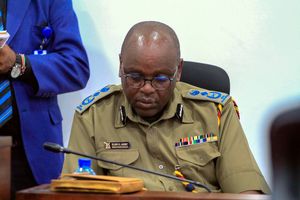
Inspector-General of Police Douglas Kanja.
Photo credit: File | Nation Media Group
A technical committee comprising police bosses and officials from the NPSC has been constituted to look into the “technical issues” that have derailed the rollout of the police recruitment.
Initially, the government had planned to recruit the new police officers by the first week of this month and admit the successful candidates to the police college for training by October 1.
But a disagreement between the civilian commissioners of the NPSC and the uniformed ones led by Mr Kanja and his two deputies has derailed the exercise.
On Friday night, the stalled police recruitment was the subject of a lengthy discussion between the President—who was in Mombasa to open the Agricultural Society of Kenya show—and the police bosses, sources told the Nation . The meeting started at around 10pm and went on past midnight.
Sources told the Nation an agitated President Ruto demanded answers from the police chiefs on why the recruitment had failed to take place as planned.
Deputy Inspector-General of Police Eliud Lagat.
Photo credit: File
During the passing-out ceremony at the National Youth Service last month, the President announced that the recruitment would take place this month, as he directed that 4, 000 slots be reserved for NYS graduates.
A source familiar with the meeting told the Nation Mr Kanja had a difficult time convincing the President about the measures put in place to ensure that the exercise gets back on track.
According to the new guidelines that the commission has since subjected to public hearings, a shortlist of successful candidates would thereafter be handed to the police bosses to conduct the physical screening.
This, the commission says, would promote transparency in an exercise that has been riddled with corruption. But police chiefs say the hasty rollout before the systems are tested would complicate the hiring.
In the end, the President is said to have directed Mr Kanja to make sure that the recruitment proceeds as planned.
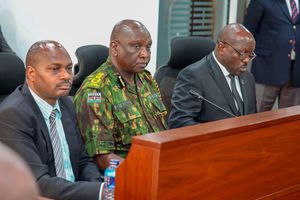
The following day, the police chiefs joined NPSC Chairperson Amani Komora and other commissioners for the meeting at the Kenya School of Government where discussions on the recruitment continued. Only Deputy IG Gilbert Masengeli was absent at the commission meeting, which also doubled as an induction meeting for new commissioners.
Mr Amani Yuda Komora.
Photo credit: Billy Ogada | Nation Media Group
After the meeting, the commissioners told journalists that the commission had agreed to work in collaboration with the National Police Service on the matter. Dr Komora said the recruitment of 10,000 police constables would begin soon, without giving clear dates.
The commissioners also voted Prof Collette Suda as the vice-chairperson and agreed on the formation of crucial committees.
Among the contentious issues that the technical team will address is whether the recruitment would follow the traditional model or candidates will apply for the jobs online, as has been proposed. It will also be required to provide guidelines on which between the IG and the NPSC has the power to conduct the recruitment.
The technical team, which has incorporated lawyers from both the police and the NPSC, is expected to come up with an agreeable position that does not violate the Constitution, said an insider.
It is also expected to fine-tune the contentious recruitment guidelines that were formulated by NPSC and subjected to public participation in August.
At the same time, the commission agreed that the IG would continue holding the police payroll despite orders by Parliament that he surrenders it to the commission.
The IG has been adamant that, despite an order by the National Assembly’s Public Account Committee, he would not cede the administration of the payroll that he contends is an operational matter.
Commissioners are, however, free to access the payroll, and the IG committed to facilitating this.
Mr Kanja, Mr Masengeli, Mr Lagat and Directorate of Criminal Investigations boss Mohammed Amin, have opposed the new police recruitment guidelines.
Director of Criminal Investigations (DCI) Mohammed Amin.
Photo credit: Jeff Angote | Nation Media Group
“We have just seen communication on issues that as a commission, we have never sat and agreed on. There are no minutes to show who attended the meeting that ratified these new recruitment guidelines,” one commissioner told the Nation when the controversy became public. “You cannot have one person driving an agenda and forcing the decision on other commissioners.”
The infighting at the commission has been amplified in a series of letters between the IG and the office of the NPSC Chief Executive Officer Peter Leley.
In a letter dated August 6, sent to the IG, Mr Leley said the commission had withdrawn all powers that had been delegated to the IG touching on human resource management. The letter is copied to Auditor-General Nancy Gathungu, Treasury Principal Secretary Chris Kiptoo, National Assembly Clerk Samuel Njoroge and Bernice Lemedeket, who is the Secretary Administration/Accounting Officer of the NPS.
“In view of the foregoing, and in full compliance with the Constitution, parliamentary committee resolution and the task force recommendation, the commission hereby withdraws, with immediate effect, all instruments of delegation on any human resource management functions previously assigned to the office of the Inspector General and the secretary administration/accounting officer,” Mr Leley wrote.
Chief Executive Officer of the National Police Service Commission, Peter Kiptanui Leley.
Photo credit: File| Nation
The constitution mandates the NPSC to recruit and appoint persons to hold or act in offices in the service, confirm appointments, and determine promotions and transfers within the NPS.
The law also says the commission shall develop policies, regulations and procedures for the proper carrying out of the recruitment and appointment process. But the commission can delegate to the IG the recruitment of police officers below the rank of the superintendent.
“A delegation to the Inspector General shall be in writing and shall be subject to such conditions as may be imposed by the Commission from time to time and shall not divest the Commission of the responsibility concerning the exercise of its powers or the performance of the duty delegated,” the law states.