Struck down: High Court quashes Ruto's new State departments
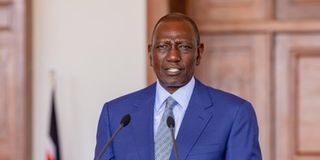
President William Ruto.

President William Ruto has six months to regularise seven new State departments after the High Court ruled their creation was unconstitutional, citing failures to show required consultation and oversight by the Public Service Commission (PSC).
Justice Roselyne Aburili quashed the President’s March 2025 decision that increased the number of State Departments by six to 57 and was linked to the creation of the Broad-Based government following a political arrangement with former Prime Minister Raila Odinga in 2024.
The departments are:


- Public Investments and Assets Management
- National Government Coordination
- Justice, Human Rights and Constitutional Affairs
- Science, Research and Innovation
- Aviation and Aerospace Development
- Special Programmes
- Children's Welfare Services
However, the court suspended the judgment for six months from November 26, giving the Executive time to undertake the process afresh in line with the Constitution and the Public Service Commission Act. If it does not, the order will take effect automatically, without another court application.
“Should the executive fail to regularise the process within the said period, the order of Shall automatically take effect upon the expiry of that period without the necessity of further orders of this court,” said Justice Aburili.
The State departments affected are Public Investments and Assets Management; National Government Coordination; Justice, Human Rights and Constitutional Affairs; Science, Research and Innovation; Aviation and Aerospace Development; Special Programmes; and Children’s Welfare Services.
The affected Principal Secretaries include Cyrell Odede Wagunda, Ahmed Abdisalan Ibrahim, Judith Nayaiai Ramaita Pareno, Prof Shaukat Ali Abdulrazak, Teresiah Mbaika, Ismail Maalim Madey and CPA Carren Achieng Ageng’o, respectively.
The judgment arose from a petition by Francis Njoroge, filed on March 22, 2025. He challenged their establishment, arguing that the President had created them without adhering to the public participation rule stipulated in Article 10 of the Constitution.
He also cited Section 27 of the Public Service Commission Act, which provides that the Commission may establish a public office upon receiving a written request from an authorised officer, provided the request is supported by comprehensive plans and workload analysis, indicates the financial implications, and meets other statutory requirements on the office’s functions, staffing, grading and remuneration.
Mr Njoroge asked the court to declare the decision unlawful and quash the executive order or gazette notice establishing them.
The departments formed part of a reorganisation announced through Executive Order No.1 of 2025. The order repealed Executive Order No.2 of 2023, established seven departments and realigned functions across ministries. It also directed the National Treasury to align ministerial budgets for the 2025/26 financial year with the new structure.
In its judgment, the court accepted that the President had constitutional authority to organise government. But it said that power was subject to legal safeguards and evidence that the process had followed them.
The court said the Attorney General demonstrated presidential authority under the Constitution, but failed to prove that the process complied with other various Constitutional provisions and the Public Service Commission Act.
The judge said the safeguards were meant to ensure that public offices arose from objective institutional needs and a transparent, accountable process. The court found no evidence establishing that the government had met that standard for the seven departments.
“The purpose of those safeguards is to ensure that establishment of public offices is informed by objective institutional needs and undertaken through a transparent, accountable and legally compliant process,” said the court.
A central issue was the role of the Public Service Commission, which is involved in the constitutional process for creating public offices. The court said the President’s authority did not remove the Commission’s oversight or exempt the Executive from criteria set by Parliament.
The court also separated public participation in creating departments from parliamentary hearings on the people nominated to lead them. Parliament invited public memoranda, held committee proceedings and considered nominees for Principal Secretary positions. The court accepted that participation had taken place during those approval hearings.
However, those hearings came after the departments had been created and nominees identified. The court was not shown evidence that the public had been notified beforehand, given reasons for the proposed offices, informed of their functions and financial implications, or allowed to influence the decision.
“Public participation concerning appointment of office holders is not equivalent to public participation concerning the creation of the offices themselves,” Justice Aburili said.
She added that public participation in one process could not replace the other. Without information on the proposed departments’ purpose, functions and costs, she said, the public could not take part meaningfully in the decision.
Justice Aburili issued a declaration that the establishment of the departments breached the Constitution and the Public Service Commission Act. She also quashed Executive Order No. 1 of 2025 and any related instrument, but limited the order to the seven departments.
To avoid disruption to public administration, the court suspended that remedy for six months.
Follow our WhatsApp channel for breaking news updates and more stories like this.