For public servants, a presidential declaration can mean more than applause or headlines. It can mean finding unbudgeted money, changing agency plans or explaining to Parliament why a promised project has not happened.
President William Ruto’s increasingly frequent directives and promises are exposing tensions between political declarations and the laws, budgets and procedures governing government operations.
From ordering the Kenya Revenue Authority (KRA) to lower taxes on consolidated imports to directing a crackdown on foreigners running small businesses, the President has recently issued orders requiring agencies to act quickly. Some have raised legal and diplomatic questions, while others have exposed gaps between presidential promises and available resources.
The latest example came on Wednesday when President Ruto intervened in a dispute between small traders and KRA over taxes on a 40-foot container of consolidated goods.
After traders complained that the tax had risen from Sh2.5 million to Sh3.2 million, the President directed KRA to reduce it to Sh2 million. He proposed removing high-value goods before taxing the remainder at the lower rate.
KRA had raised the rate following an internal review aimed at preventing import undervaluation and updating applicable rates. The process included consultations with trade representatives and cargo consolidators.
The intervention raised questions about how presidential directives interact with statutory taxation processes.
On the same day, President Ruto ordered a nationwide crackdown on foreigners operating small businesses, giving hawkers until Monday, September 7, to close.
“There are businesses that foreigners cannot operate in Kenya by law,” he said, urging MPs to pass a Bill to close loopholes foreigners have used to establish businesses.
The directive has potentially wide implications for enforcement agencies and operators, who must translate a broad political instruction into a lawful enforcement programme.
He said the government would replace the company with an operator capable of establishing glass and chemical plants.
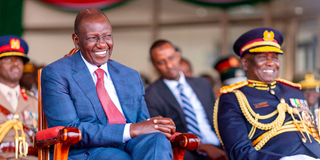
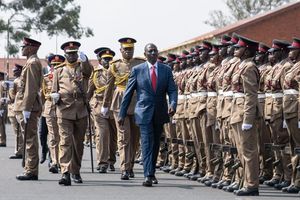
President William Ruto and Inspector-General of Police Douglas Kanja arrive for the 59th passing-out parade at the National Police College in Embakasi, Nairobi on September 4, 2026.
Photo credit: PCS
The remarks came as Tata Chemicals Magadi challenges in the High Court the suspension of its operations by the Ministry of Mining, raising questions about the relationship between presidential directives, administrative decisions and judicial proceedings, and their implications for investor confidence.
Former Attorney-General and opposition leader Justin Muturi criticised the President’s approach, saying taxation and business regulation should follow established legal processes.
“Taxation is a matter of law and can’t be handled through roadside declarations,” Mr Muturi said. “This model of governing through public relations and executive fiat, such as the case for Tata Chemicals, cannot work.”
Opposition politicians have also questioned the President’s motives in the Magadi dispute. MPs from the Democracy for the Citizens Party alleged the area contains valuable lithium deposits and oil prospects, but provided no evidence to support the claims or establish that the President had personal interests in the resources.
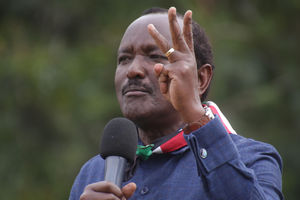
Wiper leader Kalonzo Musyoka questioned the process, asking: “For whose benefit is Lake Magadi being reorganised, and by what lawful process?”
Nairobi Senator Edwin Sifuna warned that uncertainty over investment disputes could hurt investor confidence and job creation.
In July, President Ruto announced that all students entering universities and colleges would receive full government funding.
“Any student, so long as they have passed exams and they have been placed in a college or university. Each one of them will get funding,” he said on July 21.
Presidential declarations
The announcement came about a month before universities began admitting first-year students. At the time, however, there was no law providing for the proposed universal funding model and no Bill had been introduced in Parliament.
The episode illustrates the challenge agencies face when political announcements precede the legal and financial frameworks needed for implementation.
The Teachers Service Commission (TSC) has faced a similar challenge. At State House last year, President Ruto promised to double annual teacher promotions to 50,000. But TSC’s current budget provides for 12,000 — 6,000 each in primary and secondary schools.
The Kenya National Union of Teachers says about 30,000 teachers have received promotions since the President’s October 2025 promise, still below the announced annual target.
In February, the State Department for Higher Learning disclosed that it was struggling to implement Sh1.28 billion in projects promised by the President to various universities and sought MPs’ help to secure funding.
Such cases leave ministries and agencies weighing approved plans and budgets against commitments made outside them.
Treasury Cabinet Secretary John Mbadi acknowledged the problem in March, saying the government sometimes lacked resources to implement presidential directives.
National Treasury Cabinet Secretary John Mbadi.
Photo credit: File | Nation Media Group
“Sometimes, some directives come and we don’t have the resources,” he said.
In November 2023, then Health Cabinet Secretary Susan Nakhumicha told the Senate that Treasury had not released Sh300 million promised for Kakamega Teaching and Referral Hospital.
In May 2024, her then Principal Secretary for Medical Services, Harry Kimtai, told MPs that a request for Sh8.2 billion to finance projects arising from presidential directives had not been honoured. Mr Kimtai is now Mining Principal Secretary.
In the water sector, former Cabinet Secretary Alice Wahome also faced questions over a presidential promise to sink a borehole in Bangale Town, Tana River County.
Bura MP Yakub Adow asked Ms Wahome to support the National Irrigation Authority (NIA) in implementing the project, saying nothing had happened since the President issued the directive.
Ms Wahome declined to commit the ministry or NIA, explaining that the project required funding approved by Parliament.
“I can commit myself that we are looking at the survey. We have started the exercise because every commitment is supposed to be followed with funding,” she said.
The following year, she told the Senate that her ministry had sometimes struggled to incorporate presidential commitments into its budget because of the timing of the announcements.
She cited a Sh400 million promise to construct canals and drains in Mutithi Ward under the Mwea Irrigation Development Project.
“Although we are aware of the presidential pronouncement regarding additional funding, we have not yet received that money and it is not part of our budget,” Ms Wahome said.
The National Irrigation Authority has similarly attributed a missed target at the Galana Kulalu irrigation project to a presidential intervention.
The original plan was to plant maize on 5,100 acres during the 2023/24 financial year, but only 538 acres were planted.
Treasury documents attributed the shortfall to a 2023 presidential directive transferring the project to a private operator. In the following financial year, 1,500 acres produced 19,700 tonnes of seed maize, according to the documents.
Presidential declarations can create expectations immediately, while implementation depends on legislation, procurement rules, parliamentary appropriations, agency mandates and the availability of funds.
When those elements are not aligned, officials can be left defending decisions they did not make or trying to implement commitments they did not budget for.
The Constitution gives the President executive authority, while Parliament controls the appropriation of public funds. Government agencies also operate under laws and regulations that prescribe how public resources are raised and spent.
That can create friction when an announcement made publicly requires an agency to depart from an approved plan.
President William Ruto (centre) and Inspector-General of Police Douglas Kanja join Administration Police recruits in a dance when the Head of State presided over the 59th passing-out parade at the National Police College in Embakasi, Nairobi on September 4, 2026.
Photo credit: PCS
In March last year, MPs acknowledged the problem while debating the Budget Policy Statement.
Kuria East MP Maisori Kamero said Parliament needed a mechanism for ensuring presidential directives were implemented.
“This House must find a way of dignifying the President’s directives. The President cannot be going around the country, making pronouncements and giving directives only for those directives not to be implemented,” he said.
His Kirinyaga counterpart, however, urged MPs to distinguish between political rhetoric and priorities that serve citizens’ needs.
“We are all taxpayers. We must also ensure that the President makes declarations that impact the people of Kenya,” he said, citing a request for a machine capable of producing one million chapatis a day.
The Treasury’s resource-sharing framework provides some recognition of presidential directives. It takes into account directives formally communicated by the Chief of Staff and Head of Public Service.
That distinction is significant: not every statement made at a public gathering automatically becomes a funded government programme.
For ministries and agencies, the challenge is turning politically compelling promises into legally and financially executable programmes.
State officials did not respond to questions on Friday about how presidential pronouncements are assessed, funded and incorporated into government plans, or how the administration prevents them from disrupting existing programmes.
Messages sent to Head of the Presidential Communication Service Munyori Buku, Government Spokesperson Charles Owino and State House spokesperson Hussein Mohamed had not been answered by publication time.
For public servants, the consequences are immediate. A presidential declaration can raise expectations among citizens long before the machinery of government has determined whether the promise is lawful, affordable and administratively possible.
And as recent disputes over taxes, foreign traders, university funding and mining show, the gap between what is announced and what government can legally and financially deliver can leave agencies caught in the middle.