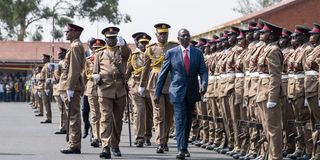
President William Ruto has called on security officers to uphold human rights, accountability and professionalism, even as Interior Cabinet Secretary Kipchumba Murkomen dismissed claims that parallel units exist within the National Police Service (NPS).
Speaking during the 59th Passing-Out Parade of Administration Police Service recruits at the National Police College in Embakasi on Friday, President Ruto said the ongoing reform programme is aimed at building a police service that is professional, accountable and responsive to the needs of citizens.
“The Constitution requires the National Police Service to uphold professionalism and discipline, prevent corruption, practise transparency and accountability, respect human rights and maintain public confidence,” President Ruto said.
He added that these principles must guide arrests, investigations, crowd management and all interactions between officers and members of the public.
The Head of State also reminded officers that constitutional freedoms, including freedom of expression, association, assembly, demonstration and political participation, must be protected.
The President said police reforms are being undertaken in the public interest and financed using taxpayers’ money, making transparency and scrutiny necessary components of the process.
President Ruto further told the graduating officers that the success of reforms would ultimately be judged by the experience of ordinary citizens rather than policies, speeches or new equipment.
“It will be measured by whether an officer responds when called, applies the law without fear or favour, refuses a bribe, protects the vulnerable, respects human dignity and treats every Kenyan equally before the law,” he said.
“Serve with courage, but never without restraint; exercise authority, but never without accountability; and enforce the law, but never without humanity,” the President said.
His remarks came as CS Murkomen defended the National Police Service against allegations that some units operate outside the authority of Inspector General Douglas Kanja.
According to the Interior Ministry, reports suggesting the existence of a parallel command structure within the service are inaccurate and designed to undermine confidence in the police.
“Those who are suggesting that there are units in the NPS that operate outside the command of the IG are false propagandists,” Mr Murkomen said.
He reiterated that the Government remains committed to supporting the operational independence of the National Police Service and shielding it from undue external influence.
“We will continue to support the independence of the NPS from any external interference,” he said.
The CS said the reforms currently being implemented are guided by recommendations made by the National Taskforce on Police Reforms, chaired by former Chief Justice David Maraga.
The reforms, he added, are intended to create a professional police service, properly equipped and people-centred.
Among the measures already undertaken, Mr Murkomen said, is the revision of police training curricula to place greater emphasis on constitutional values and respect for citizens’ rights.
“One of the things that have been done is to improve the curriculum. It now includes training on human rights, constitutionalism and the rule of law,” he said.
The Government is also investing heavily in technology and modern equipment for security operations and service delivery.
According to both the President and the Interior CS, reforms have focused on digitisation, modernisation of equipment, enhancement of mobility and strengthening the institutional capacity of the police service.
President Ruto said the Government has already operationalised the Multi-Biometric Identification System and rolled out police hire services through the e-Citizen platform.
Work is also continuing on the National Police Service Information Management System, including the introduction of a Digital Occurrence Book.
The Government, he said, has completed a three-phase salary review that raised the entry-level basic salary of a police constable by 36 per cent, while also investing in housing, healthcare and specialised operational assets.
The Head of State said the police housing programme is being expanded, including projects at Embakasi, while healthcare services have been strengthened through the Usalama Cover medical scheme.
Mr Murkomen echoed those remarks, saying authorities are paying greater attention to officers’ mental health and access to quality medical care.
“We are focusing more on mental health, making sure medical facilities and insurance cover are improved, and also their basic salary has increased significantly,” he said.
In his remarks, the President highlighted what he described as significant milestones achieved since 2022, including the construction of 252 police stations, recruitment and training of 10,000 officers and advanced professional training for more than 31,000 serving officers.
He also noted that the National Police Service Referral Hospital at Mbagathi has been completed, while the national forensic laboratory has been established and is being equipped.
The new recruits, who completed nine months of training, will now be deployed to support operations across the country, including efforts to combat banditry and terrorism, strengthen border security and address staffing shortages within the service.
As debate continues over policing standards and accountability in Kenya, the message from both President Ruto and CS Murkomen was clear: the future of police reforms will depend not only on technology, infrastructure and improved welfare, but also on respect for human rights, professionalism and public trust.
“The true measure of police reform will not be found in speeches, policies, equipment, technology or uniforms. It will be found in the experience of the citizen,” President Ruto said.