The cost of constructing the multipurpose Thwake dam has escalated to Sh53 billion, breaching the legal variation limits and risking public funds as interest on delayed payments skyrocketed, according to Auditor-General Nancy Gathungu.
Beyond the flagged cost variations, the audit on the accounts of the national government for the fiscal year 2024/25, before Parliament, reveals that critical delays in the acquisition of ownership documents for the project land expose the government to “severe legal risks and encroachment threats, leaving the promised public services in limbo.”
The Sh53 billion, according to the auditors, as of July 2025, includes Sh48.9 billion, which is the revised cost of the multipurpose dam, Sh3.53 billion paid to acquire 9,158 acres of land for the dam project, and Sh468.14 million in “avoidable interest due to the contractor on delayed payments” by the National Treasury.
The audit reveals that physical verification conducted in July, 2025 “revealed that there were no project activities at the site for the last year and that staff had left the construction site,” denting any hopes that the project will be completed any time soon to save public funds from needless expenditures.
“The non-completion within the stipulated extension risks increased variations in pricing due to changes in market rates,” the audit says, adding, “delays in obtaining land ownership documents expose the government to the risk of disputes, encroachment, and potential legal claims from third parties.”
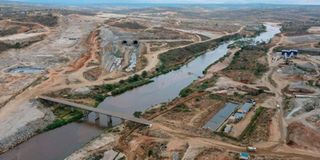
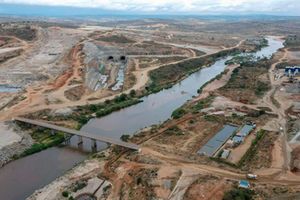
Ongoing construction of the Thwake Multi-purpose Dam on the border of Kitui and Makueni counties in early February.
Photo credit: Pius Maundu | Nation Media Group
The price variation, the audit says, was contrary to the Public Procurement and Asset Disposal Act of 2015 as revised in 2022.
Section 139 (d) of the Act states that any variation of a contract shall only be considered if the cumulative value of all contract variations for goods does not result in an increment of the total contract price by more than 25 percent of the original contract price.
The dam, whose construction works started nine years ago, is located in Makueni County, near the border with Kitui County, and is a key flagship development project by the national government meant to alleviate perennial water shortages in the two counties.
It is situated at the confluence of the Athi and Thwake rivers, with primary access via Wote town in Makueni.
It was designed to provide water for domestic use, irrigation, and hydropower generation of about 20 megawatts.
The State Department for Water and Sanitation entered into a contract with a contractor on November 15, 2017, valued at Sh37 billion for the construction of the dam with joint funding from the African Development Bank (ADB) and the government of Kenya.
The project was expected to be completed by November 4, 2022.
However, review of documents revealed that the contractor was granted the first extension up to February 5, 2024, and the end of the defects liability period on February 5, 2025.
Later, a second extension was sought and granted up to December 6, 2024, with a defects liability period of December 7, 2025.
The contractor applied for a third extension, which was granted on June 24, 2025, by the Ministry of Water and Sanitation for a further period of five months to August 9, 2025.
The project cost was first revised to Sh37.5 billion through an addendum of February 6, 2025.
The audit reveals that during the fiscal year 2023/24, the Ministry conducted a technical and financial appraisal of the program, which showed that the remaining works and the additional financing required to complete the mega dam was Sh11.92 billion, comprising Sh9.65 billion from AFDB and Sh2.3 billion from the government of Kenya.
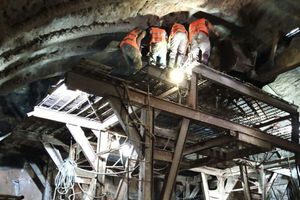
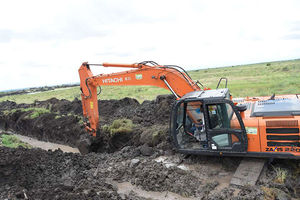
Thwake Dam workers at the site in this file photo.
Photo credit: Pius Maundu I Nation Media Group
This, Ms Gathungu says, increased the total contract sum to Sh48.9 billion, “indicating a 32 percent increase from the initial contract sum,” and therefore, against the procurement law.
The audit shows that as at the time of the audit, Sh100.9 million had been paid in interest on delayed payments, “leading to an unsettled Sh468.14 million.”
“Interest on delayed payments was an avoidable and a lack of value for money liability, often un-budgeted for and distorts the current or future fiscal year's appropriations,” reads the audit report.
Other than the 9,158 acres of land for the dam project, the government acquired an additional 24.27 hectares, about 59.96 acres of land at Sh45 million, encompassing nine land parcels and affecting 28 Project Affected Persons (PAPs).
The acquisition was necessitated by the need to facilitate construction of the employer's camp, a saddle dam, an enlarged spillway and main access road.
The audit has also cast doubts over the project’s Sh80 million in Corporate Social Responsibility (CSR) component for various community projects targeting structural improvement of existing public schools, public health centers and drilling and equipping of boreholes for supply of clean water in the two counties.
Physical verification of schools, health facilities and boreholes in Mbooni East Constituency, in Makueni, revealed major structural and finishing defects that were yet to be repaired.
Kwa Kavithi borehole for Mutukya community was non-operational due to a malfunctioning inverter, which rendered it unable to pump water to the kiosks same to Kwa Kimanthi borehole for Kathulumbi community.
The four classrooms renovated at Kathulumbi Primary School had floors that were in poor condition, and the walls had visible cracks.
The same was reported of the seven classrooms renovated at Kitoto Secondary School and the two classrooms at Kathulumbi Secondary School.
Further, the audit reveals that Kathulumbi Health Centre’s floor was in poor condition as the walls had visible cracks and the ceiling was collapsing, while the borehole drilled for water supply at Kwa Kautheu Mulani for Kisyaani Community, “was not operational since it had broken down.”
Two renovated classrooms, a kitchen and two toilets at Mumbeeni Primary School, two renovated classrooms at Katithi and Mathangathi Primary Schools and two renovated blocks at Mavindini Level Three Hospital, all had floors that were in poor condition, and the walls had visible cracks.