State and public officers, including elected politicians and Cabinet Secretaries, have until December 31 to submit their income, assets and liabilities declaration forms or risk fines or jail terms as the Conflict-of-Interest Act come into force.
The law, which came into operation on August 19, seeks to deal with corruption in the public service.
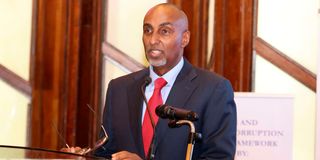
In a notice by Ethics and Anti-Corruption Commission (EACC) Chief Executive Abdi Mohamud, the officers are required to fill and submit the declaration of income, assets and liabilities of themselves, their spouses and children below the age of 18 to the commission.
According to the notice, the two-year declaration of income, assets and liabilities for 2025 should be filed between November 1 and December 31.
“Filing and submission of the declarations is a personal responsibility of the state or public officer, who also takes responsibility for the completeness, accuracy and truthfulness of the information,” the notice reads.
Section 45 of the Act provides that a person who violates the law risks a fine not exceeding Sh4 million, a prison term not exceeding 10 years or both.
Public Officers Ethics Act
The EACC is mandated to administer and oversee the law. It is also mandated to develop regulations and administrative procedures “which are expected to provide clarity on the implementation of the requirements under the Act”.
Integrity Centre in Nairobi which houses the Ethics and Anti Corruption Commission offices.
Photo credit: Pool I Nation Media Group
The law repealed the Public Officers Ethics Act and made changes to the Leadership and Integrity Act, the EACC Act and the Anti-Corruption and Economic Crimes Act.
It defines conflict of interest as a conflict between the public duty and private interests of a public official, in which the public official has private capacity interests that could improperly influence the performance of his or her official duties and responsibilities.
The law also defines a family to mean the spouse, dependent child or parent of a public officer, a dependent child of the spouse of a public officer and a parent of the spouse of a public officer.
Kenyans who take up state or public appointments will be required to give up private practice and devote their full time, energy and focus on public duties.
This means a public officer shall take responsibility to avoid any, real, apparent or potential conflict of interest in connection with the official duties and disclose any private interests that affect the official duties of the officer.
According to Section 32 of the Act, the declarations shall be made and filed to the EACC through government agencies prescribed as responsible commissions.
These commissions shall submit compliance reports to the EACC by July 31, 2026 in the prescribed template while advising for forfeiture, undeclared or unexplained assets.
The law says a responsible commission for a public officer for which no responsible commission is specified, “is the commission, committee or other body prescribed by regulations”.
“A body that is the responsible commission for a public officer by virtue of exercising disciplinary control over that officer remains the responsible commission notwithstanding the delegation of any disciplinary powers with respect to that officer,” reads the law.
Other than income, assets and liabilities, the Act requires declaration of information on any material change in, or changes affecting any of the categories of income, assets and liabilities.
The commissions are required to undertake responsibilities in terms of the declarations received from state and public officers for which they are prescribed.
This includes analysing the declaration to ascertain its completeness and correctness, whether it raises possible issues of conflict of interest and if it has any discrepancy or inconsistency.
“Within six months from January 1, 2026, the responsible commission shall be required to seek clarification from the declarant on information that may have been omitted or to explain discrepancies or inconsistencies in the declaration,” the notice says.
Processing of requests for access to a declaration by any person or law enforcement agency shall also be undertaken but not abused.
This shall be done by maintaining safe custody and storage of the declarations and retain declaration information collected under the Act for at least five years after the declarant ceases to be a public officer.
The responsible commission shall also take “such appropriate disciplinary action against a State or public officer who fails to comply with any of the requirements for declaration of income, assets and liabilities.”
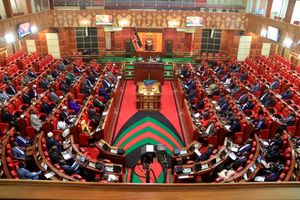
In complying with the law, the committee of the National Assembly responsible for the ethics of members shall be responsible for the Cabinet, MPs, Director of Public Prosecutions (DPP) and Secretary to the Cabinet.
Bishop David Oginde during the launch of the EACC Strategic Plan aimed at aiding the fight against corruption at KICC on September 26, 2023.
Photo credit: File | Nation Media Group
The House committee shall also receive declarations from members of the Judicial Service Commission (JSC), members of commissions and independent offices and members of the EACC and staff of the commission holding the rank of Deputy Director and above.
The committee of the Senate responsible for the ethics of members is the responsible commission for Senators.
The committee of a County Assembly responsible for the ethics of members is the responsible commission for its respective county executive committee, MCAs and members and the secretary of its respective County Public Service Board (CPSB).
The Public Service Commission (PSC) is the responsible commission to receive declarations from PSs, High Commissioners, Ambassadors and Diplomatic and consular representatives.
PSC shall also oversee declarations from public officers in respect of which it exercises appointive and disciplinary control, including advisors and personal staff and public officers who are officers, employees or members of state corporations that are public bodies.
A County Public Service Board is the responsible commission for public officers in respect of which it exercises appointive and disciplinary control, including advisors and personal staff and public officers who are officers, employees or members of county corporations and entities that are public bodies.
The Judicial Service Commission (JSC) is the responsible commission for judges, magistrates and the public officers in respect of which it exercises disciplinary control.
The Parliamentary Service Commission (PSC) is the responsible commission for the public officers in respect of which it exercises disciplinary control.
The Teachers Service Commission is responsible for teachers, the Defense Council is responsible for members of the Kenya Defense Forces while the National Intelligence Service Council is responsible for members of the National Intelligence Service.
The National Police Service Commission is responsible for members of the National Police Service with the Witness Protection Advisory Board responsible for the members of the Witness Protection Agency.