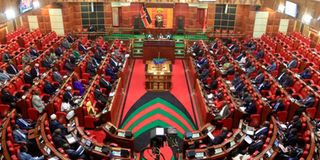
Kenyans could face up to five years in prison and a fine of up to Sh5 million for providing false information about their wealth during vetting in Parliament for State or public positions if a proposed legislation is enacted into law.
The proposal is contained in the Public Appointments (Parliamentary Approval) (Amendment) Bill, 2025, which seeks to tighten vetting laws for State and public officers to cure wealth cheats by nominees.
“A candidate who submits a false statement of income, assets and liabilities commits an offence and shall, on conviction, be liable to a fine not exceeding Sh5 million or imprisonment for a term not exceeding five years or both,” reads the proposed law.
In the new proposals, any candidate nominated to a State or public position will be required to provide a statement of income, assets and liabilities to the vetting committee.
Sponsored by Funyula MP Wilberforce Oundo, the proposed legislation states that, under the income side, the nominee will be required to provide evidence of deferred income or future evidence, outside commitment during service in office, and all sources of income.
Under the deferred income, the nominee will be required to list to the vetting panel amounts and dates of all anticipated income arrangements stocks, uncompleted contracts and other future benefits which the nominee expects to derive from previous business, relationships and professional services.
Under the outside commitment bit, the nominee will be required to state whether he has any agreements to pursue outside the employment.
On the sources of income, the proposed legislation provides that the nominee will be required to list sources and amounts of all income received during the calendar year preceding his nomination and the current calendar year.
According to the proposed legislation, the nominee will also be required to list all the physical properties that have monetary value such as real estate, vehicles, jewellery and precious metals, cash and bank deposits, investments such as stocks, bonds and mutual funds.
In the new proposals, any candidate nominated to a State or public position will be required to provide a statement of income, assets and liabilities to the vetting committee.
Photo credit: Shutterstock
The proposed legislation, if passed into law, will also require nominees to list the financial obligations or debts that must be repaid such as personal loans, credit and debt, unpaid taxes, mortgages, car loans and business loans.
The nominee will also be required to attach an accountant certificate of statement of income on the assets and liabilities issued by an accountant registered under the Accountants Act.
In addition, the proposed legislation compels the nominee to attach a valuation report of assets issued by a valuer registered under the Valuers Act.
Accountants and valuers found culpable of certifying false information to any nominee will face punishment as provided by law.
“An accountant who certifies a statement of income, assets and liabilities as required while knowing the statement to be false commits a dishonest practice and shall be guilty of offence as provided in the Valuers Act,” reads the proposed legislation.
The move is meant to cure the current gap in law where nominees, such as Cabinet Secretaries or other public officers, just mention that they are worth a certain amount without attaching any report such as a valuation report to support it.
Currently, a nominee can just say he is worth Sh1 billion made up of land, houses, vehicles, shares in listed companies and money in the bank and it ends there. They are not compelled to disclose further or provide evidence of the actual value of the land based on a report by a valuer.
According to Dr Oundo, the current law, which does not require nominees to provide evidence, leads to the over- or under-declaration of their wealth, leaving room for the plundering of public resources upon approval by Parliament.
“People keep on lying during vetting. They over state their wealth to leave room for stealing,” Dr Oundo said. “All we need is verifiable documents of all the wealth they own, including those of assets and liabilities.”
At the moment, it is the Clerk of the National Assembly that writes to the agencies and the Office of the Registrar of Political Parties requesting for reports with respect to the nominees on matters of ethics and integrity, tax compliance, criminal records, higher education loan repayments and political party affiliations.
The bodies are just supposed to provide the information of the respective nominee, which will be availed to the committee during vetting. It is now upon members of the committee to peruse the documents and ask the questions.
Section 6 (9) of the Public Appointments (Parliamentary Approval) Act of 2011 provides that “any person may, prior to the approval hearing and by written statement on oath, provide the clerk with evidence contesting the suitability of a candidate to hold the office to which the candidate has been nominated”.
This is the second time the National Assembly will be attempting to tighten the vetting rules, especially for Cabinet Secretaries.
In the 12th Parliament, various proposals were floated seeking to amend the Parliamentary Approval Act 2011 that guides the vetting process.
Although the lawmakers increased the vetting period from the initial 14 days to 28, other parts that could have raised the integrity probe and higher academic level for the Cabinet Secretary nominees were never considered by the House.
Some of the proposals then included having representatives from investigative agencies such as the Ethics and Anti-Corruption Commission, the Kenya Revenue Authority, the Higher Education Loans Board and the Directorate of Criminal Investigations physically present during the vetting of the nominees, so they can ask critical questions on matters of integrity and taxes.
In bringing representatives of the bodies on board during the vetting process, the MPs argued that Parliament is not competent to check criminal background of nominees hence it is the agencies that can ask such critical questions.
However, the move was shelved as there were fears that it would compromise the separation of powers, and Parliament would have been seen to have ceded its functions to other bodies.
The Committee on Appointments, which is chaired by the Speaker and normally conducts the vetting of CSs, also wanted Section 9 of the Approval Act to be amended by deleting the provision that, after the expiry of the consideration period and if Parliament has neither approved nor rejected a candidate's nomination, the candidate shall be deemed approved.
On the questionnaire bit, the committee proposed amendment of question 28, which currently just asks whether a nominee has been charged in a court of law. The committee instead wanted the nominee to be asked about conviction and status of a case if appealed. This would have provided an avenue to reject or put aside the vetting of the nominee until he concludes his case.