When the late Justice Mohammed Kadhar Ibrahim faced the darkest hour of his judicial career, many feared his time on the bench was over.
In 2013, the Judges and Magistrates Vetting Board shocked Kenya’s legal fraternity by declaring him “not suitable to continue serving” in the judiciary. The ruling stemmed from mounting complaints about delayed judgments, some dating back seven years.
Then President Mwai Kibaki with members of the Judges and Magistrates Vetting Board at Harambee House in 2012.
Photo credit: File | Nation Media Group
Judge Ibrahim, who was buried yesterday at Nairobi’s Kariokor Muslim Cemetery, had amassed 270 undelivered judgments and rulings between 2003 and 2011, frustrating litigants and eroding public confidence. At his vetting interview, he admitted the delays, saying: “I regret what happened… it was not intentional.”
Supreme Court Judge William Ouko uses a spade to throw soil into the grave of Justice Mohamed Ibrahim at Kariokor Muslim Cemetery on December 18, 2025.
Photo credit: Evans Habil | Nation Media Group
His predicament, however, reflected systemic weaknesses in Kenya’s courts at the time.
“There was no electronic case tracking system, and judges relied on paper diaries. Heavy caseloads and transfers across stations like Nairobi, Eldoret, and Mombasa compounded Justice Ibrahim’s backlog,” explained Senior Counsel Fred Ngatia.
The vetting board, chaired by retired Judge Sharad Rao, acknowledged that while many judges faced similar pressures, few allowed their delays to reach such alarming levels.
For Justice Ibrahim, the board’s finding was devastating. Senior Counsel Ngatia, who later represented him during a review, described the ruling as “the most difficult part of his career.”
“The vetting board’s decision was the most devastating moment of his life and the hardest part of his career in the judiciary and legal practice,” Mr Ngatia said. Despite the setback, Justice Ibrahim challenged the ruling.
Mr Ngatia successfully argued that the original panel may have been biased, prompting the board to annul its determination and order a fresh interview.
Candidly discussed struggles
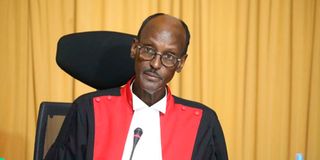
Justice Mohammed K Ibrahim.
Photo credit: File | Nation Media Group
During the second vetting, Justice Ibrahim candidly discussed his struggles, admitting that his transition from private practice to the bench was a tough lesson in time management.
“I was too idealistic and too enthusiastic… I thought I could carry all the responsibility of my station on my shoulders,” he told the panel. His honesty, coupled with evidence that he had cleared his backlog, persuaded the panel to declare him suitable to serve on January 15, 2013. Justice Ibrahim’s resilience resonated beyond his personal vindication. His journey became emblematic of judicial reform, accountability, and independence in Kenya’s evolving legal landscape.
Once reinstated, Justice Ibrahim continued to shape constitutional jurisprudence. Elevated to the Supreme Court in 2011, he played a pivotal role in several landmark rulings.
One of the most debated came in the 2023 LGBTQ rights case concerning the registration of LGBTQ groups. The divided court held that denying registration was discriminatory and unconstitutional, affirming the right to freedom of association under Article 36, read with the non-discrimination clause in Article 27.
Justice Ibrahim dissented, arguing that groups promoting activities illegal under Kenyan law should not automatically qualify for registration. He maintained that constitutional rights are not absolute and can be limited if “reasonable and justifiable in an open and democratic society.”
He emphasised that moral foundations, reflected in the Constitution and statutes, must guide interpretation. Any expansion of rights—such as adding “sexual orientation” to non-discrimination grounds—should follow democratic processes, like a referendum, rather than judicial interpretation.
His dissent sparked robust debate on the role of courts in interpreting evolving rights and balancing legal reform with societal values. While some critics called for judicial accountability, many jurists viewed his stance as highlighting the tension between law, culture, and constitutionalism.
In 2023, he sat on the Supreme Court bench that limited the president’s power to appoint a majority of Judicial Service Commission (JSC) members. The court ruled that out of 11 members, the president could only appoint two representatives of the public, while other members nominated by peers or professional bodies required no parliamentary approval.
In 2025, when the JSC sought to initiate removal proceedings against several Supreme Court judges, including Ibrahim, he and others secured court orders halting the process. A High Court affirmed that the JSC was not immune from judicial supervision, reinforcing constitutional safeguards.
Throughout his career, Justice Ibrahim presided over diverse High Court matters, including constitutional petitions, administrative law, and commercial disputes. His judgments often reflected a deep understanding of the law and genuine concern for fairness. Notably, he championed minority rights, including the legal protection of Kenya’s Somali community, long before his Supreme Court appointment.
Beyond the courtroom, his life was marked by personal trials.
“He battled illness, including a kidney condition requiring a family member’s donation. Yet he continued his judicial duties with quiet dignity, even as his health waned,” recalled Mr Ngatia.
Supreme Court Judge Isaac Lenaola.
Photo credit: File | Nation Media Group
Supreme Court colleague Justice Isaac Lenaola described Justice Ibrahim as a mentor and friend, a figure whose example taught “humility, empathy, and justice tempered with humanity.”
“He struck me as a simple, warm individual far removed from his celebrity status,” Mr Lenaola said.
“Until his death, he called me ‘my young brother.’ Serving with him at the Supreme Court was a lesson in humility, empathy, and justice tempered with humanity.”
“All his life, he served the legal profession and the nation of Kenya with immense dedication, integrity, and wisdom. As an advocate, High Court judge, and founding Supreme Court member, his profound legal intellect and unwavering commitment to justice leave an indelible mark on Kenya’s judiciary and constitutional history,” Mr Lenaola added.
Justice Ibrahim’s burial ceremony on Thursday, conducted according to Islamic rites, drew a large gathering of mourners who hailed him as a judge who ruled without favouritism. Among attendees were Supreme Court colleagues Justices Smokin Wanjala and Isaac Lenaola, former Chief Justices David Maraga and Willy Mutunga, and political figures including DAP-K leader Eugene Wamalwa and Deputy Speaker Justin Muturi.
Mr Maraga lauded him as “an outstanding man who never tolerated corruption. He was a straight man who carried out his duties diligently.”Justice Mohammed Kadhar Ibrahim’s life story is one of perseverance, integrity, and dedication to justice.
From personal and professional setbacks to landmark rulings that shaped Kenya’s constitutional landscape, his legacy will continue to inspire generations of legal practitioners and citizens alike.