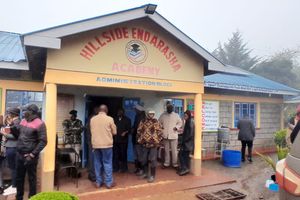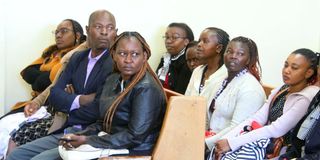
Parents and relatives of the 21 boys who died in the Hillside Endarasha Academy fire in 2024, during the opening of a public inquest into the tragedy at Nyeri Law Courts on November 20, 2025.

Two years ago today, Kenyans woke up to a horror that shook the nation. On the night of September 5, 2024, at least 21 boys perished in a dormitory fire at Endarasha Hillside Academy in Nyeri County, throwing families and relatives into mourning and agony.
But the suffering did not end when the flames were extinguished and the victims were laid to rest. The pain did not end when learning finally resumed at the institution.
Once things had settled down, attention turned to the families of the survivors. While 21 boys died, several others were injured, three of them seriously.
And as the tragedy turns two years today, the survivors still bear the scars and carry the weight of the trauma, while their families shoulder the burden of their medical care.
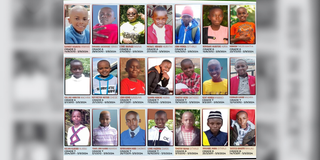
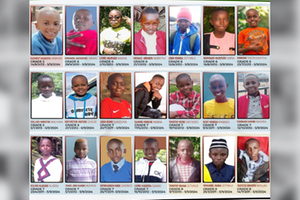
Pictures of the 21 children who died in the dormitory fire at Hillside Endarasha Academy.
For the survivors and their families, time has not healed the wounds. The children are under pressure as they move through their teenage years, having to wear pressure garments and conceal physical scars.
Family members interviewed said that, other than relatives, no one ever checks on them to see how they are coping. Their loved ones’ full recovery is a journey defined by a constant battle with physical and emotional scars, trauma and broken homes.
“We need a shoulder to lean on. We need help,” said Shiphirah Waithera, whose son was injured in the incident, in a phone interview.
For mothers like Waithera, every day is a stark reminder of the night her son was injured. He was in Grade 6 at the time and is now in Grade 8.
The burns have severely affected his hands and face, and he is reminded of the incident every time he looks in the mirror. The wounds have affected his self-esteem.
“He keeps reminding me about the scars. As he grows older, I think he is beginning to realise that the scars will take a long time to disappear. He looks at photos of himself from before the incident and asks, ‘Mum, when will my face be the same again?’ The trauma consumes him as though it happened yesterday,” said Waithera.
She has since moved to Nairobi, where she now works. This has also meant that she is now closer to Kenyatta National Hospital (KNH), where her son has regular check-ups.
“Since he can’t keep hiding his hands and face, he asks how we can eliminate the scars. He also experiences continuous itching... we are going through a very difficult time,” Waithera said.
After the initial three-week stay at the KNH and the bills that the government paid , the family was left to figure out the complex referral process on its own.
“We were forgotten and left to be on our own,” Waithera says. “Even from the school, no one checks on us or cares anymore.”
When he was ready to go back to school, Waithera transferred her son to a school in Karatina, Mathira Constituency.
Waithera’s experience is similar to that of Millicent Murage, whose son suffered severe burns on his face and thighs. After the incident, she stayed with her son at the KNH for two months, which were followed by routine specialist clinics.
While the government paid for the initial expenses, the financial strain has been overwhelming. She also had to buy pressure garments and expensive gels to manage the scars.
Last year, Millicent would take her son for check-ups on a monthly basis, which were scaled down to once every two months this year.
While she estimates medical expenses so far to be over Sh800, 000, she has also spent more than Sh200, 000 on accommodation, meals and transport. With no support from the school management or the government, she has been forced to use her savings, and contributions from relatives and friends to treat her son.
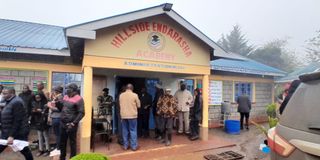
Parents at Hillside Endarasha Academy in Kieni, Nyeri County, in September 2024 following a fire tragedy that claimed the lives of 21 learners.
“In 2025, we had to go to KNH every month; this year, it’s every two months. However, the clinics have not healed the trauma. Sometimes his badly burned leg starts shaking violently. He also gets severe headaches due to the burns on his face. It is not easy.”
For David Wamathai, whose son was burnt on both hands, the pain has been compounded by a lack of funds to cater for his medical expenses.
While he transferred his son, who is now 15 years old, to a new school in Murang’a County, where he is in Grade 10, Wamathai says the boy suffers trauma and wears gloves to hide the scars.
After the initial treatment, which was paid for by the government, Wamathai, a farmer in Kieni Constituency, says he could not afford to take his son for specialised treatment.
“We went for the clinics at Mwai Kibaki Hospital (in Othaya) for several months, but I could not cope with the costs. The expenses for each monthly visit went up to Sh30, 000, which was too much for me,” he said.
“I wish somebody could come to my aid and help so that my son can resume treatment because he has not recovered yet. I am also told plastic surgery could be a solution, but who would afford that? I see my son suffer, but what do I do?”
On Thursday, Mr David Kinyua, the Endarasha Hillside Academy director, said they would be willing to help those in need of assistance.
“We recognise their suffering and even us, we were equally affected. We are open to working with the affected families so that they get to full recovery,” Mr Kinyua said.
David Karani, a human rights activist who pushed for the commencement of the inquiry to establish the cause of the fire, says that after the incident, some couples went through denial, with some of them blaming their partners. The emotional toll on some families led to separation.
“Before parents decide to take a child to a certain school, they usually discuss and there is usually one who prevails. In this case, the blame was heaped on the one who insisted on taking the child to Endarasha Academy, which brought complications in relationships. I know of some who went into depression and separated from their partners,” Karani said.
Mr Karani says that after more than a year of lobbying, the inquest began in November last year, but they have to contend with a justice system that moves at a slow pace.
The inquest is the only source of information for parents of the victims, since they say they have never been conclusively briefed on the investigations into the cause of the fire. On April 27, the inquest heard that six days before the fire incident, all 11 CCTV cameras at the school were fully functional.
Mr James Githinji, a surveillance systems specialist with Gian Security Systems, said he had serviced the system on August 30, 2024. He said the work involved replacing the digital video recorder, hard disk, five cameras and the cameras’ power supply.
And on August 4 this year, the inquest heard that the electrical system at the school failed several safety standards.
Mr Allan Mogoli, an electrical engineer with the Energy and Petroleum Regulatory Authority (EPRA), told Nyeri Senior Resident Magistrate Mary Gituma that the system had undersised cables and circuit breakers and inadequate earthing.
After conducting an assessment of the school’s power reticulation system on September 10, 2024, five days after the incident, Mr Mogoli found that its design and installation did not meet the standards required for places of public use.

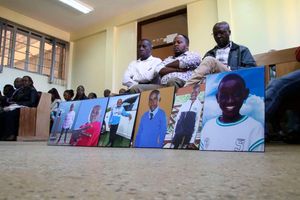
Parents display portraits of some of the 21 boys who died in the Hillside Endarasha Academy fire of September 5, 2024, as the public inquest into the tragedy begins at the Nyeri Law Courts on November 20, 2025.
At the same time, Mr Karani says two constitutional petitions have so far been filed at the High Court in Nyeri County. The first case was HCCHRPET E014/2025, filed over human rights violations.
Although the respondents have filed their responses, the petition is set to be resolved through oral evidence, which requires all parties to prepare and submit detailed witness statements.
In Civil Case HCCC E013 of 2025, which was filed for wrongful death compensation, the defendants filed their defence alongside a preliminary objection on the grounds of sub judice. The court has ordered the parties to submit written arguments regarding the preliminary objection.
Both cases will be mentioned on November 16 to confirm compliance and receive further directions.
According to Mr Karani, procedural bottlenecks are delaying justice for the victims.
“One of the challenges affecting the progress of these cases is that the same judge has continued to handle both, despite them arising from different contexts,” he said.
“There has also been concern about the continued handling of compliance-related issues at the judicial level, rather than such administrative matters being dealt with by the Deputy Registrar.”
“There is also the issue of the spacing of hearing dates, which are quite far apart. This has contributed to delays in the progression of the cases and in addressing some of the issues expeditiously,” he added.
Follow our WhatsApp channel for breaking news updates and more stories like this.