A confidential UK military inquiry has found that some British Army personnel stationed in Kenya continue to engage in transactional sex with local women, despite a strict “zero tolerance” policy introduced nearly three years ago.
The Service Inquiry reviewed allegations involving members of the British Army Training Unit Kenya (Batuk) between July 2022—when the policy was published—and March 2025.
Out of 7,666 personnel deployed during that period, the inquiry identified 35 incidents where sexual exploitation or transactional sex was suspected.
In nine cases occurring after the policy’s full implementation, the allegations could not be proven, but investigators concluded such conduct is still taking place at a “low to moderate” level.
“It is more likely than not that… the reality about the prevalence of transactional sexual activity by UK personnel in Kenya… is that it is still happening, that the level is somewhere between low and moderate… but it is not out of control,” reads the 82-page report published by the UK Army.
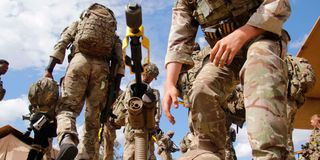
Soldiers troop during a simulated military excercise of the British Army Training Unit in Kenya (BATUK) together with the Kenya Defence Forces (KDF) at the ol-Daiga ranch, high on Kenya’s Laikipia plateau on March 26, 2018.
Photo credit: File | AFP
The report states that the policy—known as JSP 769—prohibits soldiers from paying for sex while deployed overseas and carries a presumption of discharge for offenders. Although published in July 2022, it was only enforced from November that year after troops received training on the rules.
Despite pre-deployment briefings, curfews, off-limits zones and patrols, the inquiry found that “it is more likely than not” some soldiers continue the practice, often shielded by the difficulty of securing evidence in Kenya’s legal and social context.
Investigators cited a culture in which neither soldiers nor sex workers are incentivised to report incidents, compounded by mistrust of local law enforcement and the policy’s severe career consequences. Some soldiers also alleged being targeted for extortion by women threatening to make false claims of sexual exploitation.
“Nobody involved is incentivised to make a complaint or to make admissions… the JSP 769 presumption of discharge is clearly a disincentive to making admissions,” the report states.
The report also notes that most Nanyuki residents value Batuk’s economic and security presence and that local perceptions of soldier behaviour have improved. However, it warns of reputational risks to both the Army and the UK government if violations persist.
The British Army Training Unit Training in Kenya -BATUK at Lolldaiga training area in Laikipia County on November 14, 2022.
It recommends stronger integration of the policy into Army command orders, annual refresher training and a shift towards using administrative procedures rather than courts martial to address alleged breaches—an approach intended to improve enforcement.
General Sir Roly Walker, the Chief of the General Staff, condemned the ongoing misconduct and promised sweeping reforms.
“There is absolutely no place for sexual exploitation and abuse by people in the British Army. It is at complete odds with what it means to be a British soldier. It preys on the vulnerable and benefits those who seek to profit from abuse and exploitation,” Sir Walker said in a statement.
He pledged to implement the report’s recommendations in full, including a new training programme, increased ability to discharge offenders, and enhanced oversight measures.
“We are fully committed to preventing sexual exploitation in any form,” Walker said. “We will continue to listen, step up, and take action when we need to—working with other Services to learn lessons and share best practice across Defence,” he said.
The inquiry’s findings have revived scrutiny of Batuk’s conduct, including the unresolved 2012 killing of Agnes Wanjiru. This week, senior British military officials from Batuk failed to appear before the National Assembly’s Defence, Intelligence and Foreign Relations Committee.
Defence Cabinet Secretary Soipan Tuya appeared before MPs on Tuesday alongside her Principal Secretary, Patrick Mariru, but admitted she had no explanation for Batuk’s absence despite formal invitations being issued through the Ministry of Foreign Affairs.
British Army Training in Kenya (Batuk) during an exercise in Laikipia County.
Photo credit: Joseph Kanyi I Nation Media Group
“We cannot speak for them. We did our bit through the Ministry of Foreign Affairs, and they are not here,” Ms Tuya told the committee, prompting an angry rebuke from lawmakers.
Committee chair Nelson Koech accused the British of treating Parliament with contempt, warning MPs may designate Batuk a “hostile witness” over its refusal to engage in the inquiry into allegations of sexual exploitation, unlawful killings, environmental damage, and abuse of power.
“There are children who were born out of these illegal relationships with British soldiers,” Mr Koech said, adding that Parliament had been “very reluctant” to approve the Defence Cooperation Agreement with the UK in light of past abuses.