Resistance to a new automated traffic fines system is growing, with a court petition and interest groups citing lack of public participation, inability to challenge the punishment and loopholes open to abuse.
The National Transport and Safety Authority’s (NTSA) has rolled out the Instant Traffic Fines Management System, which has seen motorists captured on CCTV cameras violating rules like breaching speed limits being slapped with penalties, to curb reckless driving that has caused deaths.
Fines must be paid within seven days of the SMS notification, failure to which interest charges will accrue and the offenders also risk further restrictions like being blocked from accessing NTSA digital services.
However, this has infuriated public transport operators, consumer groups, private motorists and rights advocates who argue the system offends the constitution, warn it could fuel corruption and punish motorists unfairly.
A motorist - Kennedy Maingi Mutwiri - yesterday filed a constitutional petition at the High Court’s Constitutional and Human Rights Division, challenging the system, which he argues effectively declares motorists guilty of traffic offences without trial.
“The system violates the most basic tenets of natural justice by condemning alleged offenders of traffic laws unheard,” the petitioner says in the urgent application seeking orders suspending the system pending determination of the case.
The only way that the instant fine system will apply, the incoming Law Society of Kenya president Charles Kanjama said, is that people must have a right to deny the offence.
Law Society of Kenya president Charles Kanjama during an interview at his office in Nairobi on February 24, 2026.
Photo credit: Bonface Bogita | Nation Media Group
“When you give an instant fine, it's like you've convicted someone. You only convict someone based on their consent,” said senior counsel Kanjama.
If that is not the case, he explained, “you can create a big opening for abuse because the police can decide to charge you with any offence, and you don't have any recourse.”
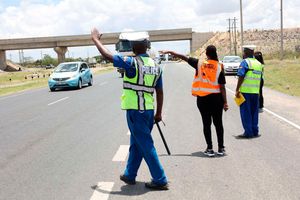
Police officers and officials from the National Transport and Safety Authority flag down vehicles at Lukenya, Machakos County during a crackdown on unroadworthy vehicles and drivers on March 27, 2024.
Photo credit: Evans Habil | Nation Media Group
“The mechanism of instant fines, it has to be made consistent with the statutes, and people have to be entitled by making the instant fines lower than the fine that you will be charged if you go to court," Mr Kanjama added.
“For you to be penalised, to pay a penal consequence, either a fine, a penalty, or even jail term, you have to be sufficiently given time to defend yourself,” outgoing LSK Vice President Kabata Mwaura said.
It seems, he argued, the system is hell bent on raising revenue rather than curbing traffic violations.
“It does not give someone the ability to defend themselves,” Mr Kabata argued, as is the principle of fair hearing. In a healthy environment, he said, the accused have at least to be given the opportunity to defend themselves, including appealing the outcome if dissatisfied.
Matatu operators said the system was introduced without adequate consultation and risks disrupting the public transport industry as “the rollout ignored the realities of the public service vehicle industry.”
“The concept of the automated system is good but implementation is flawed,” said Dickson Mbugua, chairman of the Matatu Welfare Association and secretary general of the Federation of Public Transport Sector.
In an interview with Nation, he said the policy skipped a crucial stage of public participation and sensitization. He said the regulator’s push for technology-driven enforcement should have been preceded by adequate involvement of the industry stakeholders.
Mr Mbugua said PSV owners and operators as well as long distance vehicles were excluded from discussions on how the system should work.
“The concept is good but public participation would have allowed people to give ideas on how the system should operate and how the fines should be moderated. The fines remain too high for drivers and transport operators,” he said.
“As long as the fines are punitive they will still encourage corruption. A driver charged Sh10,000 may instead bribe an officer with Sh2,000 or Sh3,000 to avoid the penalty,” Mr Mbugua said.
According to him, the fines should have been moderated to make them affordable and discourage bribery.
The businessman also questioned how motorists travelling long distances transiting to the neighbouring countries would handle the strict payment timeline.
“A driver travelling from Mombasa to Busia may be fined along the way. If he has only seven days to pay, when will he have time to appear in court or settle the fine?” Mbugua asked.
Mr Mbugua said the system also fails to consider the unique employment structure in the matatu industry and transport sector in general, including those ferrying cargo from the port of Mombasa across border.
“If a driver commits an offence and the vehicle is fined Sh10,000 he may simply abscond and move to another vehicle. The burden then falls on the vehicle owner whose car may be impounded,” said Mr Mbugua, pointing to the gaps in the NTSA regulations.
Operators further criticised the speed of implementation. Mr Mbugua said authorities should have first conducted nationwide civic education to help motorists understand how the system works.
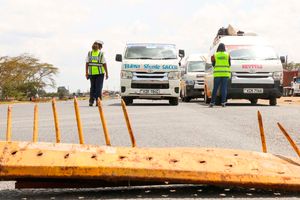
Police officers and officials from the National Transport and Safety Authority inspect vehicles at a roadblock in Lukenya, Machakos county on March 27, 2024.
Photo credit: Evans Habil | Nation Media Group
“These changes should have been explained to the public for at least two weeks through radio and public forums before implementation,” he said.
Stephen Mutoro, secretary general of the Consumers Federation of Kenya (Cofek), said the organisation would challenge the arrangement between NTSA and its private partner involved in implementing the system.
“We will be challenging the entire public-private partnership arrangement between NTSA and Pesa Print Ltd,” Mr Mutoro said.
He stated that the authority must first establish clear regulations governing the accuracy and verification of speed cameras before deploying them nationwide.
Mr Mutoro also warned that the instant fines framework could violate constitutional rights. “The use of instant fines assumes someone is guilty before being declared innocent,” he said.
He added that such an approach risks undermining Article 50 of the Constitution, which guarantees every accused person the right to a fair hearing.
Court documents describe the framework as fully automated, operating without human intervention in detecting offences and issuing penalties.
“The operationalisation of the automated system effectively allows the respondent to determine traffic liability and impose monetary penalties without the involvement or oversight of a court of law,” he states.
Mr Mutwiri also claims the system presumes guilt by compelling motorists to pay fines quickly to avoid penalties and service restrictions.
“The system proceeds on the assumption that an alleged offender is guilty unless they prove otherwise,” he argues.
The NTSA introduced the system as part of broader efforts to use technology to curb traffic violations and improve road safety.
However, the NTSA defended their stance, saying that for too long, the conversation about safety in the county has been one of the grim statistics of road accidents.
NTSA Director General Nashon Kondiwa said Tuesday that the authority was stepping up their mandate because it hopes to shift that conversation from statistics to solutions.
“It's about restoring the integrity of our enforcement management. The core objective of this instant fine system is to bring sanity and deterrence,” Mr Kondiwa said.
“The moment you make offenses negotiable, you set the standard too low. Bringing certainty and deterrence to that process actually makes people behave. Eliminating corruption is another issue.
By removing human negotiation, the authority hopes to eliminate corruption, the NTSA DG told journalists in his first media briefing since assuming the role.
In a public notice, NTSA said the fines would be channeled through the branch network of KCB Group within seven days. Defending it, Mr Kondiwa said the move is only temporary. “When the threshold of cameras on the road increases, we'll make this using mobile money. This means transparency,” he said, adding that the owners of the vehicles will bear the responsibility and not the drivers.
Wading on the matter, the Deputy President Kithure Kindiki said the instant fines and new cameras will not only reduce road accidents but also make drivers accountable.
Senior Counsel Kanjama also took issue with the requirement that offenders pay the penalties by physically visiting the bank.
While urging the authority to reconsider the money transfer mechanism, Mr Kanjama described the approach as “unfortunate” in this day and age when there are automated money transfer systems that use mobile money.
“That system has to make sense,” he said. “If they are going to run with that system, then the motorists' ability to pay should not be inconvenienced by them being told to visit a physical branch office of a specific bank.”