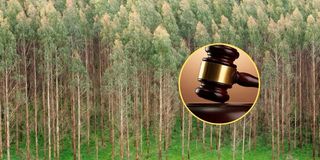
The Environment and Land Court sitting in Ol Kalou has issued orders stopping the cultivation of eucalyptus trees within 30 metres from water sources and 10 metres from boundaries.
Justice Mugo Kamau in his judgment has directed the National Assembly to enact laws that govern the cultivation of eucalyptus trees in Kenya within 12 months.
In the meantime, the court issued a list of directives that should guide the cultivation of the trees pending the formulation and enactment of legislation by Parliament.
The guidelines include stopping cultivation and ordering the uprooting of eucalyptus trees planted at a distance of less than 30 metres from wetlands, riparian land, water catchment areas, rivers, streams or ponds and the immediate surrounding of lakes, oceans, dams and other bodies of standing water.
The court ordered that no eucalyptus trees should be planted in marshy areas unless authorised by the Cabinet Secretary for Environment and Climate Change.
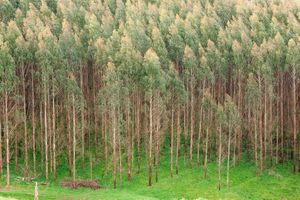
A eucalyptus plantation.
Photo credit: FILE
The trees will not be planted on irrigated farmlands, lands that are less than a quarter acre as well as in areas that receive less than 400 mm of rainfall annually.
“For avoidance of doubt, these orders shall apply across the country and the respondents are ordered to ensure compliance with the court’s judgment,” ruled Justice Mugo.
The orders followed a petition by environmental activist and lawyer Wilfred Omariba who argued that the trees are responsible for the drying up of water sources in the country.
In his petition filed in 2022, Mr Omariba sued the government for what he claimed to be uncontrolled and unsupervised cultivation of eucalyptus trees, which he said have caused adverse environmental impacts in the country.
The lawyer argued that the unsupervised cultivation of eucalyptus in Kisii and Nyamira counties had reduced the amount of water in local water bodies, threatening to leave the country facing a water crisis by 2082.
The lawyer told the court that the eucalyptus trees, popularly known as the blue gums, have been planted in the wetlands, next to the water catchment areas, springs and other water bodies, which has significantly reduced the volume of water in the said bodies.
According to him the cultivation of the water thirsty trees has been going on for over 40 years under the watch of the government, which he said has failed to enact laws to guide and protect the environment.
The reduced volume of waters in the two counties, he said, has led to conflicts among the residents who have to queue for the precious commodity and forced the government to start drilling boreholes.
The people of Kisii and Nyamira used to grow enough food for themselves and could also sell the rest to other counties but today they buy those foodstuffs from other counties. Eucalyptus trees are to blame for all this,” he said.
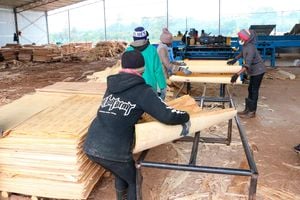
Plywood drying in the sun.
Photo credit: Boniface Mwangi | Nation Media Group
According to him the tree was introduced in Kenya in 1902 by the Europeans to provide firewood for the Kenya Uganda Railways. However, today, the tree is grown in homesteads in all food basket counties.
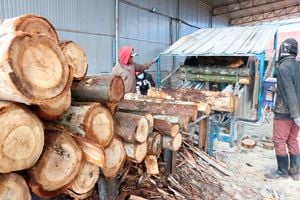
Kenyans cultivate the trees for firewood, timber, plywood transmission poles, fencing, among others due to their fast maturity.
Mr Omariba noted that the wetland counties in Kenya risk extinction in 50 years due to the continued unplanned cultivation of the tree. These areas may end up turning into deserts.
He sued the Cabinet Secretaries for Environment, the CS Water, the National Environment Management Authority (Nema), Kenya Forest Service and the Attorney-General.
The court, in its ruling, granted the government 45 days before they can start implementing the order.
Reacting to the judgment, lawyer Omariba expressed his satisfaction with the court's decision, which he said will go a long way in solving many difficulties that are experienced by residents in his village and other affected areas.
He described the ruling as a win for Kenyans, environment and future generations.
“People plant eucalyptus trees on the boundary with their neighbour and with small parcels. They deny the neighbour sunlight; food crops can't survive; and even grass for the animals can't grow. Picture that. I’m happy it will go a long way in protecting the environment for posterity,” said Mr Omariba.
The private sector has welcomed the recent court’s decision, but is calling for caution during its implementation.
Kaberia Kamencu, the Chairperson of the Timber and Furniture Sector at the Kenya Association of Manufacturers (KAM), agrees that eucalyptus is harmful to water catchment.
“Eucalyptus have a dimorphic root system, meaning it has shallow lateral roots and deep sinker roots that make them very efficient at water and nutrient uptake. They are also invasive and competitive with nearby vegetation,” he states.
A plantation of eucalyptus trees in Bobaracho, Kisii County.
Photo credit: Ruth Mbula | Nation Media Group
However, Mr Kamencu emphasises the importance of raising awareness among farmers on planting these trees to maximise the benefits of growing them in suitable areas.
“Most of the trees planted by farmers across the country were left by the colonial government, which is pine, cypress, eucalyptus and grevillea. As much as eucalyptus does well here, farmers need to be educated on other tree species that can do better,” he adds.
According to KAM, eucalyptus is the third most used for timber in the country, but it is currently facing market resistance due to the “condemning policy”.
Kamencu states that “the tree is loved for its fast growth rate, use in pulp, vineyard, papers, poles and posts. But it has been affected by policy statements that have been made over the years condemning the timber for its good qualities.”
Eucalyptus is the prime timber used in Western Kenya, tea plantations and private plantations.