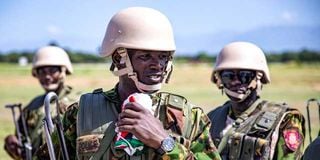
The United States of America (US) is contemplating the deployment of Latin American troops to Haiti, where Kenya is leading a Multinational Security Support (MSS) Mission aimed at eradicating gangs that have destabilised the Caribbean nation.
In the plans which Kenya says it is aware of, the deployed troops from Latin America will be operating under the umbrella of the Organisation of American States (OAS) and would be the latest move to fight off the gangs that are causing mayhem in Haiti.
On Wednesday, Kenya said that it was aware of the plans that have kicked off just five months before the Kenya-led mission comes to an end and a decision is made whether it will be a fully-fledged United Nations (UN) mission or not.
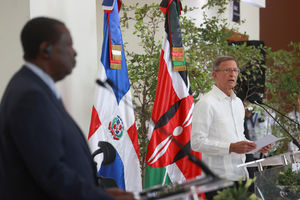
“Yes, we are aware. That is a greater involvement of Caribbean countries, and it will serve to make the Haitian stabilisation effort a collective international effort enhancing its likely success,” said Foreign Affairs Principal Secretary Dr Korir Sing’oei.
The plan to change the mission into a UN fully-fledged one is uncertain, as Russia and China are against the deployment of UN blue berets, and the only option that the US has is to work with OAS to deal with the gangs.
If at all the plan by President Donald Trump goes through and the countries in the Caribbean and Latin America agree to provide their troops, then the OAS will be made of officers from the US, Brazil, Uruguay, Costa Rica, Argentina, Bolivia, Paraguay, Colombia, Chile and Venezuela.
A man holds placards near a burning barricade during a protest against gang-related violence and to demand the resignation of Haiti's transitional presidential council, in Port-au-Prince, Haiti, May 15, 2025.
Photo credit: Jean Feguens Regala
Other countries are; Anguilla, Antigua and Barbuda, Aruba, the Bahamas, Barbados, Belize, Bermuda, British Virgin Islands, Cayman Islands, Cuba, Dominica, Dominican Republic, Grenada, Guyana, Jamaica, Haiti, Montserrat, Netherlands Antilles and Puerto Rico.
Before Kenya agreed to lead the MSS Mission and deploy a total of 1,000 police officers to Haiti, former US President Joe Biden had sought support from regional partners, but none was willing to release their soldiers to Haiti.
Recently, the head of US Southern Command, which oversees military operations in the Caribbean Admiral Alvin held a meeting with Colombia's Defence Minister Pedro Sanchez as part of the plan to deploy officers from the region.
Later, the Colombian government said, “the US expressed interest in advancing with Colombia on a multinational strategy to support Haiti.”
Commander Alvin also recently met with Jamaica’s top defense leadership, where they discussed a similar partnership.
“Together, America and Jamaica are building a safer, stronger Caribbean- united by shared values, mutual respect, and a commitment to regional security,” the US Embassy in Jamaica said following the May 9, meeting.
This comes at a time when the ongoing MSS mission is equally facing challenges, with Kenyan officers saying that they have been left alone in the battlefield.
Currently, there is disquiet among the Kenyan officers who are part of the MSS mission as they are raising concerns that their colleagues have abandoned them to fight the gangs alone.
New Content Item (1)
Photo credit: Fildor Pq Egeder | Reuters
According to the Kenyan team, they have been left to battle the highly weaponised gangs as their colleagues who hail from other countries are given lighter duties.
Jamaica, Guatemala, Bahamas, El Salvador and Belize are the countries that form the MSS.
A Kenyan officer who was a close ally of one of the dead officers told the Nation that it would only be fair if their counterparts from other countries were given similar roles in battling the gangs.
“Here only Kenyan officers are being sent to the battlefield, raising the question why are the officers from the other countries in Haiti?” posed the officer who spoke in confidence for fear of being victimised.
Another Kenyan officer said that ever since they entered Haiti and were joined by the officers from other countries, those who were securing government buildings were redeployed and the task given to the newcomers.
“For instance, I was amongst those officers tasked with securing buildings, but when officers from other countries arrived here we were redeployed and asked to start dealing with the gangs,” he said.
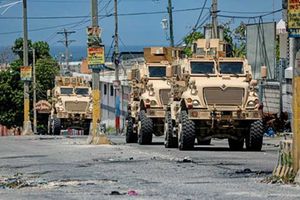
Just last week, Interior CS Kipchumba Murkomen, in an interview with a local media house, said that the Kenyan officers in Haiti were using modern armoured vehicles.
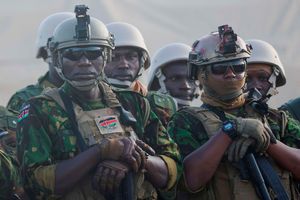
Kenyan police forces patrol a neighbourhood, a day before the arrival of US Secretary of State Antony Blinken who will visit the Caribbean country as Washington seeks to solidify the UN-backed security mission, in Port-au-Prince, Haiti September 4, 2024.
Photo credit: Ralph Tedy Erol | Reuters
“The armoured vehicles that we were supplied with are wanting, plus they are faulty. They keep breaking down, and this is what led to the disappearance of one of us,” said another Kenyan officer.
The officer confessed that what Haiti's civil society had said before Kenya deployed them to Haiti, the gang members were using deadly weapons.
Another officer said that the mission’s base, where all officers operate from, had a challenge with spacing.
“That only means that more officers from other countries might not be coming anytime soon,” he said.
On March 25, 2025, Benedict Kabiru , who was part of the Kenyan officers battling with the gangs in Haiti, disappeared following an ambush after one of the armoured vehicles they were using disappeared.
A picture of Benedict Kabiru Kuria, a police officer who went missing in Haiti.
Photo credit: Lucy Wanjiru | Nation Media Group
When the Nation visited his home following the incident, Philip Kamau, the younger brother to the deceased officer, said that he had informed them that there was partiality in the manner in which they were being deployed.
“He used to talk of the manner in which deployment was taking place, saying that Kenya was carrying the battling burden, but he never had a problem with that,” Kamau had told the Nation then.
On March 5, an officer identified as Samuel Tompoi Kaetuai was shot dead by gang members in the Lower Artibonite region.
The late Samuel Kaetuai, the police officer who was killed in Haiti.
Photo credit: Evans Habil | Nation Media Group
Currently, the Nation understands that the Kenyan officers have camped within the Lower Artibonite region, where they have been facing off with the gangs and have managed to make positive strides.
The United Nations Security Council approved the deployment of a multinational mission to support Haiti in October 2023. This is after Kenya agreed to lead the MSS Mission by deploying 1000 police officers.
Kenya sent its first contingent of police officers to Haiti in June 2024 and has been consistent in making more deployments.
The US is a major donor to Haiti, providing a significant portion of its humanitarian aid funding.
However, there have been some recent pauses or freezes in certain US funding, particularly related to the UN Trust Fund for the Multinational Security Support Mission.
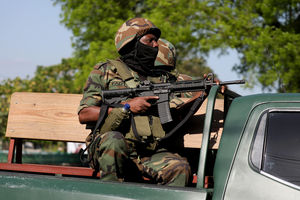
A Kenyan police officer walks in front of an armoured personnel carrier during a joint operation with Haitian police, in Port-au-Prince, Haiti July 29, 2024.
Photo credit: Jean Feguens Regala | Reuters
Other countries funding the mission include: Canada, France, Spain, Italy and Algeria.
The mission is scheduled to come to an end in October 2025, after which the UN Security Council will review the mission’s mandate and make a decision on the future of the mission, including whether it will be transformed into a UN peacekeeping operation.