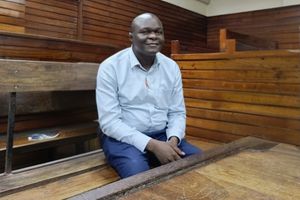
Dias Juma Wabwile, a clinical officer accused of raping a dialysis patient at Pandya Memorial Hospital in Mombasa. He has been acquitted after the complainant died before testifying.

The death of a dialysis patient before she could testify as a complainant in the rape case against a medic at Pandya Memorial Hospital in Mombasa, along with his wife's testimony regarding a condom found at the scene of the alleged incident, helped lead to his acquittal.
A Mombasa court that acquitted clinical officer Dias Juma Wabwile of two counts of sexual offences ruled that none of the eight witnesses who testified in the case had witnessed the alleged rape, and that the prosecution's case was largely based on circumstantial evidence.
The court said that suspicion, however strong, could not form the basis of a conviction. It added that had the complainant testified, she could have told the court whether she consented to the sexual encounter. In her absence, the court said, it could not presume that she had not consented.
"The court could not guess what the complainant would have said and then make a finding on that basis," it ruled.
"I find that the evidence on record, looked at as a whole, cannot safely lead to a conclusion that there is proof beyond reasonable doubt that the accused person had unlawful penetration of the complainant, as alleged in the particulars of the offence."
Prosecution's case
Wabwile had been charged with rape and committing an indecent act with an adult. The prosecution alleged that he sexually assaulted the patient at the hospital on January 31, 2025, at around 5am, and had earlier inappropriately touched her between October 2024 and January 31, 2025.
Wabwile denied the charges when he first appeared in court last year, setting the stage for a full trial.
The prosecution called eight witnesses, including hospital staff and a Government Chemist, and relied on accounts of the alleged incident as well as forensic evidence recovered from the facility.
Omari Ali, a member of the hospital's senior management team, testified that he was summoned to a meeting on the material morning and informed that a patient had reported being raped during a dialysis session in the early hours. He joined the head of security in escorting the patient to Central Police Station to make a report, before she was taken to Coast General Teaching and Referral Hospital for a P3 form and other medical procedures. Ali later led police officers to Wabwile's residence within the hospital compound, where he was arrested.
Hospital staff identified the alleged scene, although none had witnessed the incident. A nurse who worked at the hospital testified that the patient reported being raped by Wabwile at about 5am, after he connected her to the dialysis machine.
Another nurse from the dialysis department recalled meeting the patient that morning in one of the dialysis cubicles. The patient initially told her, "the doctor has done me the thing." When asked to explain, she disclosed that she had been raped, and told her that Wabwile had used a condom before discarding it in a dustbin. She directed the nurse to look for it there, where it was found.
The prosecution also presented forensic evidence, with Government Chemist Maxwell Boy testifying that he compared the used condom with a buccal swab obtained from Wabwile. Testing established that semen recovered from the condom contained his DNA.
A third nurse, at Coast General Teaching and Referral Hospital, also testified that the patient narrated how Wabwile allegedly raped her after connecting her to the dialysis machine. The patient reportedly told her that Wabwile had previously made sexual advances toward her while she was receiving treatment.
Wabwile's defence
The defence, however, presented a different account of how the condom ended up in the dialysis unit of the hospital.
Wabwile, who had worked at Pandya Memorial Hospital for eight years, said he had carried the condom from home after a sexual encounter with his wife, not the complainant.
His wife backed his account, telling the court that they already had a young child and used condoms during intimacy to avoid another pregnancy. She maintained that on the morning of the alleged incident, she had sex with Wabwile at their home using a condom, and that he wrapped the used condom and carried it with him when he left for work. His defence, therefore, maintained that the condom recovered at the hospital had been used during Wabwile's sexual encounter with his wife, not the patient.
The court, however, questioned why Wabwile's wife had not been involved at the beginning of the investigation, so that her DNA could have been obtained and compared with the sample recovered from the condom. Such testing, it noted, could have established whether the condom had been used during the couple's sexual encounter.
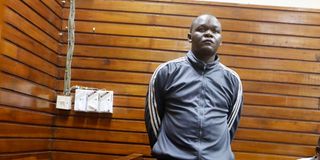
Dias Juma Wabwile at a Mombasa court on February 3, 2025.
For his part, Wabwile denied having a romantic relationship with the patient, or sexually assaulting or touching her.
Wabwile acknowledged knowing the patient but described her as a friend whom he had assisted with transport and medication because she was financially constrained. He told the court that she had made advances toward him and sent him sexually suggestive messages, including invitations to visit her home. His wife discovered the messages, he said, leading to tension within their marriage. However, he did not produce the messages in court, or any evidence to substantiate his claim that he had financially assisted the patient.
The court's decision
In its analysis, the court acknowledged that the circumstances surrounding the alleged incident raised serious questions, but said the evidence still had to establish that the sexual encounter was unlawful.
It found that while the nurses' accounts constituted admissible evidence that Wabwile had sex with the complainant, they amounted to hearsay and required independent evidence to establish that the encounter was unlawful.
"There is therefore required independent evidence to prove that the accused had unlawful carnal knowledge of the complainant," the court said.
The court then examined the DNA evidence, which confirmed that semen recovered from the condom contained Wabwile's DNA. However, it noted that this was also consistent with his defence that he had had sex with his wife at home that morning, carried the used condom to the hospital, and later disposed of it in a dustbin.
The court said Wabwile's explanation had to be considered alongside the other evidence, rather than examined in isolation. It questioned how the complainant could have known the item in the dustbin was a condom, if Wabwile had wrapped it in tissue paper, as he claimed.
It further acknowledged that disconnecting a patient from a dialysis machine could cause massive bleeding and blood loss, making it possible that Wabwile could have taken advantage of the complainant's vulnerable condition. However, it said, the absence of her testimony meant her consent could not be presumed.
On the alternative charge of committing an indecent act with an adult, the court reached the same conclusion, citing the evidentiary gaps in the main charge.
"Due to reasons given in the first count, particularly the absence of evidence from the complainant, the absence of eyewitnesses to the alleged incident leads to the same outcome as the main count. Consequently, for the foregoing reasons, I find the accused person not guilty of the main charge and the alternative charge, and he is accordingly acquitted," the court said.
The court subsequently ordered that documents deposited by Wabwile be released to him.
Speaking after the judgment, Wabwile thanked God for his acquittal, saying he had always maintained his innocence.
"I want to appreciate God that it was successful. I knew that I was innocent, and the truth has come out today," he said, adding that the case had taken a toll on him.
FIDA Kenya, which had been following the case, said it respected the court's decision but was dissatisfied with the outcome.
"We are disappointed that the victim never got a chance to testify, as she passed on before the trial. We are waiting for the full copy of the judgment so that we can look for any loophole that we could address in the appeal," FIDA Kenya lawyer Terry Mwongeli said.
Ms Mwongeli added that FIDA's attempt to have a statement from the complainant recorded with police and admitted as evidence was rejected by the court. The court found that admitting the statement in her absence could deny Wabwile the opportunity to cross-examine her, since she was dead.
Follow our WhatsApp channel for breaking news updates and more stories like this.