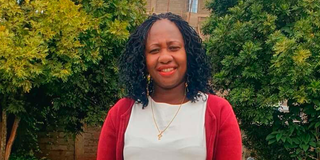
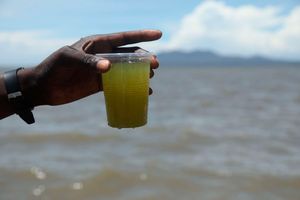
Two years after she was shot during the Gen Z protests, Minnie Gathoni still struggles to hold a full cup of tea with her left hand.
The 25-year-old says injuries she sustained during the anti-Finance Bill demonstrations on June 25, 2024, continue to affect her physically, emotionally and financially as Kenyans prepare to mark the protests’ anniversary.
Standing at the roadside in Waithaka, Kikuyu, where she was shot, Ms Gathoni recalls the day that changed her life.
“As we stood there with my friends, three police Land Cruisers passed. Officers in the third vehicle were hanging outside and one of them aimed his gun at me. That is how I was shot,” she says.
“It was my friend who told me I was covered in blood. That is when I realised I was bleeding profusely from my hand.”
Three bullets struck her left hand, shattering bones and causing severe tissue damage.
With roads blocked, getting medical help proved difficult.
“Most roads were impassable, but we had to find a way to get to Kenyatta National Hospital. I was first taken to a nearby hospital, which gave us an ambulance to KNH. When I arrived, I was patient number 121 with a gunshot wound,” she says.
Doctors warned that any delay could have led to amputation. Over the next two months, she underwent three surgeries, including reconstructive procedures and the insertion of metal implants.
Minnie Gathoni was shot 3 times on her left hand by police officers during the June 25, 2024 Gen Z protests in Waithaka.
Photo credit: Pool
Although her hand was saved, it never regained full function.
“My hand is not the same anymore. I cannot lift heavy things or do many of the tasks I used to do. Even holding a full cup of tea or glass of water is difficult. I cannot do house chores or touch cold water because my hand goes numb,” she says.
Doctors recommended physiotherapy, but each session costs about Sh1,550, making treatment difficult after months without work.
“My mental health has really been affected. Sometimes I sit alone and cry. I underwent counselling, but it still gets to me. I look at my hand and know it will never be the same. How will I earn a living now?” she says.
Several kilometres away, 24-year-old Eugene Arogo is dealing with the aftermath of injuries sustained during a demonstration outside Parliament.
“The teargas exploded on my face and I suffered a deep injury. I was bleeding from the right side of my face and from my thighs,” he says.
Although discharged the following day, he says he continues to suffer lingering health complications.
“To date, I have constant chest pains. Doctors told me it could be due to inhaling teargas particles at close range. During cold weather, my chest aches and the injured leg also hurts,” he says.
Without stable employment, he often struggles to buy medication.
“There are times when I simply endure the pain because I do not have money for medicine,” he says.
Mr Arogo says he has never received formal psychological counselling and that the experience fundamentally altered his perception of law enforcement.
“Whenever I see the police, I view them as the enemy. We were protesting peacefully with flags and water bottles. We were not armed,” he says.
According to the Kenya National Commission on Human Rights, 39 deaths linked to the 2024 protests were documented.
As Kenyans prepare to commemorate the anniversary, both Ms Gathoni and Mr Arogo say they will join the memorial demonstrations despite their experiences and despite not having received compensation.
“I am scared, but I will still go,” says Mr Arogo.
“Those of us who were shot will be there. I am not scared,” she says.
For the two survivors, the anniversary is more than a remembrance. It is a reminder that, while the demonstrations ended, the consequences of that turbulent period remain part of their daily lives.