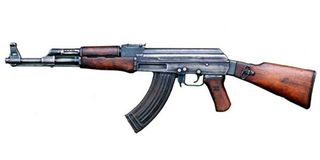
The AK-47, an assault rifle relied on by dozens of security agencies globally, has caused senseless loss, with a new study showing that the weapon accounted for many of the 847 deaths stemming from terror attacks in Kenya.
Kenya has recorded 883 terrorist attacks between February 1975 and May 2022, with 311 incidents—about 35 per cent—involving firearms. These attacks resulted in 847 deaths and 315 injuries.
According to the report, which draws on data from the Global Terrorism Database, a total of 1,162 Kenyan casualties were documented across 236 attacks. An additional 75 incidents reported no victims. The findings further associate a notable share of the violence with Russian-made weapons and their proliferation across Africa.
A key observation in the study by Stephen Bandera, is the prominence of Kalashnikov rifles (AK-47s), which were the only firearms specifically identified in the dataset, even though weapon details were missing in about 74 per cent of the recorded attacks.
“The Kalashnikov and other firearms shooting bullets are supplemented by Russian weapons firing projectiles from simple grenades with a range of a few hundred meters to sophisticated missiles that can fly several kilometers, most notably the Soviet and Russian surface-to-air missiles called SAMs,” read the research.
“Anybody boasting about Kalashnikovs is by extension responsible for all the Buks, Iglas, Pantsirs, Strelas, Tors and Zushkas – Russian weapons that have been used to kill civilians on civilian flights – actual symbols of death and destruction that were being paraded on the Kremlin’s Red Square as late as 2021, even after they were used to down flight MH-17 over Ukraine in the summer of 2014, and flight PS-752 in Tehran in 2020, right before the pandemic,” it added.
The study highlights that between 2007 and mid-2022 alone, Kalashnikov rifles were specifically cited in 39 attacks in Kenya, which led to 188 deaths and 293 injuries. All the victims in these incidents were Kenyans, underscoring the weapon’s central role in domestic terror-related violence.
According to the research memo, the rifle—often associated with liberation struggles—has instead contributed to sustained insecurity, with its proliferation enabling both organised militant groups and criminal networks to carry out attacks with deadly efficiency.
Beyond small arms, the report also links broader patterns of violence in Africa to the circulation of other Russian-made weapon systems, including surface-to-air missiles such as Strela and Igla, which have been implicated in attacks on civilian targets in different parts of the continent.
“485 people died in 13 civilian flights shot down by military aircraft, 365 (75.3%) of whom died as a result of being shot down by 9 Soviet fighters between 1947 and 1989. Soviet and Russian anti-aircraft weaponry ranging from the shoulder-fired Strela to the Buk accounted for deaths of 1,031 people, or 61.4% of the total number of civilians killed by SAMs,” it read.
A Kalashnikov AK-47 gun.
Photo credit: AFP
In Kenya, past incidents such as the 2002 Mombasa attack, where missiles were fired at an aircraft, and an earlier foiled plot in 1976 involving similar weaponry, are cited as examples of the continued threat posed by the spread of such arms.
The findings add to growing concern among security analysts over the long-term impact of illicit arms flows into the region, prompting calls for stricter controls and stronger international cooperation to curb the proliferation of small arms and light weapons.
However, the circulation of illicit weapons in Africa is not limited to a single source. Data shows that arms flow into the continent from Eastern Europe, the Middle East and Asia, alongside those originating within Africa itself, including recycled weapons from past conflicts.
According to the Small Arms Survey, weapons trafficked across Africa include both those imported from outside regions—often through embargo-breaking transfers—and those originating within Africa itself, including recycled arms from past conflicts.
“The weapons trafficked comprise both those sourced from within the continent… as well as arms sourced from other parts of the world, including… Eastern Europe and the Middle East,” the report notes.
Research by the Stockholm International Peace Research Institute (SIPRI) further shows that a significant proportion of illicit weapons are not newly manufactured imports, but arms diverted from legal stockpiles. These include weapons originally supplied by multiple countries but later lost, stolen or resold.
The study highlights diversion as a central driver of proliferation, particularly in conflict zones such as Somalia, South Sudan and the Democratic Republic of Congo, where embargo violations and weak controls allow weapons to circulate beyond their intended users.
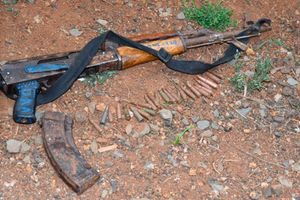
The two AK-47 rifles which were recovered from three suspected gangsters who were shot dead at Shell petrol station in Changamwe, Mombasa on Wednesday July 30, 2014.
Photo credit: File
Beyond imports, analysts point to internal African dynamics as a major source of weapons used in violence. Studies show that cross-border trafficking within the continent is the most common pathway, supported by smuggling networks and the recycling of weapons from previous wars. In many cases, older firearms—sometimes decades old—are continuously recirculated, while locally manufactured “craft weapons” also contribute to the pool of arms.
“Weapons which enter the illegal trade originate from both within and outside Africa,” one analysis found.
Beyond small arms, the report also links broader patterns of violence in Africa to the circulation of other Russian-made weapon systems, including surface-to-air missiles such as Strela and Igla, which have been implicated in attacks on civilian targets in different parts of the continent.
“In summary, the numerous investigations revealed that both sides in the genocide had Iglas (and Strelas, and other Russian weaponry) in their arsenals, and that Russia stepped in to take the place of the Soviet Union as the chief supplier of the weapons of terror and genocide in the a country that Moscow is claiming to have helped “decolonize.” Sure enough, Putin’s Russia in 2026 continues this Russian tradition of supplying weapons to both sides in African conflicts,” it read.