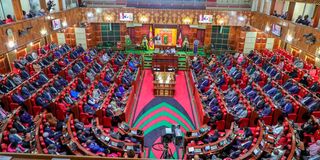
The country may soon have a law guiding public participation, with MPs preparing to debate a proposed Bill from the Attorney-General.
The lawmakers, who resume sittings on Tuesday after a three-week recess, are to give priority to the Bill, which sets parameters on how the three arms of government – the Judiciary, Legislature and the Executive – should conduct public participation. The Bill is among those listed by the National Assembly as a priority.
The National Assembly prepared a draft Public Participation Bill, 2024 and forwarded it to the AG for comments.
A release from the National Assembly indicates that the AG’s Office has undertaken extensive public consultations and subsequently prepared a draft Bill, which has since been submitted to the House for publication.
National Assembly Clerk, Samuel Njoroge, confirmed to the Saturday Nation that he has received the Bill and that it would undergo the normal process before it is published.
“We are going to start republication and then release it to media houses,” Mr Njoroge said.
The Bill is expected to indicate the rights of Kenyans attending public meetings, the applicable methods of public participation and the criteria for their selection by the responsible authorities.
The authorities will also be required to prepare for approval public participation plans, the use of media during public participation, the publication of public participation reports and the mechanism of feedback from the process.
The responsible authorities will also have to state the manner of promoting accessibility to public participation by persons with disability, provide translation and sign language and disclose important information during such an exercise.
This means that no information should be hidden during public participation and then introduced later, as has happened before.
Parliament has been grappling with what exactly constitutes public participation, a question that has led to some Bills passed by lawmakers and signed into law by the President being nullified by courts for failing to consider the views of Kenyans.
Article 118 (1) (b) of the Constitution provides a framework for the enactment of laws to facilitate effective and coordinated public participation, which requires that public processes from policy formulation to legislation and decision-making involve wananchi.
Interior Cabinet Secretary Kipchumba Murkomen is expected to appear before the House plenary on Wednesday afternoon to answer several questions, including the death of blogger Albert Ojwang at Central police station in Nairobi. He had been picked up from his home in Homa Bay by police officers.
The minister will respond to a question from Rarieda MP Otiende Amollo, who is seeking answers on the brutality meted out on protesters and civilians by security agents during the first anniversary of the anti-Finance Bill, 2024 demonstrations.
Awaiting Mr Murkomen, too, is a question by Minority Whip Millie Odhiambo, who wants answers from the government on people dying in police custody.
Ms Odhiambo said apart from Ojwang, many people have died in police cells in many parts of the country.
Mr Murkomen is also expected to provide an explanation on when police officers will be provided with body cameras as part of the reforms he announced last month.
The National Assembly is to consider the Virtual Asset Service Providers 2025, which is to be tabled for second reading following the conclusion of public participation by the Committee on Finance and National Planning.
The Bill seeks to provide a framework to regulate virtual asset service providers and address potential risks and threats associated with the misuse of virtual asset products and virtual asset services.
According to the lawmakers, the Bill seeks to establish the licensing requirements for virtual assets services and the factors that the relevant regulatory authority is to consider while considering an application for a permit.
It also provides the general obligations of virtual asset service providers. Upon resumption, the lawmakers will also give priority to the Election Offences (Amendment) Bill, 2024.
This is among the Bills that emanated from the National Dialogue Committee (Nadco) put together by President William Ruto and Orange Democratic Movement leader Raila Odinga.
The Bill, which is sponsored by Senate Majority Leader Aaron Cheruiyot (Kericho) and his Minority colleague Stewart Madzayo (Kilifi), seeks a prison term of five years or a fine of not more than Sh2 million for Independent Electoral and Boundaries Commission officials found guilty of an electoral offence.
It proposes to make it a crime for members and employees of the commission to unreasonably delay declaring election results or knowingly alter declared outcomes.