Records showing the hospitalisation and a six-month stay at a facility for the homeless in Nairobi have raised vital questions about missed red flags over the years, as detectives seek to uncover the mystery surrounding the man suspected of murdering two patients inside Kenyatta National Hospital (KNH) wards.
Even though he is referred to as Kennedy Kalombotole, this week detectives asked a Nairobi court for ten more days to establish his true identity and address his health concerns.
With no documents, relatives or friends, and no fixed residential address, detectives are racing against time to piece together his profile.
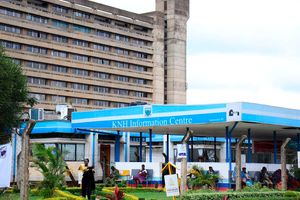
The entrance of the Accident and Emergency unit at Kenyatta National Hospital in Nairobi.
Photo credit: Wilfred Nyangaresi | Nation Media Group
Hospital records indicate that the man, believed to be in his late 20s, arrived alone at the referral facility on July 28, 2023. He was described in the documents as an “urban destitute with no social support”.
From records indicating that he first arrived at KNH sometime in November 2022, this was a return visit – seemingly without paying a shilling and being admitted in an unusually effortless manner.
The records, along with recent court disclosures, show that he was suffering from diabetes requiring regular medication and occasionally experienced convulsions. The mystery deepens from this point: how did such a patient present himself alone at the hospital? Where did hospital staff obtain the name Kennedy Kalombotole, given that he had no documents either at the time or after his admission?
To get a glimpse of his movements outside the hospital, Sunday Nation traced a home run by the Catholic Church, where he spent six months before being returned to KNH. It was at the hospital that he is suspected of committing the first murder just two months later.
Sunday Nation visited the home and separately interviewed three caregivers, who spoke on condition of anonymity as they are not authorised to comment publicly. A KNH social worker involved in the case also declined to respond to questions.
When KNH social workers took Kalombotole to the church-run facility off Thika Superhighway, they pleaded for his case as someone with “no known relatives”.
“Since his admission, he has had no visitors or any contact,” they wrote on his home placement form. The social worker also advised on his medication before leaving him at the charity home, which largely houses physically and mentally challenged individuals.
KNH murders: Mystery of suspect with no ID, abode or known relatives
A police letter supporting his admission to the home added to the mystery. It stated that Kalombotole had been admitted to KNH on July 28, 2023 and discharged a month later on August 10, 2023 – leaving a one-year gap in his whereabouts before his admission to the homeless shelter.
Records show he was taken in on June 13, 2024, the same day he had left hospital. Upon discharge, records showed that he was stable. His bill had reached Sh706,252.
The church-run facility is modest. Men of varying ages sit outside before lunch, some in wheelchairs. For a first-time visitor, it is clearly not a place for the faint-hearted.
Surrounded by residential flats, the temporary serenity created by greenery in the compound is often interrupted by the wailing of men said to be suffering from mental illness – sometimes aggressive, sometimes friendly. There is no office, and the stench of a faulty nearby sewer greets visitors to the prayer room in the compound’s centre.
Caregivers say that during his short stay, Kalombotole was “talkative” and ate well. A few months later, it was recommended that he leave the facility. According to KNH, attempts to return Kalombotole to the home were unsuccessful.
“We had no reason to keep him as he was neither physically nor mentally challenged. He had also become rather demanding and choosy with food, even rejecting the special diet meant for patients with chronic conditions like his,” said the caregivers. “He talked about everything except his surname and origin.”
They now feel relieved that the suspect did not remain longer. Sunday Nation has learnt that detectives are yet to visit the facility.
He left the home on December 11, 2024. KNH tried several times to have him re-admitted, but the facility declined.
A caregiver questioned why he wasn’t simply allowed to return to the streets or seek treatment elsewhere like other patients – and why, more than two years later, no home or family has been traced.
It is also unclear how the man, whose treatment at the country’s top referral hospital had accrued nearly Sh1 million in unpaid bills, was accepted back to the wards – where many scramble for space and must pay.
Once back in hospital, it took just 58 days for him to become a murder suspect.
Mr Gilbert Kinyua, a patient suffering from a rare neurological disorder that causes muscle weakness, was found motionless with his face covered by a blood-stained sheet in Ward 7B. Kalombotole was identified as a suspect but never interrogated.
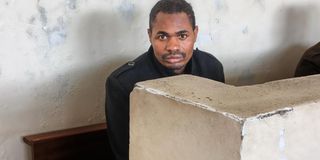
Kennedy Kalombotole at the Kibera Law Courts where he was arraigned for allegedly murdering a patient on July 17 2025.
Photo credit: Richard Munguti | Nation
Then-senior director for medical services William Sigilai said security had been enhanced and assured the public that patients, staff, and visitors were safe.
“We assure the public we are taking all necessary steps to prevent such incidents in future. We urge the public to allow the DCI to conduct investigations without interference and refrain from speculation,” Dr Sigilai said in a statement.
Little was heard afterwards about Kinyua’s death in the early hours of February 7, 2025.
“They (DCI officers) only said they would come back for him,” said a source familiar with the incident, a position echoed by KNH after yet another death.
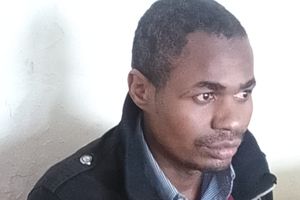
On January 24, 2025, KNH had appealed to the public to identify the man. A poster with his picture – sharp eyes, neatly trimmed hair and shaggy beard – was shared online. There was no response.
“We emphasise that the suspect had been discharged and the hospital did not intend to host him indefinitely. However, lacking alternative options and pending direction from investigative agencies, we had no choice but to allow him to remain,” said Dr Sigilai, now the hospital’s CEO, after the second murder.
On July 17, 2025, he hit the headlines. Another patient, Edward Maingi Ndegwa, was found dead in the same ward. Like the first case, he had a slit throat and was covered with a blood-stained sheet. Same pattern, same location, same suspect – this time, however, the murder occurred shortly after midday visiting hours. A relative had visited the patient earlier.
KNH was still waiting for the DCI’s results from the February incident, but this time the suspect was taken for interrogation.
A source said he becomes evasive when questioned, often claiming illness. He otherwise remains calm – the same demeanour seen in court, where he only speaks to his lawyers and sips water.
This week, the court ordered that he be admitted to Mbagathi Hospital. His lawyers’ attempt to have him returned to KNH failed.
At the homeless facility, he had reportedly become “more responsible”, taking his injections on time.
“He was odd here because he wasn’t physically or mentally disabled like the others. He washed his clothes, followed his treatment routine, and talked freely — except about his family or home,” a caregiver said.
Police now have less than a week while he remains at Mbagathi Hospital. The search for his identity continues – even his fingerprints have yielded no answers.
“Nobody just drops from the sky at 30, with no family, no home, no identity. To suggest he is an alien is insulting,” said his lawyer, Philip Maiyo, after a recent court appearance.
A social worker who signed his records declined to say how his name was obtained, or whether he is a Kenyan or a foreigner.