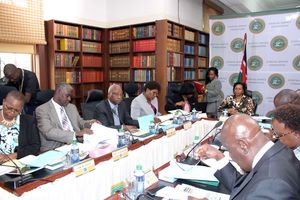
Legal troubles at the Judicial Service Commission (JSC) are once again testing the limits of Kenya’s constitutional architecture, exposing cracks in how judges are held to account and who has the final say.
At the centre of the storm is Chief Justice Martha Koome, the Ombudsman’s attempt to question JSC members over alleged maladministration, a legal gap concerning judges’ dismissal and a growing clash between the JSC and judges.
This is compounded by the Supreme Court judges’ argument that the commission has no authority to discipline them.
The dispute has thrown the accountability framework of the Judiciary into turmoil, even as the JSC – chaired by Ms Koome – lobbies lawmakers for expanded disciplinary powers.
The conflict arose from petitions seeking the removal of the entire seven-judge bench of the Supreme Court over alleged misconduct, misbehaviour and incompetence. The judges then moved to the High Court, insisting that the commission’s constitutional role is limited.
They argued that while the JSC can investigate complaints and recommend removal, it cannot discipline Supreme Court judges or adjudicate over them.
“The JSC does not – whether by virtue of the provisions of the Constitution or any other law – have the jurisdiction to deal with a petition or claim against the judges of the Supreme Court,” state the court documents.
According to the Constitution, the Supreme Court has the ultimate authority over the JSC regarding the removal of judges from office.
The lingering question is where an entire bench of the Supreme Court can file an appeal in case of removal from office.
In the case, the apex judges – including the CJ – say allowing the commission to discipline or sanction them would be an unconstitutional intrusion into judicial independence.
Supreme Court judge William Ouko.
Photo credit: File | Nation Media Group
Supreme Court judge, William Ouko, took the argument further, telling the High Court that even if the JSC had disciplinary authority, it lacked the legal framework to enforce it.
“There are no regulations to guide the receipt, investigation and determination of complaints against judges,” Justice Ouko argued, adding that without such rules, any action by the JSC would be legally void.
Lady Justice Dora Chepkwony.
Photo credit: Mercy Mwende I Nation Media Group
This argument gained support in another case filed with the JSC against High Court Judge Dora Chepkwony.
In a December 2025 ruling, a three-judge bench held that until the JSC gazettes regulations under Section 47 of the Judicial Service Act, it cannot process complaints against judges.
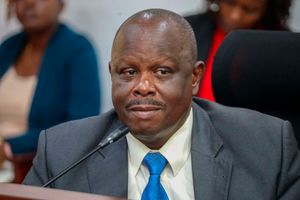
Judicial Service Commission vice-chairperson Isaac Ruto.
Photo credit: File | Nation Media Group
The decision effectively froze dozens of complaints and struck at the heart of the JSC’s oversight role.
The commission moved to the Court of Appeal and secured a temporary stay of the High Court judgment last week.
Recently, the JSC urged Parliament to amend the law and expand its powers to discipline judges.
The proposals were presented to the National Assembly’s Constitutional Implementation Oversight Committee by JSC Vice-Chairperson Isaac Ruto.