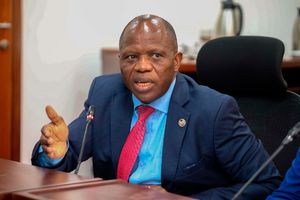
The Court of Appeal has ordered the return of two luxury vehicles and more than Sh34 million held in a bank account to a businessman after ruling that the Assets Recovery Agency (ARA) failed to prove they were proceeds of crime.
The appellate court overturned a High Court judgment that had declared the assets liable to forfeiture, saying investigators failed to establish any link between the property belonging to businessman Anthony Kepha Odiero and criminal activity.
The judges said that although ARA had raised questions about the volume and nature of transactions in Mr Odiero’s accounts, it had not identified any specific criminal enterprise, predicate offence, money laundering scheme, fraud, corruption, tax crime or other unlawful activity from which the funds were allegedly derived.
“What the law requires is proof of a clear, demonstrable and objectively ascertainable connection between the impugned assets and unlawful activity. Unless and until that connection is established, the evidential burden does not shift to the citizen to account for the source of his assets,” the judges said.
The appellate court said investigators failed to establish any link between the Odiero's property and criminal activity.
Photo credit: File | Nation Media group
The court observed that substantial cash movements, unusual banking patterns and deficiencies in financial records were, on their own, insufficient grounds for forfeiture under the Proceeds of Crime and Anti-Money Laundering Act (Pocamla).
“Ultimately, forfeiture proceedings cannot properly be founded upon mere suspicion alone, however strong, or upon dissatisfaction with the explanation offered by the owner of the property,” the court said.
ARA had told the court that investigations into allegations of money laundering and drug trafficking against Mr Odiero revealed that he had acquired assets using proceeds of crime.
The agency said he would make cash deposits in small amounts, usually below Sh1 million, to avoid triggering mandatory reporting requirements.
Between 2020 and 2023, a total of $596,500 was deposited into his accounts. However, ARA admitted that it had not established the source of the money but concluded that it was proceeds of crime intended to be laundered.
When asked to explain the deposits, Mr Odiero said he had accumulated his wealth through various business ventures and international consultancy engagements.
He described himself as a businessman and Director General for East and Central Africa of the TransPacific Africa Chamber of Commerce and Industry.
He said he was a director of three companies: AIB Associates Limited, a consultancy firm; AIB Petals Limited, which trades in flower exports; and Insurance Brokers Limited, which provides general insurance services.
He maintained that his businesses involved exporting fresh-cut flowers, insurance brokerage and international consultancy, with payments often made in US dollars and euros.
Mr Odiero also said he owned several properties, including an apartment and motor vehicles.
In addition, he told the court that he had secured a contract to negotiate the lease of several helicopters from Kenya for use during the 2023 Malagasy presidential election campaigns. He said he received a down payment of $120,000 in cash.
He further explained that cash payments were common business practice in the United Arab Emirates, where he received money for flower sales, brokerage services and consultancy engagements.
The High Court, however, had questioned why he would travel to European and Asian countries to collect payments in cash before returning to Kenya to deposit the money.
“If that was the case, did he make any declarations for the huge amounts of money in accordance with Section 12 and Second Schedule, Conveyance of Money Instruments to or from Kenya? In the opinion of the court, even if that was the case, it would still be a suspect transaction designed to defeat the reporting requirements and thus a suspicious conduct,” the judge said.
The High Court had also found that the only transaction Mr Odiero satisfactorily explained was a consultancy payment of Sh10 million received on September 28, 2021.
The Court of Appeal, however, said he had presented evidence explaining the sources of the funds through his business and consultancy engagements, as well as documentation relating to the acquisition of the vehicles.
The judges said the issue was not whether his explanations were convincing but whether ARA had first established that the assets were connected to criminal activity.
“As already stated, we are unable to identify evidence showing that the investigations disclosed a predicate offence or unlawful activity from which the impugned funds arose,” the court said.
The judges emphasised that under Pocamla, ARA bears the initial burden of proving, on a balance of probabilities, that property targeted for forfeiture is proceeds of crime.
They said the burden only shifts to the property owner after the agency establishes a prima facie case linking the assets to unlawful conduct.
“We therefore agree with the appellant that whereas criminal proceedings need not result in prosecution or conviction, there must be evidence of criminal investigations tending to establish reasonable nexus between the assets sought to be forfeited and criminal acts committed or intended,” the judges said.
The court further faulted the High Court for failing to distinguish between forfeiture proceedings under Pocamla and unexplained assets recovery proceedings under Section 55 of the Anti-Corruption and Economic Crimes Act.
It said the two legal regimes were distinct, with Pocamla requiring proof that the property in question was derived from criminal activity.
The judges added that the law was intended to prevent criminals from benefiting from unlawful activities, not to confiscate property merely because its ownership or acquisition raised suspicion.