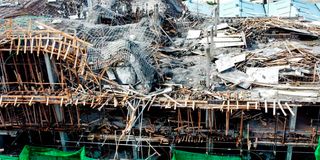
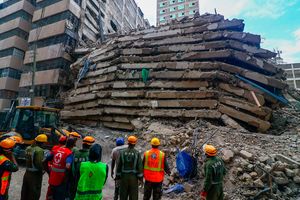
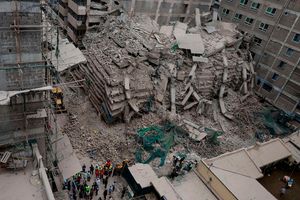
Six people were killed and five others injured after an eight-storey building under construction collapsed along Mombasa Road in Nairobi on Friday, raising fresh questions about construction safety and accountability in the sector.
Authorities said 405 people were at the construction site when the building came crashing down, with all of them eventually accounted for.
“So far we have confirmed six bodies, but also five people have been rushed to Imara Daima Hospital,” Duncan Ochieng, the Assistant Inspector-General of Police in charge of disaster management, told journalists at the scene.
Ochieng said the upper section of the multi-storey building gave way while construction work was underway, prompting an emergency response and the closure of the site.
“Three bodies were retrieved during the initial morning operations, while three more were recovered later from the debris. All six victims were middle-aged men,” said Nairobi County Chief Officer for Disaster Management Bramwell Simiyu.
The county fire team and the Urban Search and Rescue (USAR) team were deployed to the scene to comb through the rubble for anyone who might have been trapped.
The building collapsed in the Syokimau area, southeast of Nairobi, the Kenya Red Cross said in a post on X.
The incident comes less than a month after an 18-storey building collapsed in Nairobi’s Eastleigh area on October 23, killing eight people and leaving several others missing.
The latest tragedy has once again drawn attention to Kenya’s persistent building safety crisis, despite repeated warnings, regulatory inspections and enforcement measures.
Data from the Ministry of Lands, Public Works, Housing and Urban Development shows that 100 buildings have collapsed in the last 30 years resulting in the deaths of more than 40 people in the last five years alone.
Who is responsible for Nairobi's deadly buildings?
The highest annual number of building collapses reported in 2022, when 13 incidents occurred.
The ministry’s records show 12 collapses each in 2021 and 2023, nine in 2018 and seven in both 2015 and 2019. Four incidents were recorded in each of 2024 and 2025.
Building safety remains a major challenge, with inspections by the National Construction Authority (NCA) revealing widespread non-compliance with development permits and construction standards.
Between July 2025 and April 2, 2026, the authority inspected 21,282 construction sites across 14 regions. Of these, 12,018 were suspended, while only 9,264 met the required standards, representing a compliance rate of 43.5 per cent.
Nairobi recorded the highest number of inspections, at 3,908 sites, of which 1,647 were suspended for non-compliance. The region had a compliance rate of 57.86 per cent.
The Western region recorded the highest compliance rate, at 77.83 per cent, followed by Mount Kenya at 65.88 per cent. North Eastern had the lowest compliance level, at just five per cent, with only 11 of the 220 sites inspected meeting the requirements.
Upper Eastern recorded a compliance rate of 14.93 per cent, while Central Rift and Coast had rates of 18.38 per cent and 20.25 per cent, respectively.
Other regions included South Nyanza at 54.46 per cent, Lower Eastern at 52.05 per cent, Kajiado at 48.30 per cent, Kiambu at 43.94 per cent, Central Eastern at 32.88 per cent, North Rift at 29.64 per cent and Central Nyanza at 20.68 per cent.
Building collapses in Kenya have been linked to poor workmanship, substandard construction materials, inadequate supervision and faulty structural designs, according to the State-run Kenya Institute for Public Policy Research and Analysis (Kippra).
The NCA has enforcement measures targeting developers and other industry players found to have violated construction regulations. These include suspension of construction works and possible arrest.
Under the enforcement framework, the authority is required to provide information relating to an alleged offence to the officer in charge of a police station, who can then initiate the arrest process.
Where a developer addresses violations identified by an NCA officer, the authority may lift the suspension after establishing that the construction site complies with the required standards.
The authority has also established an enforcement unit comprising 15 police officers to support inspections in areas where non-compliance has been reported and enforcement action is required.
Section 23(3A) of the National Construction Authority Act provides that a person found guilty of wilfully failing to comply with an investigating officer’s order faces a fine of up to Sh1 million, imprisonment for up to three years, or both.
“A person who wilfully fails to comply with an order of an investigating officer under subsection (3) commits an offence and shall be liable on conviction to a fine not exceeding one million or imprisonment for a term not exceeding three years or both,” reads the Act.
As at March 31, 2026, the authority had secured 15 successful convictions across various counties, according to the report.
However, the report notes that few investigations into building collapses are completed and result in prosecutions, a gap it says has emboldened those responsible for construction violations.
All construction projects are also required to comply with the National Building Code 2024, which sets standards for building design, construction and maintenance to promote quality, safety, health and environmental protection.
An aerial view of the site of the collapsed building in Eastleigh, Nairobi as excavators clear debris on October 30, 2026.
Photo credit: Bonface Bogita | Nation Media Group
“A person who engages in construction works or a person who owns or occupies a building shall comply with the code,” reads Regulation 5.
Regulation 6 further provides that building designs and the supervision of construction works must be undertaken by professionals registered in their respective fields.
These include physical planners, architects, engineers, land surveyors, building surveyors, quantity surveyors, accredited site supervisors and skilled workers, who must be registered under the relevant laws.
Despite the repeated collapses and loss of lives, accountability for developers and building owners remains a major weakness in the enforcement of construction regulations.
The relatively small number of successful convictions compared with the number of reported collapses raises questions about whether those responsible for unsafe developments are being adequately held to account.
While the NCA has powers to suspend construction works and pursue offenders, the low number of completed investigations and prosecutions suggests that enforcement has not been strong enough to deter violations or prevent further tragedies.