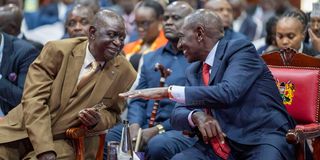
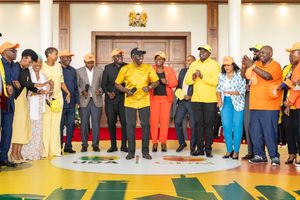
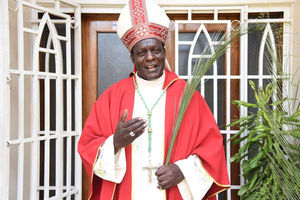
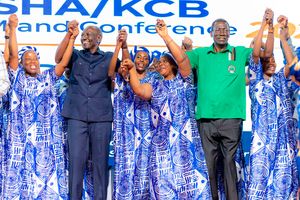
The President William Ruto-led United Democratic Alliance (UDA), Dr Oburu Oginga’s Orange Democratic Movement (ODM) and Dr Fred Matiang’i’s Jubilee Party took the lion’s share of taxpayer funds given to political parties for the year up to June 30, a report tabled in the National Assembly shows.
Forty-seven parties that took part in the 2022 General Election received a total of Sh2.26 billion in disbursements. Combined, the top three took home 79 per cent of the amount.
According to the report, prepared by the Registrar of Political Parties, the total allocation for the 47 parties was 1.98 billion for the 2025-26 financial year.
Out of that amount, ODM was allocated Sh421.22 million. It was the only party that got a supplementary allocation during that period, amounting to Sh380 million. This, added to its balance brought forward of Sh634,896, saw ODM bag the biggest chunk of the allocation at Sh801.85 million.
Wiper party leader Kalonzo Musyoka..
Photo credit: File | Nation Media Group
Kalonzo Musyoka’s Wiper Patriotic Front was fourth with Sh98.81 million as Eugene Wamalwa’s Democratic Action Party-Kenya received Sh43.20 million.
Other parties that have also received double-digit millions include the United Democratic Movement (Sh36.83 million), Ford-Kenya (Sh35.33 million), the Kenya African National Union (Sh32.89 million), Devolution Empowerment Party (Sh18.83 million) and Maendeleo Chap Chap (Sh17.25 million).
At least 48 political parties participated in the 2022 General elections and therefore qualified to benefit from the billions of taxpayers’ money in order to run their affairs.
According to the law, 70 percent of the fund is shared based on the total number of votes secured by each political party in the preceding general election and 15 percent based on the number of elected candidates from special interest groups.
Another 10 percent of the fund is given to parties based on the total number of elected representatives (MPs, Senators, Governors, MCAs) belonging to the party while five percent is allocated for administrative expenses of the Office of the Registrar of Political Parties
However, the amount given to political parties might be lower than the set benchmark.
According to a report by the Auditor-General that has since been presented to Parliament, the amount that was given to the Registrar of Political Parties for onward disbursement to qualified political parties was below the required constitutional threshold.
The Political Parties Act requires that not less than 0.3 percent of the national government’s share of revenue should be allocated to the fund.
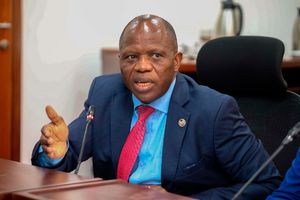
Auditor-General Nancy Gathungu.
Photo credit: Wilfred Nyangaresi | Nation Media Group
In the year under review, Ms Gathungu said in her report for the year ended June 2026, the national government’s share of revenue was Sh2.33 trillion, meaning that the fund was supposed to be given ShSh6.997 billion which represents 0.3 percent.
“The underfunding may have negatively affected the planned activities for the 47 eligible political parties that were to receive the fund,” reads the audit report.
Ms Gathungu noted that despite various political parties providing addresses for their headquarters and county offices prior to registration, a verification visit done in March 2024 revealed that a majority of the offices only existed on paper.
“It was observed that the majority of them did not have offices in more than half of the counties and there was no evidence of independent verification of the party offices by the fund,” reads the audit report.
According to the report, political parties attributed the closure of their county offices to inadequate funding from the Political Parties Fund, which made it difficult for them to afford rent for their offices after registration.
“The parties could not recruit staff to operate the offices in the counties and had to rely on volunteers for party activities due to inadequate funding,” reads the report.
Having branch offices means paying rent and hiring, so most parties just meet the requirement during the registration only then close down the branch offices later.
“A provisionally registered political party shall be qualified to be fully registered if it has submitted to the Registrar of Political Parties the location, addresses of the branch offices, which shall be in more than half of the counties,” reads section 7(2) (f) (iii) of the Political Parties Act
Under the Act, as the regulator of political parties, the Registrar of Political Parties is also mandated to ensure that all parties adhere to the provisions of the law.