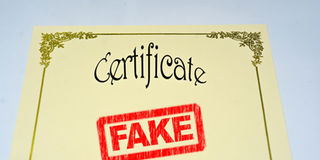
Public service workers with fake academic certificates will continue beating the system because authorities don’t have the right verification tools.
This is because the government’s outdated technology makes it difficult to detect questionable qualifications, the Public Service Commission (PSC) chairman, Francis Meja, has revealed.
Mr Meja made these revelations to the National Assembly Committee on Cohesion and Equal Opportunity last Thursday.
The fraudulent rush to acquire degrees ahead of the August 2027 general elections is expected to gain momentum as people seek to comply with the law.
In January, the government sacked 449 civil servants out of the 1,019 staff found to have used fake academic certificates to get employment.
Photo credit: File | Nation Media Group
Against the backdrop of staffing gaps and governance concerns in the public service, the PSC chairperson noted that the outdated system makes verification slow and costly.
“The commission is relying on old technology to verify and weed out fake papers. As a result, the process takes too long and is expensive,” Mr Meja said during a meeting with the committee chaired by Mandera West MP Adan Yussuf Haji.
He spoke after Ndhiwa MP Martin Owino raised concerns that the commission, which is the government’s human resource agency within the mainstream public service, had failed to deal with the rising use of forged certificates to secure jobs and promotions within the public sector.
During his vetting for the PSC chairperson job by the National Assembly Labour committee in mid-February this year, Mr Meja vowed to crack the whip on public servants with fake certificates and ghost workers.
“I believe that the issue of ghost workers in the public service and fake certificates held by civil servants has been allowed to go on due to negligence or corruption. Why is it that we don’t have ghost workers in the private sector?” posed Mr Meja.
“If I am appointed a member of PSC, ghost workers and fake certificates will not happen again. Not under my watch,” he said.
Through circulars, PSC required organisations to authenticate academic and professional certificates used by officers to secure appointments and promotions.
Public Service Commission (PSC) Chairperson Francis Meja.
Amb Simon Nabukwesi, the former University Education Principal Secretary in the immediate former President Uhuru Kenyatta’s administration, told the Public Accounts Committee (PAC) of the National Assembly that “the issue of individuals presenting fake degrees is a matter that concerns a lot.”
“We will take precautionary measures. We will write to the Universities cautioning them against giving out fake degrees. In fact, this morning we were discussing a university Professor with a fake PhD degree,” PS spoke during the 12th parliament, adding, “right now we are establishing our capacity to crack down on this vice.”
The PS went on to tell the committee that he had directed the Kenya National Qualification Authority (KNQA) and the Commission for University Education (CUE) to work closely to ensure that those with dubious academic papers are locked out of the elections.
However, with Mr Meja’s admission, it’s like the government did nothing to authenticate the academic papers issued by the universities, even as he divulged that “plans are underway for the PSC to work with CUE and KNEC to roll out a modern, integrated system capable of instantly authenticating academic documents.”
“We are carrying out reforms with the two institutions that will enable us to detect a fake academic document at the press of a button,” said the PSC chairperson.
According to Mr Meja, “interfacing KNQA, KNEC, and CUE systems will see job applications made to the PSC using fake academic certificates rejected instantly.”
The meeting with the MPs also exposed internal capacity challenges at the PSC, with CEO Mr Paul Famba explaining that there is a significant staffing shortfall hampering operations in the commission.
“The approved staff establishment is 518, but we currently have only 273 employees, leaving a gap of 245,” said Mr Famba, even as MPs said that it is ironic that the body mandated to recruit public servants “is itself understaffed.”
The issue of ghost workers in the public sector is widespread across government, with a 2024 report finding over 17,000 unaccounted-for staffers across various ministries and corporations.
The entrance to the Kenya Medical Training College in Nairobi. The institution will establish its first ever branch in Samburu
For instance, the commission in a report released last year, revealed that Kenya Railways, Kenya Medical Training College (KMTC), and Moi Teaching and Referral Hospital (MTRH) topped the list of State agencies that sacked 202 out of 650 staff found to have forged academic documents to secure jobs.
A January 2024 PSC report also exposed 156 "ghost workers" at Kenya's State House, where 1,689 staff were recorded in the database against only 1,533 confirmed by physical headcount.
This follows earlier reports from 2024 showing hundreds of unaccounted employees, marking a persistent challenge in payroll management.
The commission has since directed State agencies to verify databases in a push for a unified Human Resource (HR) system to eliminate manual, error-prone, and fraudulent systems.