A lobby group has moved to court seeking to stop the government from undertaking any prospecting or mining activities at the mineral-rich Mrima Hill in Kwale County, pending the determination of a petition.
Centre for Litigation and Trust wants the court to issue conservatory orders suspending the implementation of a preliminary agreement allegedly signed between the Kenyan and United States governments for the exploration and extraction of rare earth minerals at the site.
The organisation also seeks orders compelling the government to disclose the terms of the agreement, including the contractual framework, environmental impact assessments, ownership structure and benefit-sharing arrangements.
The lobby has named the attorney-general, the Ministry of Mining, Kwale County Government, National Museums of Kenya and the Kenya Forest Service as respondents in the case.
The petition follows reports that Kenya and the USA had finalised a preliminary agreement to develop rare earth and associated mineral deposits at Mrima Hill, one of the country's most valuable mineral deposits.
According to court papers, President William Ruto disclosed during an interview on the sidelines of the G7 Summit in France that the government, through Mining CS Hassan Joho, had launched a competitive tender process to commercialise the deposits.
The lobby group says Mrima Hill contains significant deposits of niobium and rare earth minerals estimated to be worth about Sh9.7 trillion.
It says niobium is used to strengthen steel for jet engines, oil pipelines and aerospace equipment, while rare earth elements such as yttrium, lanthanum and neodymium are critical in the manufacture of electric vehicle batteries, missile guidance systems and artificial intelligence hardware.
The organisation's director, Mr Julius Ogogoh, argues that the process leading to the agreement lacked transparency and excluded key stakeholders.
"There is a lack of transparency surrounding the preliminary agreement. The people of Kwale County and Kenyans generally have no knowledge of its terms or the framework governing its implementation," he says in court documents.
Mr Ogogoh says details of the agreement remain secret, including environmental impact assessments, ownership arrangements and benefit-sharing mechanisms.
He argues that there are no clear legal guarantees on how revenues would be shared between the national government, the Kwale County government and local communities.
The lobby group further claims that residents, community forest associations and local leaders have been excluded from discussions on the proposed mining project.
It argues that Article 10 of the Constitution requires public participation, transparency, accountability and sustainable development in decisions involving public resources.
"The people of Kwale must know what economic benefits they will derive from the mining activities and be allowed to express concerns about possible radioactivity and other health hazards," Mr Ogogoh says.
The petitioners contend that the national government failed to involve the county government despite devolution assigning counties responsibilities relating to environmental conservation, land-use planning and implementation of policies on natural resources.
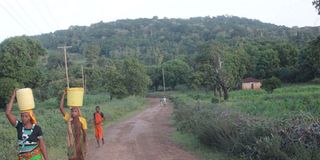
Cortec workers at the Mrima Hill niobium mining site in Kwale.
Photo credit: File | Nation Media Group
They argue that county governments should participate in negotiations involving the exploitation of natural resources within their jurisdictions.
The group also raises environmental and cultural concerns, saying Mrima Hill is a protected indigenous forest, a national monument and a natural heritage site.
According to the petition, the area contains sacred Kaya shrines that are culturally significant to the Mijikenda and Digo communities and forms part of an ecologically sensitive forest ecosystem protected by law.
The lobby group says Section 7 of the Mining Act prohibits mining activities in protected areas, including gazetted forests and national monuments.
Mr Ogogoh argues that mining operations at Mrima Hill would threaten indigenous land rights, water resources, cultural heritage sites and the forest ecosystem.
"It is evident that there has been a deliberate attempt to exclude bona fide stakeholders, rendering any public participation process ineffective, non-inclusive and unlawful," he says.
The organisation wants the court to halt any further implementation of the Kenya-USA agreement until the issues raised in the petition are heard and determined.