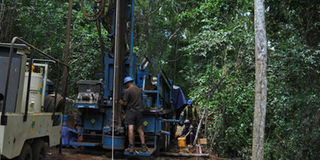
Cortec workers at the Mrima Hill niobium mining site in Kwale.

In June, residents of Mrima in Kwale County were startled when an unlikely visitor descended on their quiet village. Marc Dillard, then the United States Chargé d’Affaires, arrived in a siren-blaring convoy that shattered the stillness of the coastal settlement. The diplomat was driven up the steep road to Mrima Hill, where he held closed-door conversations with locals and Kaya elders.
Nothing on the ground has changed since that high-profile visit. But beneath the forested hill lies something that has drawn the attention of global powers for more than a decade: some of the world’s highest-grade rare earth minerals and significant niobium deposits. The scramble for control of this hill, double-gazetted as a forest reserve and a national monument, has quietly intensified, pulling the United States, China, Australia, and other actors into a geopolitical tug-of-war.
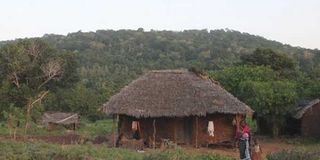
A house at the foot of Mrima Hill in Kwale County. The region is believed to be rich in rare earth minerals. Controversial businessman Jacob Juma, who was killed on May 5, died on the same day that he filed submissions in a case he had filed against the Kenyan government for Sh2 trillion for cancelling his mining licence to Mrima Hill. PHOTO | WACHIRA MWANGI | NATION MEDIA GROUP
Months before the American diplomat’s visit, villagers reported repeated encounters with unidentified Chinese nationals roaming the area, probing for information and sounding out residents about possible “community projects” in exchange for access. None were allowed into the sacred Kaya Mrima forest, where elders conduct rituals central to the Mijikenda’s cultural identity.
Community members handed Mr Dillard a memorandum outlining expectations for any investor: jobs for locals, cultural protections, land compensation, and a clear relocation framework. Yet the competing visits by foreign actors have left villagers uncertain and cautious.
Australia has also waded in. RareX, an Australian Securities Exchange–listed firm, has teamed up with Iluka Resources to pursue exploration rights, signalling strategic interest from another US ally.
According to previously published reports on feasibility studies carried out by Cortec Mining Kenya Limited Company, Mrima Hill has mineral deposits worth $62.4 billion (Sh8 trillion). The area also has niobium deposits estimated to be worth $35 billion (Sh4.5 trillion).
The company, which used to have the mining licence for Mrima Hill in 2013, confirmed a deposit of 680 million kilogrammes of niobium. Its licence was cancelled in March 2014.
Niobium is a key mineral used in making steel and high-tech electronic products whose demand is currently high globally. These results put Mrima Hills in Kenya on the global map as containing some of the highest rare mineral deposits in the world.
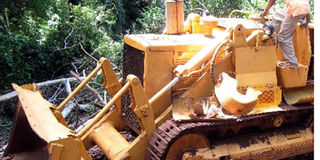
A bulldozer at a niobium and rare earth project site at Kaya Mrima Hill. The announcement of a Sh5.6 trillion mineral find in Kwale County has triggered a row over land ownership.
However, in January 2024, the government floated a tender "to undertake a detailed feasibility study on niobium and rare earth elements occurrences in Mrima Hill and surrounding area within Kwale County."
A Critical Minerals Catalogue released in August this year by the Ministry of Mining noted that most areas remain at the reconnaissance or early exploration stages, with limited systematic evaluation of their economic viability.
"This accentuates the urgent need for modern, data-driven exploration strategies, including geophysical surveys, geochemical assays and mineralogical characterisation. Additionally, the importance of coordinated efforts between the government and the private sector in improving mineral intelligence and investment readiness is emphasised," the report stated.
Mrima Hill is as contested as it is significant. The Kenya Forest Service recognises it as a forest reserve, while the National Museums of Kenya classifies it as a protected cultural monument; earning its title as a double-gazetted forest. Kaya Mrima, hidden deep within, serves as a spiritual sanctuary for the Mijikenda.
Rich rare earths
Ecologically, the hill is a biodiversity hotspot, home to rare species of indigenous plants and animals. But globally, it is Mrima’s mineral deposits that dominate discussion: some of the richest rare earths outside China, making it a prized site as countries race to secure supply chains for electric vehicles, defence technology, renewable energy, and advanced manufacturing.
Local leaders insist the community must not be sidelined again. Ayub Suya, secretary of the Mrima Hill Community Forest Association, said tension remains high as rumours swirl about renewed exploration efforts.
“As the CFA, legally mandated to co-manage the forest, we are central to any discussions,” Mr Suya said. “Nothing should happen without the community.”
Kwale Governor Fatuma Achani echoes that sentiment but with an even harder line. She says there will be no talks on Mrima’s future until outstanding royalties from previous mineral extraction in the county are settled.

Kwale Governor Fatuma Mohamed Achani.
Her frustration stems from the Base Titanium project, which extracted mineral sands, zircon, rutile and ilmenite, before wrapping up operations last year. The county is still waiting for its share of royalties.
“We are yet to see the benefits of minerals already depleted,” Governor Achani said. “How then do we start talking about Mrima? The community has not received a cent.”
Under the Mining Act, royalties are shared 70 percent to the national government, 20 percent to counties, and 10 percent to communities. In 2023, Base Titanium paid USD 15.5 million (about Sh2.9 billion) in royalties, out of which Kwale was expected to receive Sh1.2 billion. The money is yet to reach the county or affected villages.
Residents displaced during the titanium project say they received inadequate compensation and no royalty benefits, leaving them wary of new promises.
Former Ambassador and Digo community spokesperson Chirau Ali Mwakwere says locals will not allow another extraction project without direct involvement.
“Nobody will prospect these minerals without the community,” he said.
He went on: “We want to benefit from what comes from us. We welcome any investor to invite us because nobody will prospect the minerals without the direct involvement of the community.”
Despite growing foreign interest, the national government has remained largely silent. The State Department for Mining has not clarified whether companies seeking rare earth or niobium licences have applied. Principal Secretary Harry Kimtai did not respond to questions about pending applications. We had also asked him to outline the ministry’s next steps.
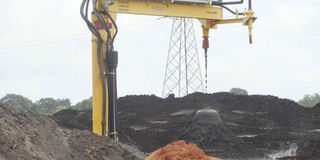
The tailing stucker separating the minerals from the soil at Titanium mining base in Kwale on September 17, 2014. PHOTO | LABAN WALLOGA | NATION MEDIA GROUP
An examination of the national mining cadaster shows that Mrima (Block 256) is marked as “previously licensed,” but no active licences are listed. The lack of clarity combined with reports of foreign envoys and investors making quiet approaches has fuelled speculation.
Oddly, Kenya’s own Strategic Plan for Mining (2023–2027) barely mentions rare earths, even though Mrima is recognised internationally. The plan emphasises lithium, graphite, niobium and titanium, leaving rare earths in regulatory limbo.
In his recent State of the Nation address, President William Ruto said the government would use the Sovereign Wealth Fund to ensure that future mineral extraction secures gains for generations.
“History has warned us,” he said. “Along the Coast, titanium deposits have been depleted—and because we lacked a sovereign wealth framework, future generations will inherit nothing.”
Records show that interests in the Mrima Hill minerals by foreign countries have been present for many decades.
A 1991 report by the Japan International Cooperation Agency (Jica) on mineral exploration in the Coast region noted that niobium and rare earths in Mrima Hill have long been explored since the early 1950s.
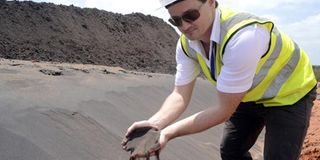
Base Titanium Manager for External Affairs Simon Wall displays the minerals produced at their factory in Kwale County on January 28, 2014. Mineral yield increased in the quarter that ended in December 2014.
According to the report, interest was first shown in the deposit after the then Mines and Geological Department had completed a prospecting program for niobium in the early 1950s which indicated reserves of 30 million tonnes.
"Anglo American Prospecting Co (Africa) Ltd. started a comprehensive exploration program in 1955 together with metallurgical tests to establish a viable method of recovering the niobium, but in 1957 it gave up its exploration licence. The reason for this was because the deposit was low grade and the friable nature of the pyrochlore crystals which led to sliming on treatment, made the deposit uneconomic," the report states.
The Mines and Geological Department carried out further tests in the 1960s together with Warren Spring Laboratory of the UK, but did not provide the breakthrough necessary to stimulate commercial exploitation of Mrima Hill. At the time, a higher grade deposit was already being exploited at Araxa in Brazil.
The occurrence of rare earth concentration in parts of Mrima Hill was of greater significance, however, and the deposit was re-examined by various mining companies. Rhone Poulenc, headquartered in France, was the most persistent and carried out a comprehensive exploration of the Mrima in 1968, followed up by successful metallurgical tests to recover the rare earths," it adds.
Jica further noted that in 1979, the company was given the right to develop the deposits by the Kenya Government. However, by the time of compiling the report in 1991, no significant progress had been made and this remains the situation to date.
The agency described the minerals as "one of significant resources of this kind in the world."
But behind the silence, the race for one of Kenya’s most valuable mineral sites is gathering momentum. And as global powers circle, the fate of Mrima Hill will be shaped as much by geopolitics as by the memories of a community still fighting to be heard.
Follow our WhatsApp channel for breaking news updates and more stories like this.