Lawmakers are warning that the Sh195.8 billion funding shortfall in the fiscal year 2026/27 threatens to cripple Kenya’s education sector, with millions of learners in primary, Junior Secondary Schools (JSS), tertiary and university education facing uncertainty.
Of the funding gap in the sector, Sh138.8 billion is in the tertiary and university sector under the State Department for Higher Education and Sh57 billion for primary, JSS and senior secondary schools managed under the State Department for Basic Education.
National Assembly Committee on Education, in a report on the estimates to the House Committee on Budget and Appropriations, warned that the gaps will severely compromise the quality of education in the country.
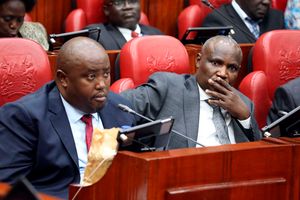
Chairperson of the National Assembly Committee on Education Julius Kibiwot Melly.
Photo credit: Dennis Onsongo | Nation Media Group
The committee, chaired by Tinderet MP Julius Melly, notes that the Sh135.3 billion allocated for the State Department for Basic Education is a drop in the ocean.
“This gap implies that the learners will not be funded based on existing policy,” reads the committee’s report, adding: “The underfunding will put a strain on the institutions.”
The report also revealed that the State Department for Higher Education, which has been allocated Sh164.1 billion in the next financial year, has a funding gap of Sh56 billion in loans for university students, Sh38.5 billion in the scholarships funding programme and a gap of Sh44 billion accumulated in the last two financial years.
Key priority areas for the State Department for Basic Education are funding towards primary, junior and senior schools in terms of the provision of capitation, examination management, school meals programmes, quality assurance, as well as funding for infrastructure improvement in primary and secondary schools and the Teachers Training Colleges (TTCs).
However, the committee cited the provision of capitation as among the areas severely hit despite recording increased enrollment of learners.
The Sh57 billion funding gap is distributed such that 23.7 billion is a shortfall for capitation senior schools, Sh23.7 billion for Junior Secondary Schools (JSS) and Sh8.6 billion for primary schools’ capitation.
According to the capitation funding policy, Sh22,244 is allocated per student in senior secondary schools, Sh15,042 in JSS and Sh2,330 for learners in primary schools.
Confusion in student transition
Notwithstanding the funding gaps with the basic education sector, the committee has slashed Sh2.3 billion meant for capitation to support payment of examination invigilators as well as quality assurance in schools.
The committee also decried the lack of a “clear” policy on the placement of learners to senior schools.
“The recent transition led to some schools admitting more than their capacity, resulting to overcrowding, putting serious strain on facilities,” the committee’s report reads. With this, a number of schools have been found not to have students, "yet heavy investments have been made to put up the schools.”
“This has created an impression that there are excess schools, which is not the case,” says the committee, even as it flagged the fragmented nature of support to learners in terms of school fees payment.
The committee established that various government entities and the private sector are involved in funding the learners.
“This uncoordinated approach has led to many instances of duplication of this support, with a possibility of even loss of public resources.”
This as the committee put on notice to Principals and Head Teachers who are not adhering to circulars from the Ministry of Education on fees charges, issuance of certificates, among others, warning that this confuses stakeholders, “creating uncertainty in the sector”.
A teacher in class during a Chemistry lesson at Langalanga Senior School in Nakuru County on February 5, 2026.
Photo credit: Boniface Mwangi | Nation Media Group
Also flagged by the committee is the fact that funding for co-curricular activities is done from the department’s headquarters and also receives support from the Sports, Arts and Social Development Fund.
The committee notes that under this arrangement, funding does not reach schools promptly, “creating unnecessary interruptions in the running of the co-curricular activities calendar in schools.”
“The need to ensure that co-curricular activities are adequately and timely funded is critical, given that sports, arts and music are a critical pathway under the CBE curriculum,” the report reads.
The MPs further note that there are many areas and regions where learners are not benefitting from the school meals programme “yet these are also disadvantaged regions.”
With this, the committee notes the need to reassess and re-map the beneficiary areas afresh to ensure the intended purpose of “these programmes is realised.”