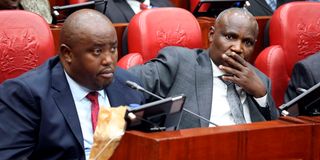
National Treasury Cabinet John Mbadi openly clashed with the MPs over the controversial decision to strip the Ministry of Energy and Petroleum Development of critical agencies and over Sh55 billion in funding, redirecting the huge budget to the newly formed but yet to be operationalised National Infrastructure Fund (NIF).
The members of the National Assembly Energy Committee said the decision to transfer Kenya Electricity Generating Company (KenGen), Kenya Power (KP), Kenya Electricity Transmission Company (Ketraco) and Geothermal Development Company (GDC) to NIF without proper approvals is a violation of their mandate.
The transfer to NIF, which is under the National Treasury, according to the committee chaired by Nakuru Town East MP David Gikaria, has significantly reduced the Ministry’s allocation for the fiscal year 2026/27.
“The transfer of the agencies may reduce the ministry to a shell with employees paid for doing nothing,” said Mr Gikaria.
The Petroleum State Department saw the government sell its 65 percent stake in Kenya Pipeline Company (KPC) through the Initial Public Offer (IPO), which closed in February 2026, leaving the department with financially crippled National Oil Corporation of Kenya (NOCK) and Energy and Petroleum Regulatory Authority (EPRA).
According to Mr Gikaria, the “illegal” movement of the GOEs and their budgets to NIF, which is yet to be operationalized, risks causing job cuts at the Ministry and has been faulted by the Parliamentary Budget Office (PBO) as disrupting the constitutional budget-making cycle.
This, as his vice chairperson, Lemanken Aramat (Narok East), whether due process, which involves the necessary parliamentary approval, was done.
“Are we not rushing this process? We have budget cuts in the energy sector. What I am worried about is whether the National Treasury followed due process in doing what they are doing at the moment,” said Mr Aramat.
But CS Mbadi defended the decision, noting that the affected projects are commercially viable and therefore do not require financing from the exchequer to remain afloat.
“There was an executive discussion and a decision was made on this matter,” CS Mbadi told the committee.
Cabinet Secretary for the National Treasury and Economic Planning John Mbadi (right) and the Principal Secretary State Department for Energy Alex Kamau Wachira when they appeared before the National Departmental Committee on Energy at the County Hall Nairobi on May 25, 2026.
Photo credit: Dennis Onsongo | Nation Media Group
“Commercially viable projects need not be funded by our taxes. We have taken the projects out of the budget to NIF to free up resources to deserving cases like health and education, among others,” said the CS.
This, even as he warned the committee that the country may not realize the much-vouched-for fiscal consolidation if the legislators oppose change.
“We allow the sagas to implement the projects on their own balance sheet. The projects will still be funded, only that the financing model is shifting.”
In the 2026 Budget Policy Statement (BPS) approved by the National Assembly in March 2026, the State Department for Energy had expenditure ceilings of Sh78.3 billion for the fiscal year 2026/27, including Sh13.3 billion for recurrent and Sh64 billion for development.
However, following the transfer of the GOEs to NIF, the Ministry’s budget estimates before the House have been slashed to Sh31.52 billion, which includes Sh13.3 billion for recurrent expenditure and Sh18.2 billion for development.
The BPS had the State Department for Petroleum allocated Sh30.23 billion, with Sh20.4 billion recurrent and Sh9.84 billion for development.
Nambale MP Geoffrey Mulanya sought to know why CS Mbadi failed to share the policy decision with the committee to determine whether the decision being taken is the right one.
Projects at risk of stalling
“These cuts are affecting key development in various agencies, like electricity. Are you saying that this sector is not important and that is why you are taking it elsewhere?” posed Mr Mulanya.
He added, “tell us what the staff are supposed to do, are we just going to pay salaries for people sitting in the office doing nothing?”
Embakasi South MP Julius Mawathe wondered why the ministry is taking away funds from key sectors under the ministry and placing them in a fund, which is yet to be fully operational.
“The issue of public participation is serious. Did you notify members of the public about this? You have taken almost 80 per cent of all the development funds to NIF,” Mr Mawathe said.
The impromptu reclassification of State agencies sparked intense resistance from Energy Principal Secretary Alex Wachira and Petroleum acting Principal Secretary Mohamed Birick.
The two PSs at a previous meeting with the committee last week openly protested the movement of the agencies, as the committee members warned that moving the GOEs into a different docket severely shrinks the Ministry’s operational budget.
This, they said, puts several multibillion-shilling donor-funded projects under the ministry at immediate risk of stalling.
Cabinet Secretary for the National Treasury and Economic Planning John Mbadi.
Photo credit: File | Nation Media Group
Last week, PS Wachira had warned that the donor-funded projects risk folding unless the movement is reversed.
“We already have obligations to undertake,” said PS Wachira, adding, “if the budget is not reinstated as it was in the BPS, all the projects in the counties and those where the government is a counterpart funder will fold.”
“We are trading on dangerous grounds. Even if we want to transition to NIF, it has to be gradual. We are asking that the budget be reinstated,” said PS Wachira.
However, yesterday, PS Wachira made an about turn saying, “I have been convinced by what the CS has said.”
The PS admission may have been influenced by CS Mbadi’s firm position to the committee that “there was an executive discussion and a decision was made.”
“The president signed the estimates and once he does so, it is no longer a case of anyone else within the ministry agreeing or disagreeing,” said CS Mbadi.
He added: “it is not going to be possible to ensure fiscal consolidation if we don’t want change. Even if we left the projects in the budget, there is no guarantee for funding,” said CS Mbadi.
However, the National Assembly Committee on Budget and Appropriations (BAC) in its report on the BPS as adopted by the House, observed that NIF lacks clarity on how it will coordinate infrastructure development with parent ministries and oversight agencies such as Parliament, Controller of Budget and Auditor General.
“This calls for the need to address concerns regarding the potential oversight gaps, fragmented planning and inefficiencies, which could undermine the effectiveness of infrastructure investments and delay the implementation of priority projects,” reads the BAC report.
To address financing constraints in the infrastructure sector, the government established NIF through the NIF Act to act as an independent investment vehicle.
Its structural objective is to aggregate public resources and tap private capital to fund strategic national projects without accumulating expensive public debt.
However, integrating entire energy parastatals without explicit parliamentary or ministerial sign-offs has raised serious jurisdictional and administrative red flags within parliament.
The movement of KenGen, KP, Ketraco and GDC, including their budgets, left the State Department for Energy with Rural Electrification and Renewable Energy Corporation (Rerec).
Ketraco was in December 2025, slapped with a Sh10 billion garnishee order in dispute with Instalaciones Inabensa SA that froze 17 bank accounts.