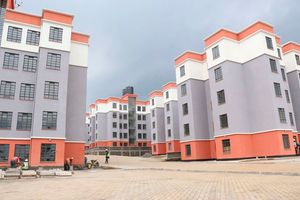
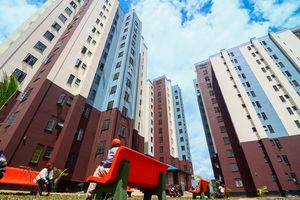
The Office of the Controller of Budget has given a damning report on President William Ruto ’s hyped housing project, saying it largely remains behind schedule.
The project is overseen by the State Department for Housing and Urban Development.
The August 2025 National Government Budget Implementation and Review report by Dr Margaret Nyakang’o comes against revelations that the government is using the proceeds of the housing levy on treasury bills and bonds.
The report reveals underperformance in the delivery of the housing units, adding that at 86 per cent, the country’s urban development recorded the lowest budget absorption rate for the 2024/25 financial year.
“These gaps point to delays in the delivery of urban infrastructure and amenities, possibly due to inadequate planning, procurement inefficiencies, poor coordination and funding challenges,” the report tabled in Parliament says.
Controller of Budget Margaret Nyakang’o.
Photo credit: Francis Nderitu | Nation Media Group
During the 2022 presidential election campaigns, Dr Ruto said he would ensure 200,000 housing units are built every year if elected, adding that the project would create thousands of jobs.
To finance the project, Parliament passed the Affordable Housing Bill, which was signed into law and became operational on March 19, 2024.
The Act established a mandatory levy to fund the housing project as part of Dr Ruto’s bottom-up economic transformation agenda.
The levy is charged at 1.5 per cent of a worker’s gross monthly income, an allowable pre-tax deduction, with a matching contribution from the employer.
Housing and Urban Development Principal Secretary Charles Hinga told a parliamentary committee early in the year that Sh5 billion to Sh6 billion is collected from Kenyans as housing levy every month.
Housing Principal Secretary Charles Hinga.
Photo credit: Dennis Onsongo | Nation Media Group
The State Department for Housing and Urban Development was allocated Sh87.57 billion in the period under review.
However, the amount was revised to Sh86.50 billion in the Supplementary Estimates I, Sh74.66 billion in Supplementary Estimates II and Sh82.44 billion in Supplementary Estimates III, compared to the Sh78.18 billion allocated in the financial year 2023/24.
The construction of 1,710 units in Starehe, Nairobi County, is at five per cent completion against a target of 40 per cent, Dr Nyakang’o’s report says.
It also highlights the construction of 5,360 units in Mavoko, Machakos County, that are at 11 per cent completion against a target of 20 per cent and 100,000 units in other parts of Kenya that are at 13 per cent against a target of 15 per cent.
The report says services under the Urban and Metropolitan Development programme are notably low, with no markets constructed.
Nonetheless, the report notes that construction of 975 units in Thika and 1,848 in Shauri Moyo, Nairobi, is ahead of the target by 18 and nine per cent, respectively.
Construction of 1,050 housing units in Ruiru, Kiambu County, achieved the target of 75 per cent completion.
The State Department for Housing and Urban Development is charged with promoting the management of Kenya’s housing policy, managing civil servants’ housing schemes, developing and managing affordable housing and promoting low-cost construction technology.
The mandate is carried out by the state department and its agencies – the National Housing Corporation, the Affordable Housing Board and the Estate Agents Registration Board.
It is also charged with developing and managing government pool housing, shelter and slum upgrading, public office accommodation lease and management, maintaining inventory of government buildings, urban planning policy and townships, municipalities and cities policy.
In February, Mr Hinga told the Housing, Urban Planning and Public Works Committee of the National Assembly that Sh2 billion in interest was realised from the housing levy billions invested in treasury bills.
As of February, the government had invested Sh46 billion of housing levy funds in treasury bills so that the money could not remain idle while construction of the houses was delayed.
The investment plan is protected by the Affordable Housing Act. Mr Hinga said it is a response to legal constraints and challenges in rolling out the housing projects.