The court has enhanced the award to Sh20 million after finding that Francis Maranga Matu was unlawfully discharged from the Kenya Air Force.

The appellate court in Nairobi has thrown out an appeal by the Attorney-General to set aside an award of Sh3 million given to a former military officer in form of damages for violation of his rights during the 1982 failed coup.
The court, instead, enhanced the award to Sh20 million after finding that the officer, Francis Maranga Matu, had also been unlawfully discharged from the Kenya Air Force.
Mr Matu was arrested on August 1,1982, following the attempted coup and was taken to Naivasha Maximum Prison where he was held incommunicado and detained in solitary confinement for 125 days.

The main gate of the Naivasha Maximum Security Prison.
The detention conditions were harsh and brutal as he was tortured, denied food, water and bedding, spent nights on the cold floor and made to eat rotten food. He was also denied reading materials and contact with the outside world; amounting to a violation of his fundamental rights and freedoms.
A three-judge bench of the appellate court consisting Justices Francis Tuiyott, Aggrey Michelle and George Odunga said the damages of Sh3 million awarded by the Employment and Labour Relations court in October 2018 was inordinately low.
"The trial court did not, however, mention that Mr Matu had sought to be compensated for unlawful termination of his service and for having lost eight years of service and loss of career. He was detained for a long time without being charged. In a case like this one, the damages should serve to enhance the dignity of Mr Matu," said the judges.
Noting that the initial award was for violation of Mr Matu's right to personal liberty and right not to be subjected to torture and inhuman treatment, the judges stated that "saying Mr Matu was treated in the most unfair manner is an understatement".
Before his arrest and discharge from the military, Mr Matu was serving as a Staff Officer in the Department of Logistics at Kenya Air Force Headquarters.
Instituted legal proceedings
In the appeal, the Attorney-General wanted the initial award set aside and the court to find that the former military officer was not entitled to any damages since his case was premised on the Constitution 2010 while the infractions occurred during the repealed 1963 Constitution.
The case was filed in November 2011, with Mr Matu explaining that he could not have instituted legal proceedings any earlier because of the then prevailing political environment.
According to the Attorney-General, the petition was tainted with laches and that the findings of the trial judge were based on no tangible evidence.
But the appellate judges ruled that the case was among those filed by various Kenyans over historical injustices and gross violations of fundamental rights that the State visited on those who sought or attempted approaching courts for redress.
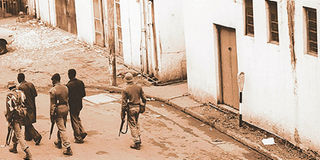
Soldiers patrol city streets after the coup attempt was crashed in 1982. Photo/FILE
"Such claimants who have brought their claims following the promulgation of the 2010 Constitution are seeking to right the historical wrongs that they suffered and fall in the category of transitional justice claimants whom the courts have to treat differently from persons who are seeking justice in ordinary claims covered by the period of limitation," said the judges while dismissing the AG's appeal.
The court added that there was no merit in the Attorney-General's argument that the petition was defective on the basis that the 2010 Constitution was not applicable where the human rights grievances and violations related to the period before its promulgation.
On whether there was sufficient evidence to establish the violations contained in the petition, the court said, "there was no indication that Mr Matu and his witnesses had conjured up what befell them following the attempted coup".
"He was not alone in the suffering. Two of his former colleagues testified to the same. The trial judge was correct in finding that the claims in the petition were proved. There was no attempt on the part of the Attorney-General to justify what happened to Mr Matu. The onus of justifying any infraction of these rights lay with the Attorney-General and was not discharged," said the judges.