Haiti is facing a multifaceted crisis unlike any in the country’s modern history.
But rather than charting a path to stability, the CPT remains mired in dysfunction as Haiti’s crisis deepens with no end in sight. Armed gangs now control most of the capital, more than a million Haitians have been displaced and half the country faces acute food insecurity.
A police vehicle is seen on patrol as people flee their homes from gang violence, in Port-au-Prince, Haiti, October 26, 2024.
Photo credit: Ralph Tedy Erol | Reuters
The United Nations says the country may be reaching a point of no return and risks falling into “total chaos.”
Haitian friends tell me their whole country feels as blocked as the barricaded streets and choke points used by the gangs to control the capital.
New Content Item (1)
Photo credit: Fildor Pq Egeder | Reuters
A security crisis paralyzing everything
The impasse is undoubtedly shaped by entrenched gang violence. Armed groups have been used by political players for political ends in Haiti for decades.
But now, new, well-organized armed gangs have emerged as political entities in their own right.
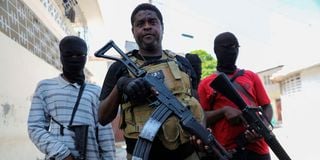
For example, the G9 Alliance, the most notorious of gangs — actually a federation of gangs — is led by former police officer Jimmy “Barbecue” Chérizier .
Chérizier presents himself on social media as a revolutionary figure fighting the elites, but in the streets of Port-au-Prince most, see him as a violent criminal .
Last year, the G9 merged with rivals to form a coalition called Viv Ansamn (Live Together). Led by Chérizier and others, the group forced Prime Minister Ariel Henry from power. Henry had become prime pinister after the assassination of Haiti’s last elected head of state, President Jovenel Moïse, in July 2021, despite himself being implicated in the assassination.
Viv Ansamn’s takeover of the capital confirms gangs have become an autonomous political force. They have since expanded their power through their control over fuel supplies, critical infrastructure and key choke points.
Members of the first contingent of Kenyan police stand in formation after arriving in the Caribbean country as part of a peacekeeping mission, in Port-au-Prince, Haiti June 26, 2024.
Photo credit: Reuters
It’s telling that the gangs have become so powerful despite the presence of a UN-approved, Kenya-led Multinational Security Support (MSS) mission. The mission has been in Haiti since shortly after Henry was forced out of power.
But with limited scope and funding from donor countries, including the United States, Canada and Ecuador, the mission has failed to achieve any major successes. Indeed, by the UN’s own estimates, gang violence continues to have a “devastating impact” on the population, despite the presence of the mission.
Democratic vacuum with no clear path forward
A common saying in Haiti goes like this: peyi’m pa gen leta , my country has no state. Once a criticism of a particular government, it now feels literal. Haiti has no elected national officials.
Instead, the CPT has become another obstacle to resolution. Mired in internal conflict, some members have been accused of bribery . With no framework for political compromise, the council reflects a system where some key players actually benefit from the political impasse.
Governing structures that can’t govern
Haiti is now in uncharted territory. The CPT operates in a legal vacuum, making decisions without a clear mandate or authority.
Still, the council is moving forward with a controversial plan to rewrite the Haitian constitution . The proposed changes will fundamentally alter Haiti’s government structure, including abolishing the senate and the prime minister, allowing presidents to hold consecutive terms, changing election procedures and allowing dual citizens and Haitians living abroad to run for office.
This constitutional reform highlights the paradox at the heart of Haiti’s crisis: an institution with questionable legitimacy is attempting to redesign the very framework that would determine its own authority.
These aren’t just procedural problems: they represent fundamental questions about who has the authority to govern and how decisions get made in a country where democratic institutions have always been fragile.
Armoured vehicles of the Kenyan peace-keeping mission patrol as residents flee Delmas 30 neighbourhood due to gang violence, in Port-au-Prince, Haiti on February 25, 2025.
Photo credit: Jean Feguens Regala | Reuters
International responses miss the mark
The MSS mission is a stop gap at best and a liability at worst. It is insufficient for the scale of the crisis.
Some observers have called for a full UN peacekeeping mission, but there is little support for it and such a mission would likely face resistance within Haiti given the country’s fraught history with international interventions.
Can the international community undo the damage it has already done? And can Haiti make it through the impasse without the international community?
Beyond the impasse: What needs to change
There are no easy solutions. Addressing gang violence without legitimate governing institutions won’t create lasting stability. Yet the path to a legitimate government remains unclear as organizing elections without basic security is unrealistic.
The international community must stop treating Haiti as a series of separate crises requiring separate responses. The current piecemeal approach treats symptoms while ignoring the underlying causes that block political resolutions.
For Haitians, the stakes could not be higher. The question isn’t whether change is needed, but whether the international community and Haitian leaders can move beyond the impasse before the situation deteriorates even further.