Kenya has signaled its willingness to prolong its security deployment in Haiti beyond the initial September timeline, reaffirming its commitment to the multinational mission aimed at stabilizing the crisis-hit Caribbean nation.
Prime Cabinet Secretary and Foreign and Diaspora Affairs Cabinet Secretary Musalia Mudavadi says the operation remains on course, with strong international backing and a clear mandate to restore order.
In an exclusive interview with Nation, Mr Mudavadi said Kenya is working in close collaboration with the United Nations to stabilise the Caribbean nation, which has been ravaged by political turmoil, gang violence, and the near-collapse of public order.
“It is ongoing,” Mr Mudavadi said of the mission. “We are collaborating with the United Nations to provide support in terms of logistics for the mission in Haiti.”
Prime Cabinet Secretary and CS for Foreign and Diaspora Affairs, Musalia Mudavadi during an interview in his office in Nairobi on May 22, 2025.
Photo credit: Dennis Onsongo | Nation Media Group
According to Mr Mudavadi, the United Nations has set aside over $100 million in a dedicated trust fund to support the mission's operations, while the United States has given both financial and diplomatic backing.
Washington has also formally designated the violent Haitian gangs as terror-linked entities, paving the way for tougher international sanctions.
“One of the assurances we got from the US is continued support for Kenya’s leadership of the Haiti mission,” Mr Mudavadi said.
President William Ruto shakes hands with Kenyan police officers when he arrived in Port-au-Prince, Haiti.
Photo credit: PCS
The current mandate of the mission is set to expire in September 2025, but its future will depend on how the international community responds to ongoing developments in Haiti.
“This was an international conversation,” Mudavadi explained. “It is now back at the United Nations for review, and the Secretary-General has already submitted a petition and report on the next steps.”
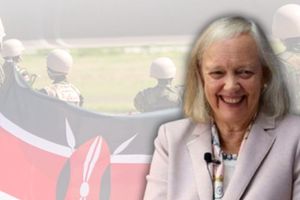
Kenya’s participation was not the result of lobbying by any single foreign official, Mudavadi clarified, pushing back against speculation that former US Ambassador to Kenya Meg Whitman unilaterally pushed Nairobi into taking the role.
“That’s not true,” he stated. “The decision was taken at the level of the US government and endorsed by the United Nations. It was not the will of one individual.”
Mr Mudavadi acknowledged that the Haiti mission, like any deployment to a conflict zone, carries risks.
So far, two Kenyan police officers have been injured, while one was reported missing but efforts to trace him are underway.
“On the record, we have two, including the one who went missing and we are working with other authorities to trace the missing officer,” the PCS said.
He noted that; “Haiti mission is supposed to end in September and as I said it now depends on how the international community takes this forward because it was an international undertaking, so this conversation has to go back there and it is already before them.”
Kenyan police officers hold a Kenyan flag after disembarking, in Port-au-Prince, Haiti June 25, 2024.
Photo credit: Reuters
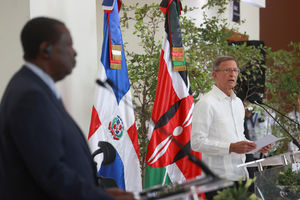
To safeguard personnel, Kenya signed a bilateral agreement with the Dominican Republic, Haiti’s neighbour, to provide emergency facilities for Kenyan officers in case of illness or injury.
“We are grateful to the government of the Dominican Republic for offering logistical and medical support to our team,” Mr Mudavadi said.
Kenya’s decision to lead the Haiti mission is rooted in its long-standing role in regional and international peacekeeping.
From Somalia to South Sudan and the Democratic Republic of Congo, Kenyan forces have earned a reputation for professionalism in conflict zones.
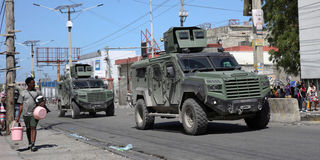
In Haiti, where gangs control large areas of the capital and the humanitarian situation remains dire, the Multinational Security Support (MSS) Mission is seen as a crucial intervention to restore stability and rebuild public institutions.
For Kenya, the deployment is also a strategic opportunity to showcase its global leadership, deepen its multilateral diplomacy credentials, and reaffirm its commitment to international peace and security.
“Kenya is not just a regional player—we are global. Our participation in Haiti is a demonstration of our responsibility as a member of the international community,” Mr Mudavadi said.
Kenyan police offices stand at the airport after disembarking, in Port-au-Prince, Haiti June 25, 2024.
Photo credit: File | Reuters
As the mission progresses, attention now turns to whether the international community will sustain support beyond September.
The success of Kenya’s deployment may depend not just on boots on the ground, but also on diplomacy, long-term reconstruction, and institutional reform in Haiti.
With strong backing from the UN and the US, and increasing cooperation with Caribbean states like the Dominican Republic, Kenya appears determined to play its part, cautiously, but firmly, according to the PCS.
The US Secretary of State Marco Rubio has said that there is a need for the Organisation of American States (OAS) to stand up and assist Kenya in fighting the gangs to restore peace in the Caribbean nation.
He told the Senate Foreign Relations Committee that it was time for OAS to step forward and lead the MSS mission.
"If ever there was a regional crisis for which an organization like the OAS should exist, it is the one Haiti is going through today," he said.
According to him, Kenya had done so well leading the mission but the initiative alone is not enough to ensure that order is restored in Haiti.
He said that there was a need for countries within the American region to join hands and ensure that Haiti gains its stability.