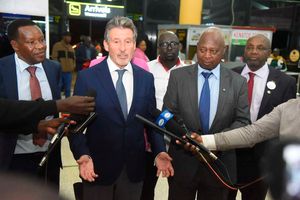
Last month, two of the world’s most influential race directors representing the Boston Marathon and the Chicago Marathon were in Addis Ababa for the 25th anniversary of the Great Ethiopian 10km Run.
Their presence highlighted the significance of Africa’s largest road race, an event that has become a cultural and athletic landmark on the continent. Ethiopian distance running legend Haile Gebrselassie started the race in 2001.
Apart from gracing the biggest race in Africa by numbers, Chicago Marathon Race Director Carey Pinkowski and Boston Marathon Race Director Jack Fleming also witnessed the signing of a five-year sponsorship deal between Bank of America and the Great Ethiopian Run. For decades, Boston and Chicago marathons have played a big role in shaping the careers and lives of Kenyan and Ethiopian athletes.
Kenya's John Korir crosses the finish line to win the men's elite race at the 129th Boston Marathon on April 21, 2025.
Photo credit: Reuters
Since Ibrahim Hussein’s historic win in Boston in 1988, the two Eastern African nations have traded victories on the global stage, turning the elite marathon scene into a friendly rivalry driven by talented athletes.
The connection between the North American majors and East Africa’s running powerhouses has grown stronger each year, with winners of the two races often emerging from the highlands of Iten, Eldoret, Addis Ababa, Bokoji, and Sululta.
In Addis Ababa, the two spoke about the delicate task of organising the races. Fleming, the Chief Executive Officer and President of the Boston Athletic Association (BAA), leads the team organising some of the world’s most prestigious road races, including Boston Marathon, Boston Half Marathon, and Boston 10km road race.
Reflecting on the event’s evolution, Fleming noted that it is remarkable how, in the modern era, Kenyan athletes have come to dominate the Boston Marathon, adding that their victories have transformed their lives and those of their families, which are also powerful stories of inspiration.
“We are not the biggest or the best, but we are special and it is good to share with those who have heard about it and that is why I’m here in Addis Ababa. It is an important moment to see where the athletes train, where they are nurtured, and how they get to change their lives……...seeing athletes competing in our races, parents and siblings standing at the finish line waiting for their loved ones, is just a special moment and that is what a marathon can do for the human spirit,” he said.
Fleming points to pioneers such as Ibrahim Hussein, the first Kenyan and African to win the Boston Marathon in 1988, who opened doors for Kenyan dominance by inspiring young athletes to dream bigger on the global stage. After Hussein, came Cosmas Ndeti, another legend of the race who stamped his authority in the race by winning three consecutive Boston Marathon titles between 1993 and 1995.
Jacob Kiplimo of Uganda crosses the finish line to win the Chicago Marathon with a time of 2:02:23 at Grant Park on October 12, 2025.
Photo credit: Reuters
Fleming said athletes such as two-time Boston Marathon champion Moses Tanui, who transitioned seamlessly from the track to road running, raised the bar and influenced generations of runners while elevating Kenya’s reputation in world athletics.
“Winning Boston Marathon gives you a different status and it is a shine you carry with you forever,” Fleming said, adding that he is fortunate to have witnessed Tanui, who started Eldoret City Marathon, competing in 1996 and 1998.
“Coming to Ethiopia is a reminder for organizers that something can be done, and when we are here, you listen more and see what they have to say and understand in what ways, and where you can support them. We in Boston can attest to Tanui’s commitment, dedication, competitiveness and credibility in his achievements,” he added.
Pinkowski said African countries have great athletics talent, and can grow own races to international standards through collaboration. He thanked Gebrselassie and Tanui by organising races that give athletes a chance to compete internationally.
Pinkowski observed that African athletes have had a tradition of winning the Chicago Marathon. Past winners from Kenya are marathon world record holder, the late Kelvin Kiptum.
Kiptum broke the world record at the 2023 Chicago Marathon when he registered 2:00:35 to lower Eliud Kipchoge’s record of 2:01:09. Kiptum died on February 11, 2023 in a road accident alongside his Rwandese Coach Gervais Hakizimana. Ruth Chepng’etich holds the women’s world record of 2:09:56 from 2024 Chicago Marathon.
“Kiptum was just an amazing athlete, and his career would have been limitless, and I knew he would have taken the race to another level. Despite his death, he left other athletes with ideas that they might run faster, and we have witnessed that.
“I once had a discussion with the late Samuel Wanjiru when he won 2009 Chicago Marathon after breaking the course record in 2:05:41. I asked him how fast he could run, and his answer was that, with good conditions and the right pacemakers, he could run 2:01, and I’m glad Kiptum saw an opportunity and ran away with it. It’s sad that we lost both of them,” Pinkowski said.
They said organising such big races takes a lot of work with the community and the local and national governments.
“Apart from supporting elite athletes in the races, a large number register to compete, and that helps improve the economy in that area. We sometimes turn away some entries in Chicago Marathon. These events are very important to the community at large,” he added.