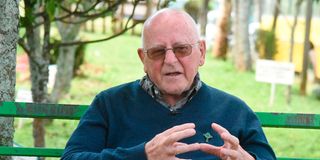
Athletics coach Brother Colm O’Connell during an interview at St Patrick’s High School in Iten, Elgeyo Marakwet County on October 14, 2025.

In 1976, Brother Colm O’Connell who is fondly known as “godfather of Kenyan athletics” in athletics circles, arrived in Kenya as a fresh-faced member of Catholic lay religious congregation called Patrician Brothers.
Nearly 50 years since he first set foot in Iten, Elgeyo Marakwet County, he has spent a lifetime giving rise to world-conquering champions and witnessing the evolution of the sport.
From his early days at St Patrick’s High School Iten in the 70s, he has seen Kenyan athletics grow through different eras, each marked by triumphs, challenges, and transformation.
Athletics coach Brother Colm O’Connell during an interview at St Patrick’s High School in Iten, Elgeyo Marakwet County on October 14, 2025.
Brother Colm first came to Kenya in 1976 to stay in the country for three months, but the Irishman changed his mind, settled down in Iten, and started teaching Geography at St Patrick’s High School.
When he arrived in Kenya, he met Peter Foster, a volunteer athletics coach at St Patrick’s High School, and the due went about drafting athletics training programmes for athletes at the school.
But after watching a disastrous performance by Kenyan men at the 2025 World Athletics Championships in comparison to the female athletes, Brother Colm believes it is time Kenya changed with the changing times.
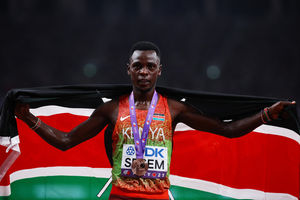
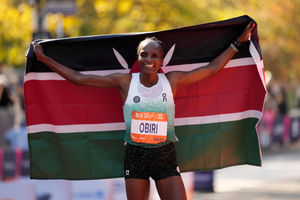
Kenyan men won three medals - one gold through Emmanuel Wanyonyi in men’s 800m, and two bronze medals through Edmund Serem (3000m steeplechase) and Reynold Charuiyot (1500m). In contrast, Kenyan women won five gold medals, two silver and one bronze. That performance sparked outrage among fans.
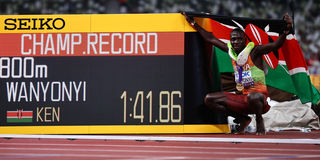
Kenya's Emmanuel Wanyonyi celebrates after winning gold in the men's 800m at the World Athletics Championships in Tokyo on September 20, 2025.
Bro Colm reckons that Kenyan athletics, like society, must change with the times if Kenyan men are to regain lost glory on the global stage. In his view, the problem goes beyond the track and reflects shifts in lifestyle, athlete attitude, and levels of motivation among young athletes.
Need for renewed mentorship
“An athlete needs enough rest after training so as to recover. That has been the tradition since I started coaching but in recent years, a lot is happening and most athletes, particularly men, don’t prioritise a good rest, and that affects performance. A tired athlete easily loses concentration,” he says.
He wants local coaches to go back to the time-tested tactic of training athletes to adopt healthy habits from a young age so as to guarantee their future success in athletics. He emphasizes the need for renewed mentorship, proper guidance, and support structures to help boys rediscover their competitive edge.
Bro Colm says that when he arrived in Kenya in 1976, the federation relied on parastatals like Kenya Power and Lighting Company, Kenya Railways, and Kenya Posts and Telecommunications to nurture athletes. Others took the route of sports scholarship.
“Basically, these (parastatals) were vehicles of youth development. I came to Kenya as a regular teacher but I was lucky to be at the centre of two schools - St Patrick’s High School and Sing’ore Girls High School - both in Elgeyo Marakwet where we produced athletics talents,” says Bro Colm.

World 800m record holder David Rudisha during a past competition.
He is credited with nurturing some of Kenya’s finest runners, among them 800m world record holder David Rudisha.
Bro Colm also coached Peter Rono who won men’s 1,500m Olympics title in 1988, Mathew Birir who bagged the Olympics 3,000m steeplechase gold in 1992, and Brimin Kipruto who won 3,000m steeplechase title at the 2008 Olympics, among others.
Rudisha won the 800m gold at the 2012 Olympic Games and also broke the world record in the two-lap race when he clocked 1:40.91. That time has since stood to date.

Athletics coach Brother Colm O’Connell during an interview at St Patrick’s High School in Iten, Elgeyo Marakwet County on October 14, 2025.
Kenyan-born Dane Wilson Kipketer, who also broke the world 800m record three times, former world 800m champion Janeth Jepkosgei, 2016 Olympics 5,000m champion Vivian Cheruiyot, Viola Kibiwott, and Isaac Songok are among the products of Bro Colm’s athletics production line.
Former New York Marathon champions Mary Keitany and Edna Kiplagat also went through the Irish coach’s programmes.
He regrets that in recent years, Kenya has moved away from using schools to roll out youth programmes and camps, which has partly solved a problem while creating another. While this strategy has not necessarily meant construction of modern training camps, there has been a decline in the number of schools playing a significant role in the development of young athletes, particularly men.
Bro Colm, who will next year mark 50 years since arriving Kenya in 1976, believes that the school calendar has been squeezed to an extent that some sporting disciplines, especially athletics events, have been left out.
He points out that in previous years, local primary and secondary schools could hold decathlon, heptathlon and cross country events in championships held in First Term, and track as well as field events in those in Second Term. However, that is no longer the case.

Athletics coach Brother Colm O’Connell during an interview at St Patrick’s High School in Iten, Elgeyo Marakwet County on October 14, 2025.
“The sporting calendar school system is not conducive in the anymore and I think school athletics is a rushed programme because we give them only three months to organise competition from the zonal areas all the way to the national level, and that to me is not youth development. There has to be an ongoing process of nurturing athletes because the limited time can even discourage an athlete who has to wait for another nine months to participate or compete at the school games,” he says.
The veteran coach also added that for Kenyan men to improve, there are options to look at, one of which is junior development across the country. He is of the opinion that Athletics Kenya is trying its best to fill the gap, but more can be done to ensure male athletes compete favourably with female ones.
He opines that children are increasingly attending school from a younger age and by the time they leave secondary school, they are still young, which presents problems with transition to elite or senior level because the age gap is bigger than it was 20 to 30 years ago.
“How many athletes get lost in the gap when they are trying to transition to the senior level? That was not there a long time ago because they were older when they graduated from secondary school and that is another challenge particularly for athletes who are not heading the scholarship way,” he said.
He encourages athletes to tell their stories, and to be media-savvy.
“Athletes have improved on education and self-confidence and as an athlete, one must do more. There are athletes who are heading to American colleges, which is another option for track athletes. Because of the good training facilities and the programmes offered, they tend to perform well,” said the coach.
The veteran coach observed that athletes tend to move to road races so as to make more money to support their families who are largely dependent on them. Since there are few track events, they have no option but to join road running.
Brother Colm believes that Kenya needs to carefully guide athletes through transition period from junior to the senior levels, and one option is to send them to American colleges where there is a good transition mechanism due to availability of many cross country and track events.